
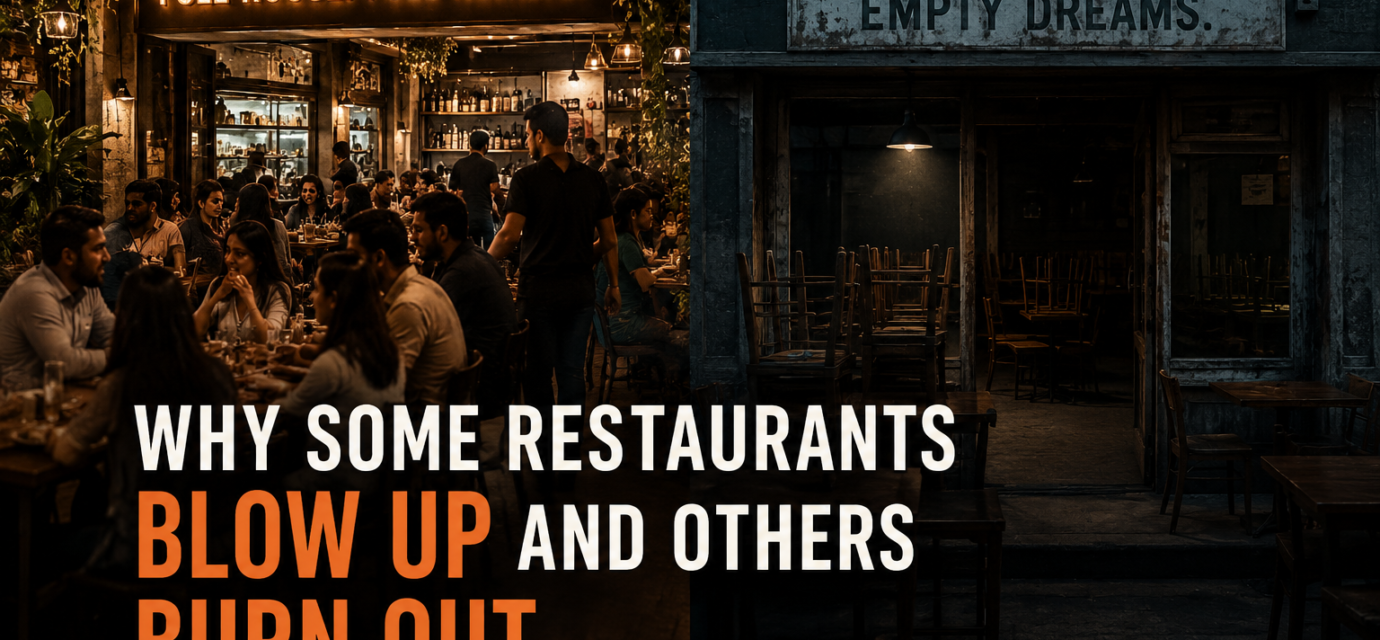
India’s Restaurant Boom: Why Some Brands Last Beyond the Hype
The sound of a hot tawa can tell a whole story before a menu ever does. Batter spreads in a quick circle. Ghee hits the iron with a soft hiss. Chutney is spooned into small bowls. Steel tumblers clink. Someone calls out an order. Someone else wipes a table before the next family sits down. In that small choreography, India’s food business world reveals something powerful: a restaurant is never just a place that sells food.
It is timing, memory, trust, rhythm, pricing, service, and culture all moving together.
Across India, restaurants, cafés, cloud kitchens, tea shops, quick-service counters, and regional food brands are growing in a marketplace that feels full of possibility. But possibility is not the same as survival. Some restaurants blow up fast because people line up for the trend, the reel, the dish, the name, or the mood. Others last because they understand something deeper: food may bring people through the door once, but care brings them back.
That is the real lesson behind food business success in India. It is not only about having a “viral” dish. It is about knowing what that dish means, who it serves, how consistently it can be made, and whether the business behind it can carry the promise every single day.
Why India’s Restaurant Boom Feels So Meaningful
India’s restaurant growth matters because food in India has always carried more than appetite. It carries region, religion, family, migration, climate, farming, festivals, memory, and hospitality. A plate of dosa in Bengaluru does not tell the same story as chole bhature in Delhi, fish curry in Kerala, litti chokha in Bihar, pav bhaji in Mumbai, or thukpa in parts of the Himalayan belt. India does not have one food identity. It has many, and that is exactly why its restaurant landscape feels so alive.
The National Restaurant Association of India has reported that the Indian restaurant industry is a major employer and economic contributor, with the sector projected to keep growing through 2028. But behind those numbers are very human scenes: a student grabbing breakfast before class, office workers sharing tea during a break, families celebrating after payday, travelers chasing a taste they cannot find back home, and entrepreneurs betting their savings on one good idea.
That is where the beauty and danger sit side by side. Food businesses can grow quickly because people are hungry for experience, convenience, comfort, and regional pride. But they can also burn out quickly when the business is built only on noise. A long line can create excitement, but it does not automatically create systems. A beautiful interior can pull people in, but it cannot fix slow service, confused pricing, inconsistent food, or a menu that does not make financial sense.
In India, where diners can be deeply loyal but also highly practical, restaurants have to earn trust bite by bite.
How To Start A Successful Food Business In India: Menu & Alcohol | Riyaaz Amlani | FO424 Raj Shamani
The Beauty of the Table
A strong Indian restaurant often begins with a feeling before it becomes a brand. The table may be simple: stainless steel plates, banana leaves for certain meals, a small bowl of sambar, chutneys in soft green and coconut white, pickles shining red with oil and spice, or a glass of sweet lime soda sweating in the heat. The air may carry roasted cumin, curry leaves, ginger, cardamom, frying onions, fresh coriander, or the smoky warmth of a tandoor.
The best food businesses understand that these details are not decorations. They are signals.
Fresh chutney tells the guest someone cared today, not just last week. A hot dosa served at the right second tells them the kitchen has rhythm. A server who notices an empty water glass tells them they are seen. A menu that is short, clear, and confident tells them the restaurant knows itself.
This is one reason some Indian food brands grow from a local favorite into a larger movement. The restaurant gives people something recognizable and repeatable. It becomes part of their routine: the breakfast stop after temple, the late-night dosa after work, the chai before a meeting, the biryani order during celebrations, the snack shared between friends who were “not that hungry” until the first plate arrived.
The Rameshwaram Cafe, for example, frames its South Indian café experience around tradition, freshness, hospitality, and consistency. Its official story highlights fresh food, local sourcing, guest-centered service, and South Indian flavors served with a modern operational mindset. Whether someone is studying it as a food lover or business owner, the larger lesson is clear: cultural emotion must be supported by operational discipline.
A restaurant can be soulful and strategic at the same time. In fact, the best ones usually are.
How Rameshwaram Cafe Built a ₹60 Crore Dosa Empire! | Stories From Bharat Ep 44 | Curly Tales
A Taste of History and Culture
Indian cuisine has evolved through geography, trade, agriculture, migration, faith, empire, regional kingdoms, family kitchens, street vendors, and modern cities. The country’s food is shaped by climate and local ingredients as much as by belief and custom. Rice dominates many southern and eastern tables. Wheat holds deep importance in much of the north. Coconut, mustard oil, sesame, lentils, dairy, seafood, millet, tamarind, jaggery, and countless spice blends carry regional meaning.
Food businesses in India succeed when they respect that depth instead of flattening it.
A restaurant serving South Indian breakfast is not simply selling “dosa.” It is working with fermentation, batter texture, heat control, chutney freshness, sambar balance, and the emotional memory of a meal many people grew up eating. A biryani brand is not just selling rice and meat or vegetables. It is stepping into layered regional debates about aroma, grain, spice, cooking method, and identity. A chai business is not just about selling tea. It is selling pause, conversation, street-corner comfort, and the daily ritual of stopping for a moment before life rushes forward again.
This is where cultural relevance becomes a business advantage. Diners can feel when a restaurant respects the food it is serving. They can also feel when a tradition has been turned into a shallow theme.
Modern Indian restaurant success often comes from balancing old and new. Some brands preserve familiar dishes with tight consistency. Others modernize presentation, ordering, packaging, or dining room design while keeping the heart of the food recognizable. Some build for delivery. Some build for social media. Some build for regional expansion. But the ones with staying power usually know what they are protecting.
Food history gives a restaurant roots. Operations give it legs.
What This Food Tradition Teaches Us
India’s restaurant boom teaches one of the most grounded lessons in business: growth without care can become exhaustion.
A restaurant can burn out when it tries to do too much too quickly. Too many menu items. Too many locations. Too many promises. Too many trends are borrowed from the internet instead of the community. It can also burn out when the founder’s passion is not supported by costing, staffing, compliance, training, vendor relationships, and guest feedback.
But food businesses that last often practice a kind of disciplined hospitality.
They know their hero dishes. They know what guests return for. They understand food cost without letting the food lose its generosity. They use menu engineering not as manipulation, but as a way to make the restaurant healthier: identifying which items are popular, which items are profitable, which items need improvement, and which items may be quietly draining the business.
That may sound technical, but it is deeply connected to care. A restaurant that cannot stay profitable cannot keep serving its community. A restaurant that ignores safety cannot protect its guests. A restaurant that undertrains staff cannot create consistent hospitality. A restaurant that chases every trend may lose the very flavor that made people love it.
In that way, food business success in India is not just about “blowing up.” It is about becoming dependable.
The deeper lesson is patience. Fermented batter needs time. Spice blends need balance. Tea needs watching. A kitchen team needs training. A restaurant brand needs trust. The most meaningful growth often comes from repeating small things well until they become part of people’s lives.
How to Bring This Spirit Into Your Own Kitchen
Even if you are not opening a restaurant, there is something beautiful to borrow from the spirit of India’s strongest food businesses: choose care over clutter.
At home, that can mean building a meal around one strong centerpiece instead of overwhelming the table. Make one dish well. Serve it hot. Add thoughtful sides. Keep the table relaxed. Let the food invite conversation instead of performance.
If you are inspired by South Indian café culture, try a simple breakfast-style table with dosa or idli, coconut chutney, sambar, and filter coffee or masala chai. If you are drawn to North Indian comfort, serve dal, rice, roti, pickle, and a cooling yogurt side. If you love the snack-shop feeling, create a casual chaat night with potatoes, chickpeas, chutneys, sev, herbs, and lime.
The point is not to copy a culture carelessly. The point is to learn from the values that make the food meaningful: freshness, balance, welcome, rhythm, and respect.
For anyone dreaming of a food business, start even more simply. Ask honest questions:
What is the one dish people would come back for?
Can it be made consistently?
Do the ingredients make financial sense?
Can the menu be explained quickly?
Does the service style match the food?
Is the restaurant honoring the culture behind the dish?
Are safety, licensing, and cleanliness treated as part of hospitality, not an afterthought?
In India, FSSAI licensing and registration requirements are part of the formal food business landscape. For restaurant owners, compliance is not the glamorous side of food, but it is one of the clearest ways to protect guests and build trust.
Before Opening A Restaurant: Watch This 8-Minute Menu Engineering Guide
Simple Serving Ideas
To bring the spirit of Indian restaurant hospitality into your own home, think in layers rather than excess.
Serve something warm first. It could be chai, rasam, soup, or a small fried snack. Warmth changes the mood of a table.
Offer contrast. A crisp dosa feels more complete with soft potato masala. A spicy curry feels balanced with rice, yogurt, or cucumber. A rich dish feels brighter with lime, herbs, or pickled vegetables.
Use small bowls generously. Chutneys, pickles, raita, dal, and sauces make the table feel abundant without needing a dozen main dishes.
Create a relaxed table setting. Stainless steel, clay, wood, linen, banana leaves, where appropriate, or simple white plates can all work. The goal is not perfection. The goal is welcome.
Let guests build a bite. Indian dining often celebrates a combination: rice with dal, roti with sabzi, dosa with chutney, chaat with toppings. A table that invites people to mix, scoop, dip, and share feels alive.
For a business-inspired hosting idea, create a “hero dish night.” Choose one main dish, then build the whole evening around making that dish shine. This is the home-kitchen version of smart menu strategy: fewer items, better execution, stronger memory.
A Thoughtful Note on Cultural Appreciation
Indian food is loved across the world, but love should come with responsibility. Appreciation means learning where a dish comes from, spelling names carefully, respecting regional differences, and avoiding the habit of treating all Indian food as one flavor profile.
It also means being careful with sacred language, religious symbolism, caste or class assumptions, and poverty-based storytelling. Street food, for example, should not be romanticized as “simple poor food” when it is often the result of skilled technique, regional creativity, and serious labor. A small tea stall, dosa counter, or snack vendor may carry more operational wisdom than a glossy restaurant with a larger marketing budget.
When cooking or writing about Indian food, it is better to be specific. Say South Indian, Punjabi, Bengali, Gujarati, Goan, Tamil, Hyderabadi, Kerala-style, Maharashtrian, or another accurate regional description when you know it. If you do not know, stay humble and keep learning.
Cultural appreciation also means crediting the people who built the tradition before it became trendy. Many of today’s restaurant ideas come from home cooks, temple kitchens, roadside vendors, family recipes, agricultural communities, and regional foodways that existed long before branding teams gave them a logo.
The most respectful approach is not to freeze tradition in the past. It is to recognize that culture lives. Indian food businesses today are allowed to innovate, expand, modernize, and reimagine. The key is whether that innovation still carries respect.
Final Thoughts: The Restaurants That Last Know Their Why
Some restaurants blow up because they catch attention at the right moment. A video goes viral, a dish photographs well, a crowd forms, and suddenly everyone wants to try it.
But attention does not guarantee longevity.
The restaurants that last usually have more than hype. They know what they stand for, what their guests expect, and what they can deliver consistently. Their food has a clear identity. Their menu makes sense. Their service feels warm. Their systems are strong enough to support growth without losing quality.
That is the real lesson behind food business success in India. A restaurant cannot survive on excitement alone. It needs trust, consistency, cultural respect, smart pricing, trained staff, clean operations, and a menu that works both emotionally and financially.
In India, food is deeply tied to memory, family, region, comfort, and daily life. When a restaurant respects that, guests feel it. They come back not just because the food tastes good, but because the experience feels dependable and meaningful.
Hype may bring people through the door once.
Care brings them back.
The strongest restaurants are the ones that protect the basics: serve good food, honor the culture behind the plate, treat guests well, train the team, and stay clear about the brand’s purpose.
Food may start the conversation.
Trust keeps it going.
And when a restaurant knows its why, it has a much better chance of becoming more than a trend. It can become a habit, a memory, and eventually, a lasting part of people’s lives.
References
- Antani, V., & Mahapatra, S. (2022). Evolution of Indian cuisine: A socio-historical review. Journal of Ethnic Foods, 9, Article 15. https://doi.org/10.1186/s42779-022-00129-4
- Britannica. (n.d.). Indian cuisine. Encyclopaedia Britannica. https://www.britannica.com/topic/Indian-cuisine
- Curly Tales. (2024, December 4). How Rameshwaram Cafe built a ₹60 crore dosa empire! Curly Tales. https://curlytales.com/originals/stories-from-bharat/how-rameshwaram-cafe-built-a-%E2%82%B960-crore-dosa-empire/
- Curly Tales. (n.d.). How Rameshwaram Cafe built a ₹60 crore dosa empire! | Stories From Bharat Ep 44 | Curly Tales [Video]. YouTube. https://www.youtube.com/watch?v=ujCGvZoFdOo
- Food Safety and Standards Authority of India. (n.d.). Food Safety and Standards regulations. https://www.fssai.gov.in/cms/food-safety-and-standards-regulations.php
- Food Safety and Standards Authority of India. (n.d.). Registration. https://www.fssai.gov.in/cms/registration.php
- meez. (2025, August 25). The ultimate guide to menu engineering: A chef’s playbook for profitability. https://www.getmeez.com/blog/the-ultimate-guide-to-menu-engineering
- National Restaurant Association of India. (n.d.). NRAI India Food Services Report. https://nrai.org/BookYourCopy.aspx
- National Restaurant Association of India. (n.d.). Riyaaz Amlani. https://nrai.org/MemberDetails.aspx?ID=gW0hHqeD834%3D
- National Restaurant Association of India. (2025, January 8). NRAI urges Finance Minister for budget support to boost restaurant sector. https://nrai.org/aboutNewsAndUpdate.aspx?ID=6EQtfBjriLQ%3D&Type=oS9yZygW1hU%3D
- Nikhil Kamath Clips. (n.d.). Before opening a restaurant: Watch this 8-minute menu engineering guide [Video]. YouTube. https://www.youtube.com/watch?v=Sat0_TxfxfU
- Raj Shamani. (n.d.). How to start a successful food business in India: Menu & alcohol | Riyaaz Amlani | FO424 Raj Shamani [Video]. YouTube. https://www.youtube.com/watch?v=w_tIdr0X2NY
- Srinivas, T. (2011). Exploring Indian culture through food. Education About Asia, 16(3). Association for Asian Studies. https://www.asianstudies.org/publications/eaa/archives/exploring-indian-culture-through-food/
- The Rameshwaram Cafe. (n.d.). About. https://therameshwaramcafe.org/about/
- The Rameshwaram Cafe. (n.d.). Rameshwaram Cafe: A taste of South Indian soul. https://therameshwaramcafe.org/
- WebstaurantStore. (2026, June 2). Menu engineering. https://www.webstaurantstore.com/article/89/menu-psychology-the-science-behind-menu-engineering.html