

Ethiopia on the Table: Coffee, Injera, and the Beauty of Slowing Down
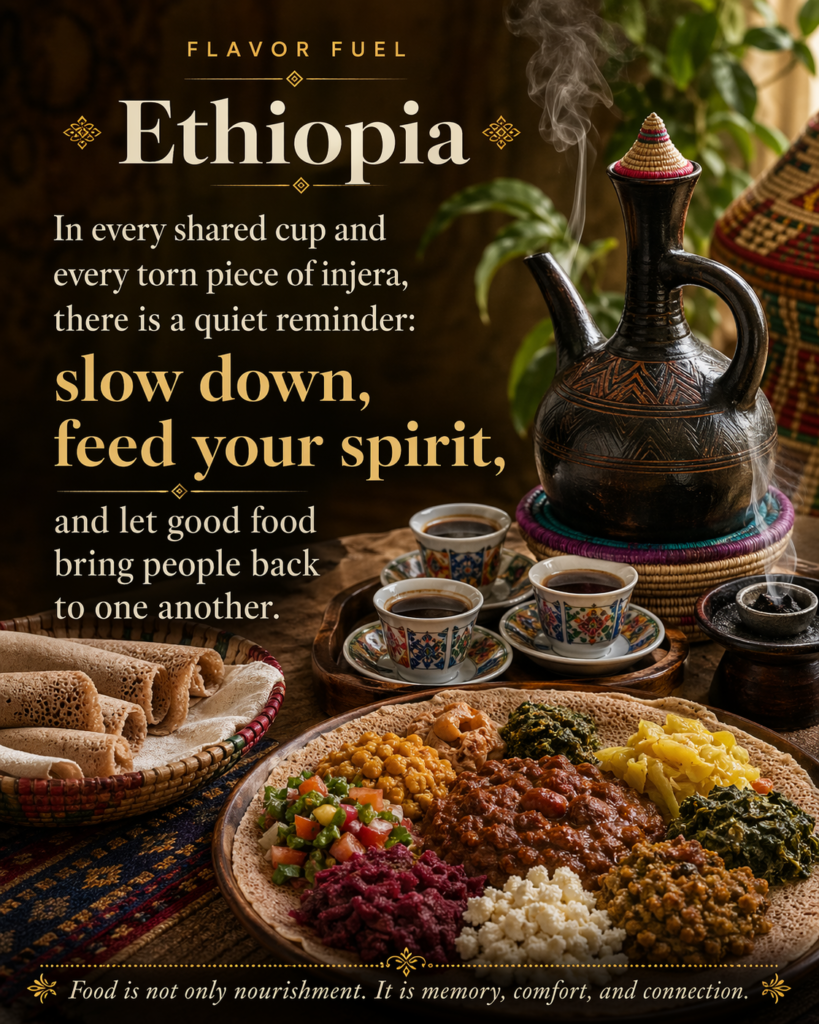
There is something tender about a table that does not rush you.
In Ethiopia, that feeling can rise slowly through the room with the smell of coffee beans meeting heat. The air changes first. Green beans turn dark and glossy in a pan, their fragrance deepening from grassy and sharp to warm, smoky, and inviting. A clay coffee pot, called a jebena, waits nearby. Small cups sit close together, ready for hands that will serve, receive, and linger.
Then there is injera, soft and wide, spread like an edible welcome across a shared platter. Its surface is dotted with tiny “eyes,” those delicate bubbles formed through fermentation. It is tangy, flexible, and quietly brilliant, acting as bread, plate, and utensil all at once. Around it may sit spoonfuls of lentils, greens, vegetables, stews, or richly seasoned dishes, each one waiting to be gathered by hand.
This is not food designed only for speed. It is food that asks people to come close. Coffee is brewed with attention. Injera is made with time. Meals are shared from the center. Conversation has room to breathe. And in a world that often treats eating like another task to finish, Ethiopia’s table reminds us that nourishment is not only about what fills the stomach. Sometimes, it is about what softens the spirit.
Why Ethiopian Coffee and Injera Feel So Meaningful
Ethiopian coffee and injera matter because they sit at the center of everyday connection.
Coffee in Ethiopia is not simply a morning habit or a quick cup grabbed on the way out the door. The traditional coffee ceremony, often called buna, is a social ritual of welcome, conversation, patience, and care. In 2025, UNESCO reported that Ethiopia was preparing a nomination file for its traditional coffee ceremony for possible future inscription on the Representative List of the Intangible Cultural Heritage of Humanity. That detail matters because it recognizes what many Ethiopian families and communities have long understood: this ceremony is living culture.
The process itself holds meaning. Coffee beans are roasted, ground, brewed in a jebena, and served in small cups. The fragrance fills the room before the first sip is taken. Guests may be offered snacks such as popcorn, roasted grains, or bread while the coffee is being prepared. The ceremony is not only about drinking coffee; it is about creating space for people to sit together.
Injera carries its own kind of importance. Traditionally made with teff flour, water, and a fermented starter, injera is one of Ethiopia’s foundational foods. It is soft enough to fold, sturdy enough to scoop, and porous enough to catch sauces. Because it is often served under stews and vegetables, it becomes part of the meal from beginning to end, soaking in flavor as people eat.
Together, coffee and injera reveal a table shaped by patience. One takes time to brew. The other takes time to ferment. Both ask the cook, the host, and the guest to slow down long enough to notice.
The Beauty of the Table
An Ethiopian table can feel beautifully alive.
A large round platter may be lined with injera, its pale gray, ivory, or lightly brown surface stretching outward like a soft canvas. On top, bright dishes bring color and warmth: red lentils seasoned with berbere, yellow split peas, greens, cabbage, carrots, potatoes, chickpeas, or tender meats, depending on the household, region, occasion, and religious calendar. Some meals lean fully plant-based, especially during fasting periods observed by Ethiopian Orthodox Christians. Others include meat stews, spiced butter, or celebratory dishes prepared with great care.
The textures are part of the pleasure. Injera is springy and slightly sour. Lentils may be creamy and thick. Greens can be silky and earthy. Stews cling to the bread, and every bite changes depending on what is gathered together.
There is also sound: the quiet tear of injera, the soft pour of coffee, the murmur of conversation, the gentle clink of tiny cups. The table setting may include a mesob, a traditional woven basket table used for serving meals, or a low communal arrangement that brings diners close to the food and to one another.
Eating with the hand, traditionally the right hand, creates a different kind of attention. You tear, scoop, fold, and lift. You become aware of texture and portion. You pay attention to the people around you because the meal is shared from a common center. There is a rhythm to it, a courtesy to it, a reminder that food can be personal without being private.
In some Ethiopian dining contexts, there is also gursha, the act of offering someone a bite by hand. Scholars have described gursha as a meaningful social gesture tied to love, honor, generosity, and relationships. It should not be treated like a casual performance or tourist trick. At its heart, it is about closeness and care within a cultural setting where feeding and being fed can express respect.
That is the beauty of this table: it makes generosity visible.
A Taste of History and Culture
Ethiopia’s food culture is deeply regional, layered, and diverse. No single plate can speak for every Ethiopian household, community, or tradition. Still, coffee and injera offer two meaningful entry points into understanding how food can hold history.
Ethiopia is widely associated with the origins of Coffea arabica, and coffee remains connected to both livelihood and identity. The familiar legend of Kaldi, the goat herder who noticed his animals becoming lively after eating coffee cherries, is often told as part of coffee’s origin story. Like many food legends, it should be understood as cultural storytelling rather than confirmed historical fact. What is clear is that Ethiopia’s relationship with coffee is old, intimate, and deeply rooted.
The coffee ceremony reflects that relationship. It turns preparation into presence. Roasting is not hidden in the back. Grinding is not rushed. Brewing is not reduced to a button. Guests see and smell the process. The host’s labor becomes part of the gift.
Injera’s history is tied to teff, a tiny grain long cultivated in Ethiopia and used widely in the making of injera. Research in the Journal of Ethnic Foods describes injera as a fermented Ethiopian staple food usually prepared from teff flour, water, and a starter from a previous fermentation. The fermentation gives injera its gentle sourness, airy bubbles, and signature softness.
But Ethiopian food is not only teff and coffee. It includes the heat of berbere, the warmth of niter kibbeh, the comfort of lentils and chickpeas, the brightness of vegetables, the celebratory nature of dishes like doro wat, and the wide influence of religious fasting traditions, Muslim communities, regional specialties, and diaspora creativity. Ethiopian restaurants around the world, especially in cities with strong Ethiopian and Eritrean communities, continue to introduce new diners to shared platters, injera, and the pleasure of eating slowly with others.
The table has traveled, adapted, and remained meaningful.
What This Food Tradition Teaches Us
Ethiopian coffee and injera teach a lesson many of us need: not everything good is instant.
Injera begins before the meal. The batter needs time. Fermentation cannot be forced into convenience without changing the result. Coffee, too, becomes something different when it is roasted, ground, brewed, poured, and shared in sequence. These traditions remind us that slowness is not always inefficiency. Sometimes slowness is the method.
They also teach community. A shared platter asks people to think beyond their own plate. You notice what others are reaching for. You leave space. You take what you need. You return to the center again and again. There is humility in that kind of eating.
They teach hospitality as a practice, not a performance. Hospitality is not about having the fanciest table or the most expensive ingredients. It is about making people feel received. A small cup of coffee can become a welcome. A piece of injera can become an invitation. A simple lentil stew can become a memory when served with warmth.
They teach gratitude for the process. The hands that grow teff, roast coffee, grind spices, stir stews, ferment batter, wash cups, and serve guests are part of the meal’s meaning. When we slow down enough to notice that, food becomes less disposable. It becomes connected to labor, land, memory, and care.
And maybe most importantly, these traditions teach presence. They remind us that a meal can be a pause. A cup can be a conversation. A table can be a place where the day loosens its grip.
How to Bring This Spirit Into Your Own Kitchen
You do not have to recreate an Ethiopian household or claim expertise to learn from the spirit of Ethiopian coffee and injera. Respect begins with humility. Let the tradition teach you without pretending it belongs to you.
Start by supporting Ethiopian restaurants, markets, coffee roasters, and cooks in your community. Order a shared platter and pay attention to how the meal is arranged. Try injera with lentils, greens, vegetables, or stews. Notice how the bread changes as it absorbs flavor. Ask respectful questions when appropriate, but remember that no one is obligated to be a cultural guide while serving your meal.
At home, you can bring the spirit of the tradition into your table by slowing the meal down. Serve food family-style instead of plating everything individually. Put one dish in the center that everyone can share. Brew coffee or tea after dinner and let people linger. Turn off the background noise for a few minutes and let conversation become part of the meal.
If you want to cook Ethiopian-inspired dishes, begin with approachable staples. Misir wat, a spiced red lentil stew, is a beautiful entry point. Atakilt wat, often made with cabbage, carrots, and potatoes, is comforting and colorful. Shiro, a chickpea-based stew, is deeply beloved in many Ethiopian homes. If you make injera, use a trusted recipe, understand that fermentation takes practice, and do not be discouraged if your first batch is imperfect.
You can also explore Ethiopian coffee with care. Look for Ethiopian coffee beans from reputable roasters, especially those that share sourcing information. Brew slowly. Smell the beans before and after grinding. Serve the coffee in small cups if you have them. Offer a simple snack alongside it. The goal is not to stage a ceremony you do not fully know. The goal is to honor the idea that coffee can be an occasion for attention.
Simple Serving Ideas
For an Ethiopian-inspired shared table, keep the mood warm, relaxed, and generous.
Serve injera with two or three dishes rather than trying to make too much at once. A red lentil stew, sautéed greens, and cabbage with potatoes can create a colorful, comforting spread. Add a small bowl of salad with tomatoes, onion, lemon, and herbs for brightness. If you eat meat, a chicken or beef stew seasoned with berbere can be served as a centerpiece.
Use a large platter if you have one. Lay injera underneath, then spoon the dishes in separate sections so the colors show. Roll extra injera on the side for scooping. Keep napkins nearby, and offer utensils too, especially for guests who may not be used to eating with their hands.
For table styling, think earthy and welcoming rather than overly themed. A woven tray, clay-colored dishes, small bowls of spices, fresh herbs, and warm lighting can create an atmosphere without turning the table into a costume. If serving coffee afterward, bring it out slowly. Let the aroma be part of the dessert.
Simple pairings may include:
- Injera with misir wat, greens, and cabbage
- Ethiopian coffee with popcorn or lightly toasted grains
- Lentil stew with a crisp tomato salad
- Spiced vegetables with extra injera for scooping
- Coffee is served after the meal as a gentle closing ritual
The best serving idea is still the simplest: invite people to sit long enough to enjoy each other.
A Thoughtful Note on Cultural Appreciation
Appreciating Ethiopian food culture means approaching it with respect, not ownership.
It is perfectly okay to enjoy injera, Ethiopian coffee, berbere, lentil stews, and shared meals. Food is one of the most beautiful ways people learn about one another. But appreciation becomes more meaningful when it includes context. Learn the names of dishes. Give credit to the culture. Support Ethiopian-owned businesses when possible. Avoid flattening a diverse country into one “exotic” image or treating sacred, religious, or family-based traditions as decorative trends.
Be careful with words like “authentic.” Ethiopian food changes across region, family, religion, budget, season, migration, and personal taste. A grandmother’s injera, a restaurant platter in Washington, D.C., a fasting meal in Addis Ababa, and a diaspora family’s weeknight dinner may all carry truth. Culture is not frozen in one perfect version.
Also, remember that some gestures, like gursha or full coffee ceremony practices, may carry meanings that are deeper than what a visitor sees. It is better to receive them with gratitude than to imitate them casually without understanding.
Respectful appreciation sounds like this: “I am learning.” “Who made this?” “What is the story behind it?” “How can I support the people who carry this tradition?” Those questions keep the table honest.
Final Thoughts: The Meal That Teaches Us to Stay
Ethiopia’s table does not whisper hurry.
It asks the coffee to bloom slowly. It lets the injera ferment. It gathers food in the center instead of separating everyone into their own little world. It makes room for hands, conversation, aroma, memory, and care.
There is something quietly powerful about that. In a fast-moving life, a slow table can feel like a small act of restoration. It reminds us that we are allowed to pause. We are allowed to feed and be fed. We are allowed to enjoy the beauty of a meal without turning it into a race.
Coffee and injera may seem simple at first glance, but together they tell a bigger story. They speak of land and labor, patience and hospitality, culture and continuity. They remind us that food does not need to be loud to be unforgettable.
Sometimes the most meaningful meals are the ones that make us stay a little longer.
References
- Food and Agriculture Organization of the United Nations. (2025, September 28). Teff row planting. FAO Science, Technology and Innovation Portal. https://sti-portal.fao.org/innovations/teff-row-planting
- McArdle, M. (2026, April 25). 11 Ethiopian recipes featuring rich stews, tangy injera, and layered spice. Food & Wine. https://www.foodandwine.com/ethiopian-recipes-11954742
- Neela, S., & Fanta, S. W. (2020). Injera (an ethnic, traditional staple food of Ethiopia): A review on traditional practice to scientific developments. Journal of Ethnic Foods, 7, Article 32. https://doi.org/10.1186/s42779-020-00069-x
- Salamon, H. (2019). From hand to mouth: Reflections on the multivocality of gursha in Ethiopia. Northeast African Studies, 19(2), 1–30. https://doi.org/10.14321/nortafristud.19.2.0001
- Sinaga, M., Teshome, M. S., Kidane, R., Yemane, T., Tegene, E., Lindstrom, D., & Belachew, T. (2019). Metabolic effects of fasting and animal source food avoidance in an Ethiopian adult cohort. Scientific Reports, 9, Article 16964. https://doi.org/10.1038/s41598-019-53185-3
- UNESCO. (2025, February 25). Brewing heritage: Ethiopia advances file preparation for traditional coffee ceremony to UNESCO Intangible Cultural Heritage List. UNESCO. https://www.unesco.org/en/articles/brewing-heritage-ethiopia-advances-file-preparation-traditional-coffee-ceremony-unesco-intangible