
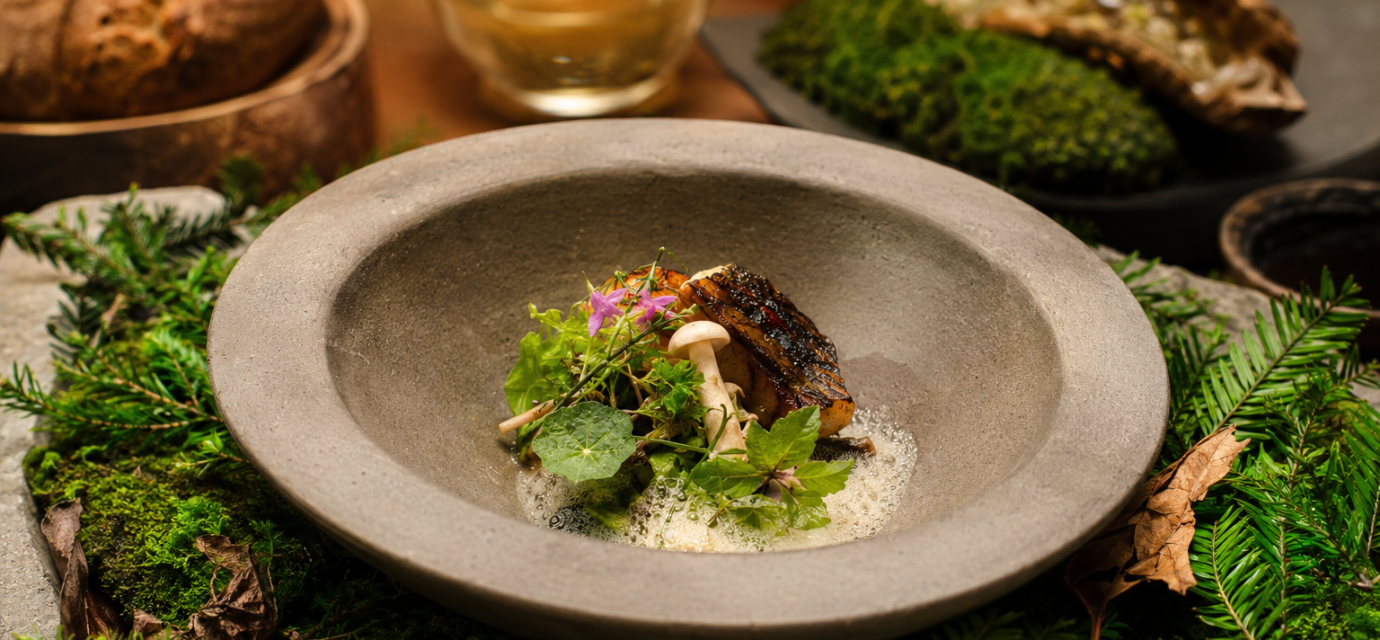
Narisawa Tokyo: The Restaurant Where Japanese Nature, Seasonality & Sustainability Become a Meal
Some restaurants chase luxury.
Narisawa chases connection.
In Tokyo’s Minami-Aoyama neighborhood, Narisawa has become one of the world’s most meaningful examples of how fine dining can feel refined without becoming disconnected from the earth. It is elegant, yes. It is technically brilliant, yes. But what makes Narisawa linger in the imagination is something quieter.
It asks a deeper question:
What happens when a meal is not only designed to impress, but to remind us where food comes from?
Chef Yoshihiro Narisawa built the restaurant around a philosophy called Innovative Satoyama Cuisine, inspired by Japan’s satoyama landscapes, where people, forests, fields, and seasons exist in relationship with one another. Narisawa’s own philosophy explains satoyama as a way of life shaped by people living and working with nature, taking only what is necessary from the earth. (narisawa-yoshihiro-en.com)
That idea changes everything.
At Narisawa, dinner is not only about rare ingredients, beautiful plating, or the thrill of a tasting menu. It is about forests, coastlines, farmers, fishermen, seasons, memory, restraint, and care.
It is luxury with a conscience.
It is Japanese fine dining with roots.
It is a restaurant that quietly suggests the future of food may depend on remembering how deeply connected we already are.
Some restaurants chase luxury.
Narisawa chases connection.
In Tokyo’s Minami-Aoyama neighborhood, Narisawa has become one of the world’s most meaningful examples of how fine dining can feel refined without becoming disconnected from the earth. It is elegant, yes. It is technically brilliant, yes. But what makes Narisawa linger in the imagination is something quieter.
It asks a deeper question:
What happens when a meal is not only designed to impress, but to remind us where food comes from?
Chef Yoshihiro Narisawa built the restaurant around a philosophy called Innovative Satoyama Cuisine, inspired by Japan’s satoyama landscapes, where people, forests, fields, and seasons exist in relationship with one another. Narisawa’s own philosophy explains satoyama as a way of life shaped by people living and working with nature, taking only what is necessary from the earth. (narisawa-yoshihiro-en.com)
That idea changes everything.
At Narisawa, dinner is not only about rare ingredients, beautiful plating, or the thrill of a tasting menu. It is about forests, coastlines, farmers, fishermen, seasons, memory, restraint, and care.
It is luxury with a conscience.
It is Japanese fine dining with roots.
It is a restaurant that quietly suggests the future of food may depend on remembering how deeply connected we already are.
Chef Yoshihiro Narisawa shares the philosophy behind his nature-rooted approach to Japanese cuisine.
What Makes Narisawa Feel So Different?
Narisawa does not feel special only because it is famous.
It feels special because its creativity has a purpose.
The restaurant’s official philosophy says Narisawa creates gastronomy that is beneficial to both body and spirit, while supporting a continuously sustainable environment. The restaurant calls this approach Beneficial and Sustainable Gastronomy. (narisawa-yoshihiro-en.com)
That phrase could sound abstract until you understand how it shows up on the plate.
Narisawa’s food is not built around forcing the same menu every season. Instead, the restaurant allows nature to set the rhythm. The Japan National Tourism Organization notes that Narisawa’s menu changes daily to honor the seasons and Japan’s diverse rural landscapes. It also describes Chef Narisawa’s relationship with farmers and fishermen, including purchasing only what is needed to help avoid food waste. (japan.travel)
That is the beauty of the restaurant.
The meal is creative, but it is not careless.
It is artistic, but it is not detached.
It is refined, but it still feels accountable to the land and sea that made it possible.
Satoyama: The Idea Behind the Meal
To understand Narisawa, you have to understand satoyama.
The word is often connected to traditional Japanese rural landscapes where human life and nature coexist. Japan House Los Angeles describes satoyama as a relationship between people and nature, with “sato” meaning a place where people live and “yama” meaning mountain. It explains the idea as a Japanese form of environmental thinking that places humanity within the natural world rather than outside it. (japanhousela.com)
That is powerful because so much modern luxury separates people from the source.
The food arrives polished.
The plate looks perfect.
The diner enjoys the experience.
But the field, the forest, the fisherman, the microbes, the soil, the season, and the fragile ecosystem behind that beauty can disappear from view.
Narisawa brings them back into the conversation.
The restaurant’s work is grounded in the idea that food is not separate from ecology. Japan House Los Angeles notes that Narisawa draws from forests and fields, using ingredients and elements such as koji, binchotan charcoal, tree bark, and foraged leaves in his practice. (japanhousela.com)
That does not mean the restaurant is rustic.
It means the sophistication has roots.
Bread of the Forest: When Bread Becomes Alive at the Table
One of Narisawa’s most famous creations is Bread of the Forest 2010.
And honestly, it is easy to understand why people remember it.
The Japan National Tourism Organization describes the dish as dough made with natural yeast from the forests of Shirakami-Sanchi, a UNESCO World Heritage Site. The dough is brought to the table raw and fermenting, surrounded by seasonal greenery. Guests watch it continue to rise before it is baked tableside in a hot stone oven. (japan.travel)
That is more than a clever dining-room moment.
It turns bread into a living reminder.
Bread is usually served finished. At Narisawa, the guest watches transformation happen. Fermentation becomes visible. Time becomes part of the dish. The forest is not just mentioned in the description. It is symbolically present in the yeast, the greenery, the rising dough, and the act of waiting.
There is something almost tender about that.
In a world trained to want everything fast, Narisawa asks the table to slow down long enough to see life moving inside food.
Why Tokyo Is the Right Home for Narisawa
Tokyo is known for precision, craft, discipline, and extraordinary culinary range.
Narisawa fits that world beautifully, but it also softens it.
This is not simply a restaurant about technique. It is a restaurant about relationship.
The World’s 50 Best Restaurants describes Narisawa as modern and sustainable Japanese cooking from a Tokyo dining mainstay, noting that Chef Yoshihiro Narisawa spent years training in Europe before returning to Japan and eventually establishing the restaurant in Minami-Aoyama. (theworlds50best.com)
That background matters because Narisawa’s cooking is not locked into one narrow category. It carries Japanese seasonality and satoyama thinking, but it also reflects a chef who studied abroad and returned home with a wider technical language.
The result is not “fusion” in the shallow sense.
It is a thoughtful return.
A chef goes out into the world, learns, absorbs, refines, and then comes back to ask what Japanese nature can say through contemporary cuisine.
That is why Narisawa belongs in Tokyo.
It reflects the city’s discipline and ambition, but also Japan’s deeper respect for season, restraint, and natural beauty.
Recognition Without Losing the Meaning
Narisawa has received major international recognition.
The Japan National Tourism Organization notes that the restaurant has received two Michelin stars and a Michelin Green Star for sustainability. (japan.travel) The MICHELIN Guide lists Narisawa as a two-star restaurant in the 2026 MICHELIN Guide Japan. (guide.michelin.com)
Narisawa also appears on The World’s 50 Best Restaurants 2025 list at No. 21, where it is described as modern and sustainable Japanese cooking from a Tokyo mainstay. (theworlds50best.com)
But awards are only the surface.
The deeper story is not that Narisawa is acclaimed.
The deeper story is why it has remained meaningful.
It offers a version of fine dining where sustainability is not a marketing garnish. It is part of the restaurant’s identity. It shows that luxury can be measured not only by rarity, but by responsibility.
Care for ingredients.
Care for ecosystems.
Care for timing.
Care for craft.
Care for the diner’s emotional experience.
That is what makes Narisawa worth writing about beyond the rankings.
What Narisawa Teaches About Luxury
Narisawa gives readers a different way to think about luxury dining.
Luxury is often described through abundance: more courses, more cost, more exclusivity, more spectacle.
Narisawa suggests another path.
Maybe luxury can also mean attention.
Maybe it can mean knowing the season well enough not to fight it.
Maybe it can mean respecting the farmer, the fisherman, the forest, and the sea.
Maybe it can mean creating a meal that leaves people more aware than when they arrived.
That kind of luxury feels especially important now.
Food culture is changing. More diners care about sourcing, sustainability, waste, seasonality, and environmental responsibility. But those values can easily become empty words when they are not tied to real practice.
Narisawa is compelling because it turns those values into a dining language.
The restaurant does not simply tell guests to care about nature.
It invites them to taste care.
Before You Go
Narisawa is not a casual last-minute restaurant stop. It is a highly acclaimed fine-dining restaurant in Tokyo, so readers should check the official website for current reservations, menus, dietary options, pricing, and policies before planning a visit.
But even without a reservation, Narisawa offers something worth carrying.
It reminds us that food is never just food.
It is land.
It is water.
It is labor.
It is time.
It is memory.
It is choice.
And when a restaurant can turn bread rising at the table into a quiet lesson about forests, fermentation, patience, and care, maybe the question is not only what is on the menu.
Maybe the better question is:
What is this meal trying to teach us about being alive on the earth?
Frequently Asked Questions About Narisawa Tokyo
What is Narisawa?
Narisawa is a fine-dining restaurant in Minami-Aoyama, Tokyo, led by Chef Yoshihiro Narisawa. It is known for Innovative Satoyama Cuisine, seasonality, sustainability, and a philosophy called Beneficial and Sustainable Gastronomy. (narisawa-yoshihiro-en.com)
Where is Narisawa located?
Narisawa is located at 2-6-15 Minami-Aoyama, Minato-ku, Tokyo, Japan. The Japan National Tourism Organization lists the restaurant in the Minami-Aoyama neighborhood. (japan.travel)
Who is Chef Yoshihiro Narisawa?
Yoshihiro Narisawa is the chef and owner of Narisawa in Tokyo. The World’s 50 Best Restaurants notes that he trained in Europe, including in the kitchens of Paul Bocuse and Joël Robuchon, before returning to Japan and developing his own restaurant career. (theworlds50best.com)
What is Innovative Satoyama Cuisine?
Innovative Satoyama Cuisine is Narisawa’s original culinary genre inspired by satoyama culture, seasonal Japanese landscapes, ancestral wisdom, and the relationship between people and nature. (narisawa-yoshihiro-en.com)
What is Narisawa’s Bread of the Forest?
Bread of the Forest 2010 is one of Narisawa’s signature creations. It features dough made with natural yeast from the forests of Shirakami-Sanchi, brought to the table in a raw fermenting state, then baked tableside after guests watch it rise. (japan.travel)
Does Narisawa have Michelin stars?
Yes. The MICHELIN Guide lists Narisawa as a two-star restaurant in the 2026 MICHELIN Guide Japan. The Japan National Tourism Organization also notes that Narisawa has received two Michelin stars and a Michelin Green Star for sustainability. (guide.michelin.com)
Is Narisawa sustainable?
Narisawa is widely associated with sustainability. The restaurant’s philosophy centers on Beneficial and Sustainable Gastronomy, and the Japan National Tourism Organization notes its Michelin Green Star and commitment to sourcing relationships and avoiding food waste. (japan.travel)
References and Further Reading
- Narisawa Official Website, “Philosophy.” Used for Innovative Satoyama Cuisine, satoyama culture, and Beneficial and Sustainable Gastronomy. (narisawa-yoshihiro-en.com)
- Japan National Tourism Organization, “Narisawa.” Used for location, satoyama description, Michelin Green Star context, daily-changing menu, sourcing approach, and Bread of the Forest 2010. (japan.travel)
- The MICHELIN Guide, “NARISAWA.” Used for the 2026 two-star listing. (guide.michelin.com)
- The World’s 50 Best Restaurants, “Narisawa.” Used for chef background, 2025 ranking, Minami-Aoyama location, satoyama cuisine, and menu information. (theworlds50best.com)
- Japan House Los Angeles, “Satoyama: Evolving with the Forest.” Used for satoyama cultural context, Narisawa’s forest-centered philosophy, and ecological approach to food. (japanhousela.com)