Jollof Rice, Afrobeats, and the Joy of a Kitchen That Refuses to Be Quiet
There are dishes that sit politely on the table, and then there is jollof rice.
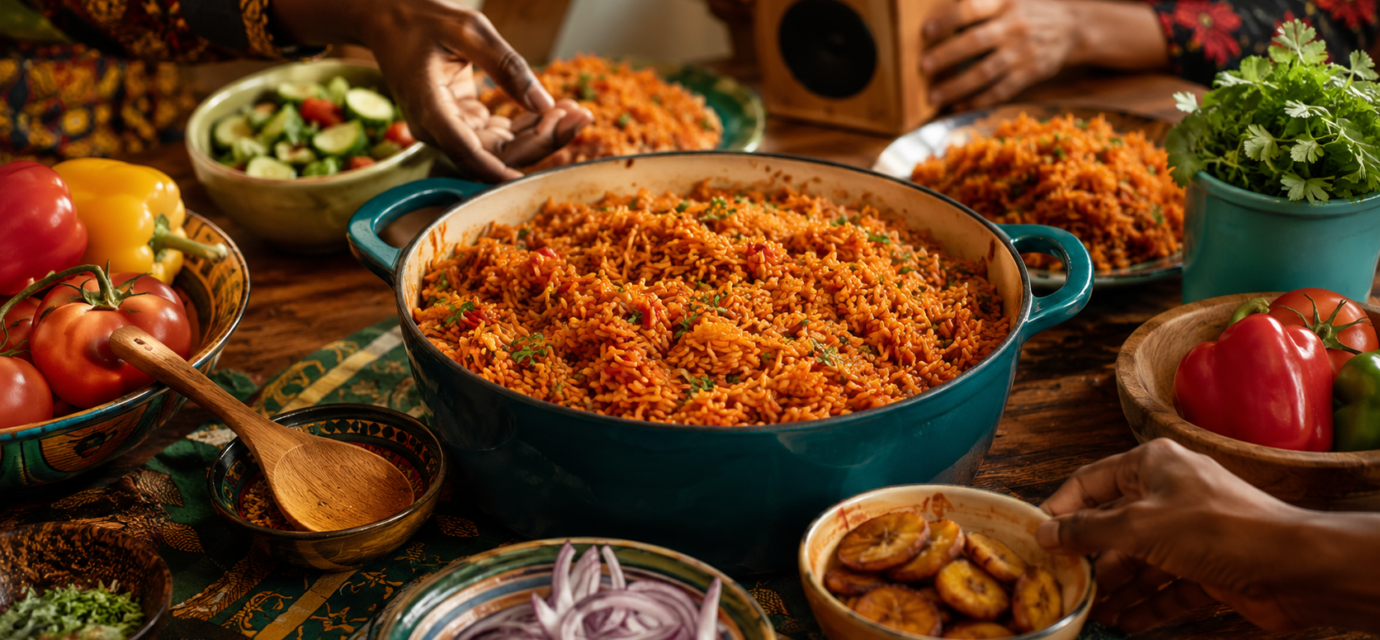
Jollof does not arrive quietly. It fills the kitchen before anyone takes a bite. The tomatoes deepen, the pepper base thickens, the onions soften into sweetness, and the rice slowly absorbs that red-gold flavor until the whole room starts paying attention. Before the pot is opened, somebody already knows dinner is going to matter.
That is why jollof feels so natural beside Afrobeats.
One brings the aroma. The other brings the pulse. One gathers people around the stove. The other makes the room move before the plates are even served. Together, they turn cooking into something fuller than a task. They make the kitchen feel like a living place, not just a working place.
Jollof rice is widely recognized as a seasoned rice dish from West Africa, commonly made with rice, tomatoes, peppers, onions, spices, and regional variations that shift from country to country and cook to cook. Britannica traces jollof’s likely origins to the Senegambian region, connected to the Wolof empire, before the dish spread throughout West Africa and became a source of cultural pride.
That history matters. Jollof is often talked about through playful rivalry, especially through the “Jollof Wars” between countries and communities that passionately defend their favorite versions. But before it became a social media debate, it was part of a much deeper food story shaped by land, rice cultivation, migration, trade, family cooking, and regional identity.
The Story Behind the Pot
Jollof rice is not just one recipe. It is a family of recipes.
In Senegal and The Gambia, the roots of jollof are often connected to dishes such as ceebu jën, also known through French spelling as thiéboudiène. UNESCO recognizes Ceebu Jën, a culinary art of Senegal, as part of the Representative List of the Intangible Cultural Heritage of Humanity, noting its cultural importance and origin in Senegalese cooking traditions.
Across West Africa, the dish changes beautifully. Nigerian jollof may lean smoky, bold, and party-ready. Ghanaian jollof may use fragrant rice and layered seasoning in a way that feels rich and deeply satisfying. Other countries have their own names, techniques, and local loyalties. Britannica notes that contemporary jollof may include tomatoes, peppers, onions, stock, spices, oil, rice, meat, fish, or vegetables, depending on where and how it is prepared.
That is part of the magic. Jollof is shared, but it is not identical. It has a recognizable spirit, but it allows room for personality.
Aunties, uncles, cousins, chefs, home cooks, and first-time learners all come to the pot with opinions. Some believe the rice must be smoky. Some care most about the pepper blend. Some insist the bottom layer is where the soul lives. Some want it with fried plantains, grilled chicken, salad, fish, goat, beef, or nothing extra at all.
And somehow, the debate does not weaken the dish. It keeps it alive.
The History of Jollof Rice | A RONU PIECE
Why Jollof and Afrobeats Belong in the Same Room
Afrobeats, like jollof, carry motion.
It is important to note that Afrobeats and Afrobeat are related in name but not identical. Afrobeat is often associated with the politically charged, jazz-funk, highlife, and Yoruba-influenced sound pioneered by artists such as Fela Kuti. Afrobeats, with an “s,” is a broader contemporary popular music movement connected to West African sounds, pop, dancehall, hip-hop, R&B, amapiano influences, and global club culture.
UNESCO described Afrobeats as an exciting sound emerging from West Africa that has entered global music consciousness. That description fits because Afrobeats often feels like confidence in motion. It is not background noise. It is an atmosphere.
Jollof has that same presence.
A good pot of jollof asks for attention. It does not whisper. It builds through patience, heat, and seasoning. The pepper base has to cook down. The rice has to steam properly. The flavors need time to settle into each grain. Like a song with rhythm, jollof depends on timing. Rush it, and something feels missing. Let it build, and the payoff is beautiful.
That is why cooking jollof with Afrobeats playing in the kitchen feels less like a trend and more like a natural pairing. The music helps set the pace. The chopping becomes lighter. The stirring feels less like labor. The waiting feels less like delay. The kitchen starts feeling like the first room of the gathering instead of the place hidden behind it.
The Kitchen Is Not Always Meant to Be Quiet
Some kitchens are calm by design. Others are alive by memory.
A lively kitchen has its own language. Oil warming in the pot. A spoon tapping against the side. Someone asking if the rice is ready. Someone else trying to sneak a taste. A child dancing near the doorway. A friend arriving too early and pretending they came to “help.” Music in the background. Laughter interrupting instructions. The smell of pepper, tomato, stock, and spice wrapping itself around the room.
That kind of kitchen reminds us that food culture does not only live on the plate. It lives in the way people gather.
The National Museum of African American History and Culture describes foodways as not only what people eat, but how food is grown, prepared, and woven into life. That idea matters here because jollof is not only an ingredient list. It is memory, social energy, family pride, and cultural expression.
Food can teach without sounding like a lecture. A pot of rice can carry geography. A spice blend can carry migration. A family method can carry memory. A kitchen playlist can carry the confidence of a generation that refuses to shrink its sound for anyone.
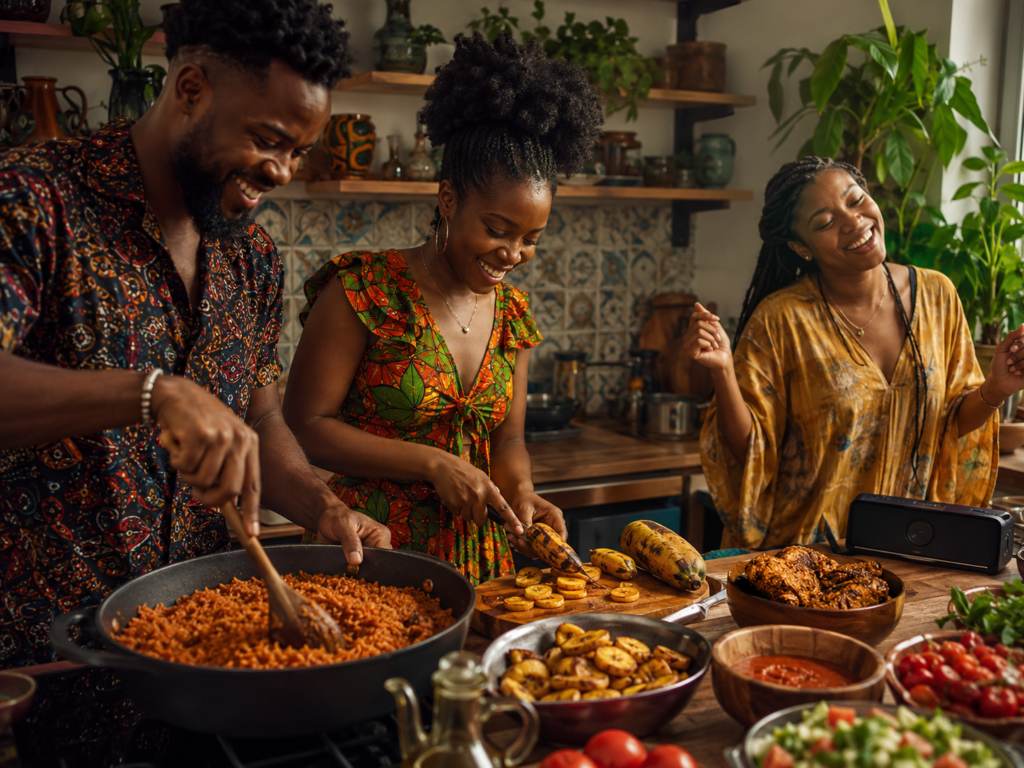
Friends cooking jollof rice and plantains together in a lively kitchen with music playing.
What Food Media Often Misses About Jollof
Food content can become too flat when it treats culture like decoration.
Jollof deserves better than that.
It is not just “red rice.” It is not just a popular dish with a pretty color. It is part of a West African culinary conversation that continues to evolve. It appears at weddings, birthdays, Sunday meals, holidays, community events, family gatherings, restaurants, festivals, and diaspora tables. It can be humble or grand. It can be everyday or ceremonial. It can be cooked in a small apartment kitchen or in a massive pot for a crowd.
Smithsonian Magazine has also pointed to a broader reappraisal of West African cuisine in the United States, including how chefs and cultural workers are helping bring deeper recognition to African and diasporic food traditions.
That recognition matters because readers deserve food stories that are more than surface-level. They deserve to know why a dish matters, where it has traveled, what it carries, and how it still feels alive today.
For Fly By Eats, this is where the article becomes more than a lifestyle piece. It becomes a bridge. It gives readers cultural context, emotional connection, and practical inspiration in one experience.
How to Build a Jollof and Afrobeats Night at Home
You do not have to host a huge party to create the feeling.
A jollof night can be simple, warm, and personal. Start with the pot. Choose your version or explore one respectfully. Build the pepper base slowly. Let the tomatoes cook down until they lose their raw edge. Give the rice time. Let the steam do its work.
Then build the atmosphere around it.
Play Afrobeats during prep when the kitchen needs energy. Choose something smoother while the rice cooks and the house fills with aroma. Bring the tempo back up when it is time to serve. If people are coming over, let the playlist meet them at the door before the food does.
Serve the jollof with sides that make sense for your table. Fried plantains add sweetness. Grilled chicken or fish adds depth. A simple salad brings freshness. Pepper sauce gives heat. A chilled drink keeps the meal balanced.
Most importantly, leave room for conversation.
Ask people how they grew up eating rice dishes. Ask what music makes their kitchen feel alive. Ask what foods remind them of home, even if “home” is complicated. Those questions turn dinner into memory-making.
Jollof | Afrobeat Vibes | Africa’s Rhythms & Roots
A Thought-Provoking Way to See the Pairing
Jollof and Afrobeats work together because both are rooted and moving at the same time.
That is a powerful combination.
They remind us that tradition does not have to stand still to remain meaningful. A dish can travel and still belong to its history. A sound can become global and still carry local pride. A kitchen can be modern and still feel ancestral. A table can be casual and still become sacred in the way people gather around it.
There is something beautiful about that.
In a world that often rushes meals, flattens culture, and turns everything into quick content, jollof asks for more. It asks for patience. Afrobeats asks for presence. Together, they ask the kitchen to become a place where people are allowed to feel joy out loud.
Not every meal has to be quiet.
Not every kitchen has to be perfect.
Not every gathering has to be formal.
Sometimes the best table is the one where the rice is steaming, the music is playing, someone is laughing too loudly, and everyone knows they are exactly where they need to be.
Reader Takeaway
Jollof rice is more than a dish. Afrobeats is more than a playlist. Together, they create a feeling that many people recognize immediately: warmth, pride, movement, and belonging.
That is the beauty of a kitchen that refuses to be quiet.
It is not chaotic.
It is alive.
Try This at Home:
The next time you cook rice, think about the sound of the meal. What music matches the flavor? What song makes prep feel easier? What dish in your life deserves its own playlist?
Explore More on Fly By Eats:
For more culture-rich food stories, kitchen inspiration, and global flavor ideas, explore the Culture & Flavor, Food & Lifestyle, and Recipes & Cooking sections on Fly By Eats.
References
- Encyclopaedia Britannica. (n.d.). Jollof rice. Encyclopaedia Britannica. Retrieved May 21, 2026, from https://www.britannica.com/topic/jollof-rice
- National Museum of African American History and Culture. (n.d.). Black foodways and cuisine. Smithsonian Institution. Retrieved May 21, 2026, from https://nmaahc.si.edu/explore/stories/black-foodways-and-cuisine
- Smithsonian Magazine. (2024, June 13). America’s best new restaurant celebrates the flavors of West Africa. There’s More to That. https://www.smithsonianmag.com/podcast/series/theres-more-to-that/season-1/americas-best-new-restaurant-celebrates-the-flavors-of-west-africa/
- UNESCO. (2021). Ceebu Jën, a culinary art of Senegal. Intangible Cultural Heritage. https://ich.unesco.org/en/RL/ceebu-jen-a-culinary-art-of-senegal-01748
- UNESCO. (2022). African pop culture. UNESCO Multimedia Archives. https://www.unesco.org/archives/multimedia/document-3998