Industrial Kitchen Design That Feels Bold, Smart, and Surprisingly Livable
An industrial kitchen has a certain kind of honesty to it. It does not try to hide the strength of its materials. It lets metal look like metal, wood show its grain, stone carry its weight, and lighting become part of the architecture. But the best industrial kitchens are not cold, stiff, or overly dramatic. They are practical, warm, grounded, and surprisingly easy to live in.
That is where the magic happens.
A livable industrial kitchen does not feel like a restaurant back-of-house or an unfinished warehouse. It feels like a home that knows how to work hard. It gives you durable surfaces, strong lines, smart storage, and an atmosphere that makes cooking feel intentional. It can be moody without being gloomy, modern without being sterile, and stylish without sacrificing comfort.
Industrial design itself is rooted in function, manufacturing, and useful objects that are both practical and visually appealing. Britannica describes industrial design as the design of mass-produced consumer products that should work well and please the eye, with historic ties to architecture, interiors, modern materials, and early 20th-century design movements. That history matters because it reminds us that industrial style is not about random exposed pipes or dark colors. It is about usefulness, structure, and beauty working together.
Expected Result: A practical, detailed guide for building an industrial-style kitchen that looks striking, functions hard, and stays warm enough for everyday living.
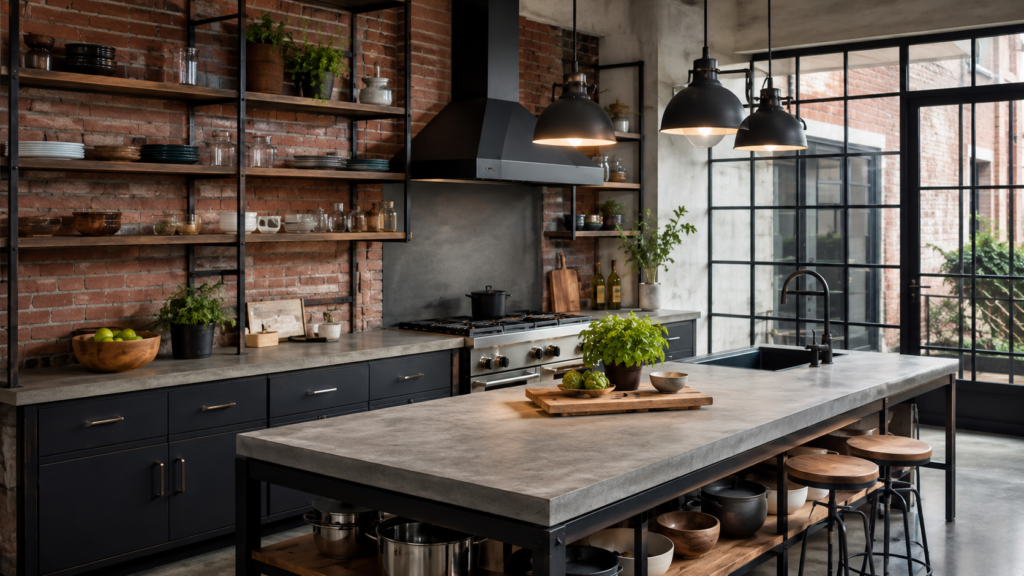
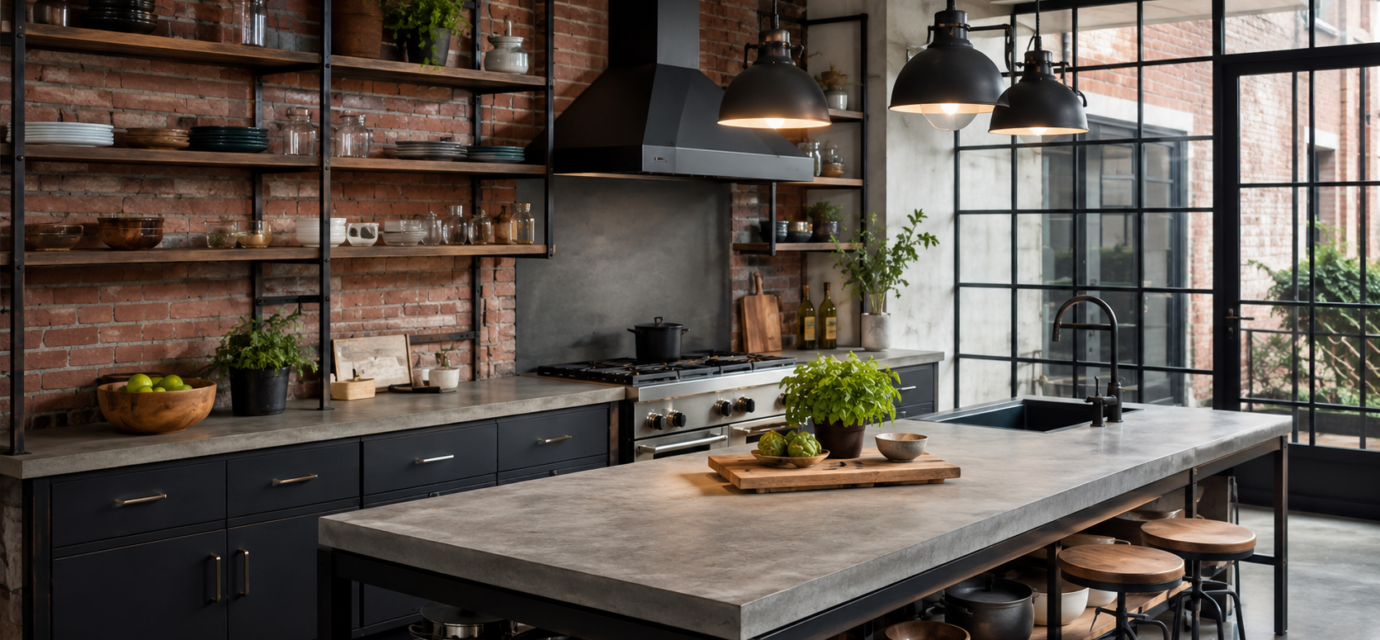
Warm industrial kitchen with black cabinets, wood shelves, concrete countertops, and layered lighting.
Why Industrial Kitchen Design Works So Well in Real Homes
Industrial kitchens are popular because they solve a real problem. Many people want a kitchen that looks beautiful but does not feel too precious. They want a space where coffee can spill, cast iron can sit on the stove, groceries can land on the island, and dinner can happen without the room losing its charm.
This style works because it honors real use. Stainless steel, matte black hardware, concrete-look surfaces, slab backsplashes, wood shelving, large drawers, and easy-clean finishes all support the way people actually cook. The look can also grow with you. You can start small with lighting and hardware, then move into bigger updates like cabinetry, countertops, flooring, or a metal-framed pantry door.
The National Kitchen & Bath Association’s 2026 Kitchen Trends Report notes that kitchens are continuing to grow in importance as connected, intelligent, personalized, and health-conscious spaces. That fits naturally with industrial kitchen design because this style already values efficiency, storage, durable materials, and a strong connection between cooking, gathering, and daily life.
The Secret: Industrial Does Not Have to Mean Cold
The biggest mistake people make with industrial kitchen design is thinking the whole space needs to be black, gray, metal, and concrete. That can quickly make a kitchen feel more like a showroom than a home.
The better approach is contrast.
Pair matte black cabinetry with warm oak shelves. Place a dark island under soft pendant lighting. Balance a concrete-look countertop with cream walls, linen Roman shades, or natural wood stools. Use metal, but let it be intentional. A black steel pantry door, a brushed stainless appliance, or bronze cabinet pulls can give the room strength without overwhelming it.
Houzz’s 2026 kitchen trend reporting shows a clear move toward warmth, with wood cabinetry overtaking white among renovating homeowners. That is important for industrial kitchens because wood helps soften heavier materials and brings the room back to human scale.
Key Industrial Kitchen Features to Consider
A strong industrial kitchen usually includes a few of these design elements:
Matte black, charcoal, deep olive, walnut, or dark-stained cabinetry.
Concrete-look, soapstone-look, stainless, butcher block, or dark quartz countertops.
Open shelving with black metal brackets and natural wood shelves.
Black steel-framed glass doors, pantry partitions, or cabinet fronts.
Factory-inspired pendant lights, linear lighting, or simple sconces.
Oversized drawers, hidden storage, pull-out pantry systems, and appliance garages.
Large-format tile, brick-look tile, zellige-style tile, or slab backsplashes.
Warm metals like aged brass, bronze, or brushed nickel to prevent the space from feeling too flat.
The goal is not to use every industrial element at once. The best design usually has one or two strong statements, then calmer supporting details.
Layout Matters More Than the Look
A beautiful kitchen can still feel frustrating if the layout is wrong. Before choosing cabinet colors or pendants, think about how the kitchen moves.
Where do you enter with groceries?
Where do you prep vegetables?
Where does hot cookware land?
Where do dishes go after dinner?
Can two people cook without bumping into each other?
Can guests sit nearby without standing in the main cooking path?
The NKBA describes its planning guidelines as an essential reference for kitchen and bath professionals, covering cabinet-centered interiors, activity centers, lighting, indoor air quality, accessibility, and other technical planning needs. For a Fly By Eats reader, the takeaway is simple: a kitchen should be styled beautifully, but planned around movement, safety, comfort, and real routines.
In an industrial kitchen, layout choices can make the style feel more intentional. Try a strong work wall with tall storage, a bold island with seating, or a metal-and-glass pantry that gives the room architectural structure. If the kitchen is small, avoid too much open shelving. Use closed storage for everyday clutter, then reserve open shelves for beautiful cookware, bowls, cookbooks, or coffee essentials.
Kitchen Zones | How To Optimise Your Kitchen Layout
Lighting Is the Difference Between Bold and Harsh
Industrial kitchens need layered lighting. Without it, dark cabinetry and hard surfaces can feel heavy. With the right lighting, the same room becomes warm, sculptural, and inviting.
Use four layers when possible:
Ambient lighting for general brightness.
Task lighting under cabinets, above prep areas, and near the stove.
Accent lighting inside glass cabinets, along shelving, or near textured walls.
Decorative lighting through pendants, sconces, or a statement fixture.
NKBA lighting guidance emphasizes that lighting is foundational, not an afterthought, and that good lighting affects how people experience a space. Another NKBA lighting resource highlights ambient, task, and accent lighting as part of effective kitchen and bath design.
For industrial kitchens, warmer bulbs often work better than cool blue-white lighting. A warmer glow helps soften black metal, concrete, and stainless steel. Dimmer switches are also worth considering because they let the kitchen shift from bright meal prep to quiet evening atmosphere.
Ventilation Is Part of Good Design
A kitchen is not just visual. It is also air, heat, steam, sound, and movement.
If you cook often, especially if you sear, fry, roast, or use a gas range, ventilation matters. The Washington State Department of Health notes that ventilation with sufficient airflow can dilute or remove indoor contaminants from any type of stove, and that fans exhausting outdoors are important for removing gases and particles created while cooking. The agency also notes that recirculating hoods are generally less effective than ducted hoods for removing cooking pollution.
The EPA also explains that kitchen fans exhausting outdoors can remove contaminants directly from the room and increase outdoor ventilation.
From a design perspective, this means your range hood should not be treated as an afterthought. In an industrial kitchen, the hood can become a beautiful architectural moment. Consider a simple stainless hood, a black metal hood, a plaster-look hood over a darker backsplash, or a custom hood that blends with cabinetry.
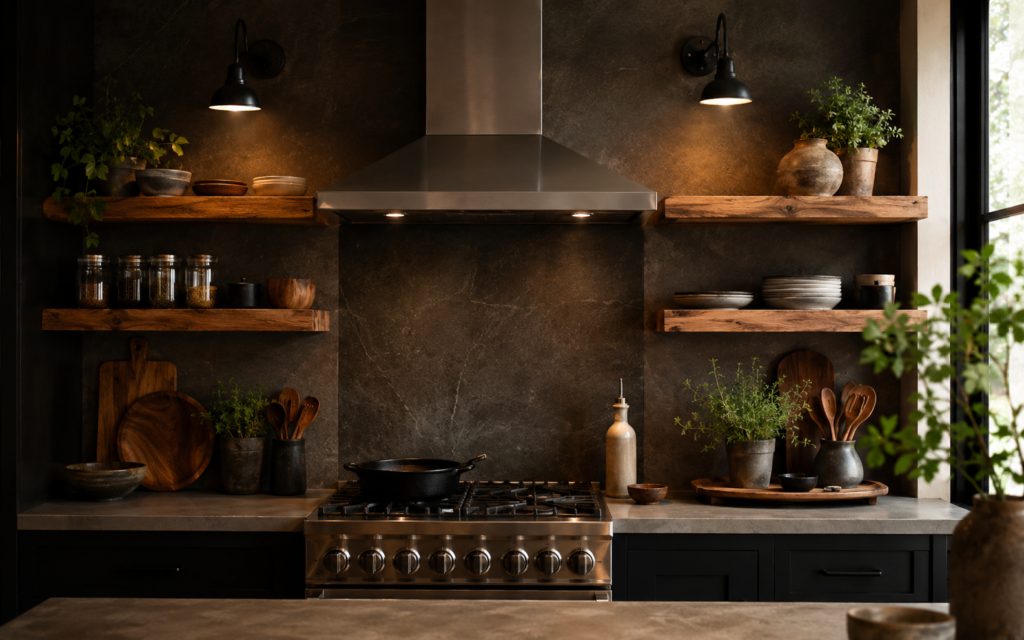
Industrial kitchen range wall with stainless hood, dark backsplash, wood shelves, and black sconces.
Materials That Feel Industrial but Still Welcoming
Industrial kitchen materials should feel honest, sturdy, and easy to care for. But they should also support the mood of the home.
Concrete-look quartz is a practical option if you love the look of concrete but want easier maintenance. Soapstone-look counters can bring depth and a softer matte feeling. Stainless steel can look professional and timeless, especially on appliances, islands, range hoods, or backsplashes. Wood keeps the room from feeling too hard. Ceramic tile, handmade-look tile, or textured stone-look surfaces add movement.
A good industrial palette might include:
Matte black
Charcoal
Warm white
Smoky taupe
Aged oak
Walnut
Brushed stainless steel
Bronze
Soft olive
Cream
Concrete gray
Deep espresso brown
The best industrial kitchens do not feel flat. They have layers. Smooth metal against grained wood. Matte cabinets against a glowing light. Dark counters against warm walls. Hardworking surfaces against soft seating.
Smart Storage Keeps the Kitchen From Looking Unfinished
Industrial style can look messy fast if storage is not planned well. Open shelving is beautiful, but it needs editing. Too many jars, mugs, appliances, and random containers can make the kitchen feel cluttered instead of collected.
Use closed storage for items that do not need to be seen. Keep open shelving for pieces with visual rhythm, like matching bowls, glassware, cookbooks, cast iron, cutting boards, or a coffee station. Deep drawers are ideal for pots, pans, mixing bowls, and small appliances. Pull-out trash and recycling bins help maintain the clean lines that make industrial kitchens feel intentional.
NKBA’s 2026 design research also connects wellness and daily comfort with hidden or integrated storage that reduces visual clutter, along with better lighting, airflow, materials, and layout.
Appliances: Where Performance Meets the Look
Industrial kitchen design pairs well with appliances that look clean, durable, and high-performing. Stainless steel is the classic choice, but panel-ready appliances can work too if you want a softer, more furniture-like feel.
Energy-efficient appliances can also support long-term comfort. ENERGY STAR explains that certified products meet strict energy-efficiency specifications set by the U.S. EPA and can help save energy and money while reducing environmental impact.
For an industrial kitchen, consider:
A quiet dishwasher with a stainless interior.
A counter-depth refrigerator or panel-ready refrigerator.
An induction range or cooktop for a cleaner, sleek cooking zone.
A wall oven, if the layout supports it.
A powerful range hood that vents outdoors, where possible.
A beverage fridge only if it supports your lifestyle and does not replace needed storage.
Top 10 Energy Efficient Home Appliances 2026 Smart Devices That Save Power and Money
How to Create the Look Without Remodeling Everything
You do not need a full renovation to bring industrial style into your kitchen. Start with upgrades that change the mood without tearing the room apart.
Try matte black cabinet hardware. Replace a dated light fixture with a simple metal pendant. Add wood floating shelves. Use a darker washable wall color or peel-and-stick tile behind a coffee bar. Bring in counter stools with leather, wood, or black metal. Add a rail system for utensils if it fits your cooking style. Use a large cutting board, ceramic crocks, glass jars, and warm textiles to make the kitchen feel lived in.
For renters or smaller budgets, focus on lighting, hardware, stools, art, and organization. Those changes can still create a strong industrial feeling without permanent construction.
Common Industrial Kitchen Mistakes to Avoid
Avoid going too dark without enough lighting. A black kitchen can be beautiful, but it needs warm light, reflective surfaces, and contrast.
Avoid using every industrial cliché at once. Exposed pipes, Edison bulbs, brick, black metal, concrete, stainless steel, and distressed wood can become too much together.
Avoid ignoring comfort. A kitchen needs places to sit, rest a dish towel, lean a cookbook, or enjoy coffee in the morning.
Avoid cluttering open shelves. Industrial does not mean messy. It should feel useful and collected.
Avoid choosing materials only for looks. Ask how each surface cleans, ages, reflects light, handles heat, and supports daily cooking.
Who Industrial Kitchen Design Is Best For
Industrial kitchen design is a strong fit for people who want a kitchen that feels practical, bold, and grounded. It works beautifully for home cooks who use their kitchens often. It also suits people who like modern design but want more texture, depth, and personality than a plain minimalist kitchen.
This style can work in lofts, apartments, ranch homes, modern farmhouses, townhomes, and open-concept spaces. The key is not copying a warehouse. The key is bringing in the parts of industrial design that make sense for your life: durability, structure, useful beauty, and materials that feel real.
10 Stunning Industrial Kitchen Design Ideas You’ll Want to Steal! – Video
Final Thought: Let the Kitchen Feel Like It Has a Pulse
A good industrial kitchen should not feel like it was staged and left untouched. It should feel ready.
Ready for coffee before sunrise.
Ready for cast iron on a busy weeknight.
Ready for friends leaning against the island.
Ready for a pot of soup, a cutting board full of herbs, and a room that can handle real life without losing its style.
That is the heart of industrial kitchen design. It is not just bold. It is capable. It is not just smart. It is soulful. And when it is balanced with warmth, light, air, and thoughtful storage, it becomes one of the most livable kitchen styles you can bring into a home.
Reader Review Question
Would you choose an industrial kitchen for the bold look, the practical materials, the easy-clean surfaces, or the warm modern mood? Share your thoughts below and tell us which design detail you would try first.
References
- Britannica Editors. (n.d.). Industrial design. Encyclopaedia Britannica. Retrieved May 21, 2026, from https://www.britannica.com/topic/industrial-design
- Britannica Editors. (n.d.). Industrial design: Modern design in the United States.
- Encyclopaedia Britannica. Retrieved May 21, 2026, from https://www.britannica.com/topic/industrial-design/Modern-design-in-the-United-States
- ENERGY STAR. (n.d.). Energy efficient products. Retrieved May 21, 2026, from https://www.energystar.gov/products
- National Kitchen & Bath Association. (2025, September 18). NKBA | KBIS releases annual 2026 Kitchen Trends Report. https://nkba.org/press/nkba-kbis-releases-annual-2026-kitchen-trends-report/
- Parker, M. (2026, January 13). 10 kitchen remodeling trends to know for 2026. Houzz. https://www.houzz.com/magazine/10-kitchen-remodeling-trends-to-know-for-2026-stsetivw-vs~184007085
- U.S. Environmental Protection Agency. (n.d.). Improving indoor air quality. Retrieved May 21, 2026, from https://www.epa.gov/indoor-air-quality-iaq/improving-indoor-air-quality
- Washington State Department of Health. (n.d.). Ventilation while cooking. Retrieved May 21, 2026, from https://doh.wa.gov/community-and-environment/air-quality/indoor-air/ventilation-while-cooking
Recommended Reads
This post may contain affiliate links. As an Amazon Associate, Fly By Eats may earn from qualifying purchases at no extra cost to you.