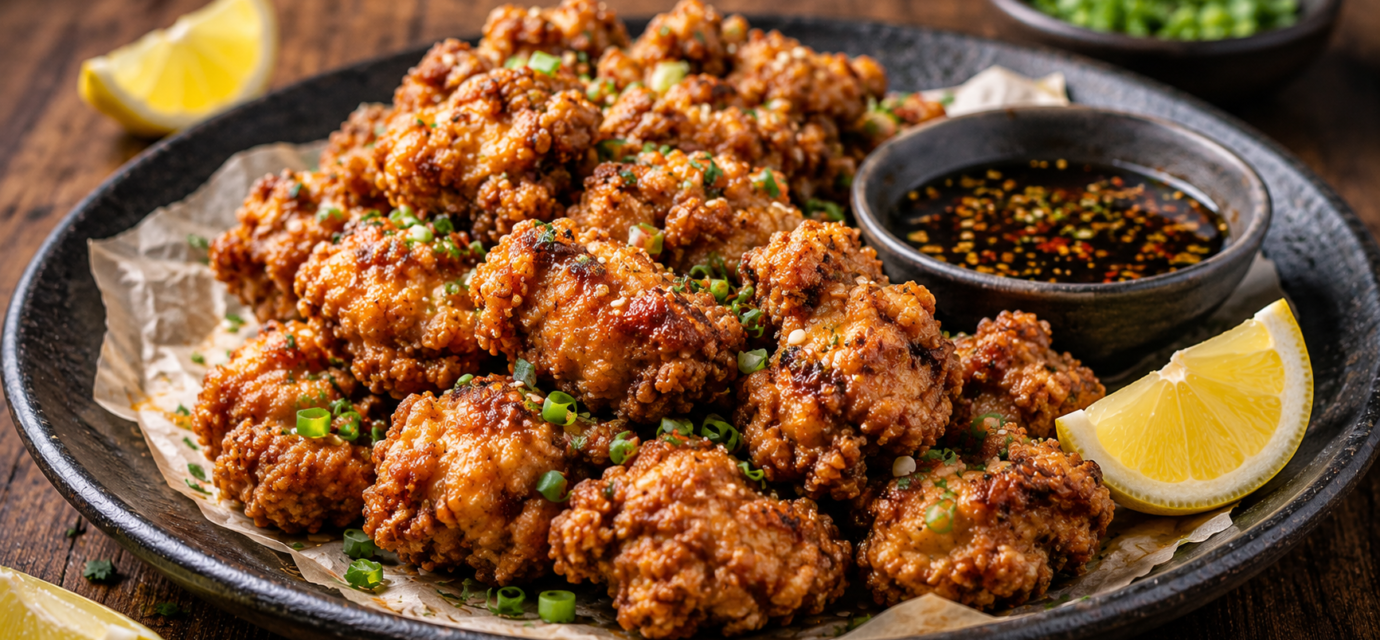
Japanese Karaage with Lemon Soy Dip
Crispy chicken has a way of making a kitchen feel instantly alive. The first sound of Japanese karaage hitting hot oil is gentle but exciting: a soft crackle, a rush of steam, the scent of ginger, garlic, and soy rising through the air. Each piece turns golden at the edges, then deeper and craggier after a quick second fry, becoming the kind of bite that makes everyone gather near the stove before the plate even reaches the table.
This Japanese karaage recipe is made with bite-sized chicken thighs marinated in soy sauce, sake, ginger, and garlic, then coated in potato starch for that light, shattering crunch. The chicken itself stays juicy and savory, while the lemon soy dip gives every bite a clean, citrusy finish. It is rich without feeling heavy, familiar without losing its cultural personality, and deeply satisfying in that “just one more piece” kind of way.
Karaage is beloved in Japan as home cooking, bento food, izakaya comfort, and casual takeaway. It is not meant to be fussy. The beauty of it is in the balance: a short marinade, a dry starch coating, steady oil temperature, and a little patience between fries. The result is chicken that feels both humble and special, the kind of dish that belongs beside rice on a weeknight or at the center of a relaxed weekend table.
For Fly By Eats, this is the kind of recipe that carries culture through comfort. It honors the classic soy-ginger profile of chicken karaage while keeping the steps approachable for home cooks. Serve it with lemon wedges, shredded cabbage, steamed rice, and a small bowl of lemon soy dip, and you have a plate that feels crisp, warm, bright, and beautifully shareable.
Quick Recipe Snapshot
- Prep Time: 20 minutes
- Marinating Time: 30 minutes
- Cook Time: 10-12 minutes
- Total Time: About 1 hour
- Servings: 4
- Difficulty Level: Beginner to intermediate
- Best For: Weeknight dinners, bento-style lunches, appetizer platters, family meals, izakaya-inspired nights
- Expected Result: Juicy soy-ginger chicken bites with a light, crisp potato starch coating and a bright lemon soy dipping sauce
Why You’ll Love This Recipe
- The chicken is deeply seasoned from the inside, not just coated on the outside.
- Potato starch creates a crisp, delicate shell that feels lighter than a thick flour crust.
- The lemon soy dip balances the richness of fried chicken with citrus, salt, and gentle sweetness.
- Bite-sized pieces cook quickly, making this recipe realistic for home kitchens.
- It works as a main dish, appetizer, lunch box protein, or party platter.
- The ingredient list is simple but flavorful.
- The recipe includes food safety cues, frying tips, storage guidance, and reheating instructions so readers feel confident from start to finish.
Cultural Background: What Is Karaage?
Karaage, often written as kara-age, refers to a Japanese cooking method in which ingredients are seasoned or marinated, coated lightly in flour or starch, and deep-fried. While the technique can be used for fish, vegetables, pork, or tofu, chicken karaage has become the version many people think of first.
Japanese chicken karaage is commonly associated with home meals, bento lunch boxes, casual restaurants, izakaya-style dining, supermarkets, convenience stores, and takeout counters. It is loved because it tastes good hot and can still be enjoyable at room temperature, which helps explain its popularity in lunch boxes and picnic-style meals.
Food history can be layered, and karaage has more than one story attached to it. Some food culture sources trace restaurant-style chicken karaage to Tokyo in the 1930s, while regional tourism sources also highlight Oita Prefecture, especially Usa City and Nakatsu City, as important centers of karaage specialty shop culture after World War II. Usa and Nakatsu are often discussed together because both cities helped shape the modern karaage boom, with shops developing their own marinades, seasonings, and frying styles.
This recipe stays close to the classic home-cooking spirit: chicken thighs, soy sauce, sake, ginger, garlic, potato starch, and a crisp finish. The lemon soy dip is a Fly By Eats-friendly addition that keeps the flavor bright and welcoming without taking the dish away from its Japanese-inspired foundation. In Japan, lemon wedges are a familiar accompaniment to karaage, and the dip builds on that idea with a little extra citrusy balance.
Why This Recipe Works
Karaage succeeds when three things happen at the same time: the chicken is seasoned, the coating stays light, and the oil stays hot enough to crisp without burning.
Chicken thighs are ideal because they remain tender during frying. Boneless, skinless thighs are easy to cut into bite-size pieces, and their natural richness stands up well to soy sauce, ginger, and garlic.
The marinade is short but effective. Soy sauce adds salt and umami. Sake helps carry flavor and softens the sharp edges of the aromatics. Ginger gives warmth and brightness, while garlic adds savory depth. A little sesame oil is optional, but it can round out the aroma.
Potato starch is the key to the coating. Compared with a thick batter, a dry potato starch coating fries into a crisp, slightly craggy shell. Letting the coated chicken rest for a few minutes before frying gives the starch time to hydrate lightly from the surface moisture, which helps it cling better.
The double-fry method gives karaage its best texture. The first fry cooks the chicken through. A short rest lets steam move outward. The second fry at a slightly higher temperature drives off surface moisture and crisps the coating. The result is chicken that is juicy in the center and crisp on the outside.
Ingredients
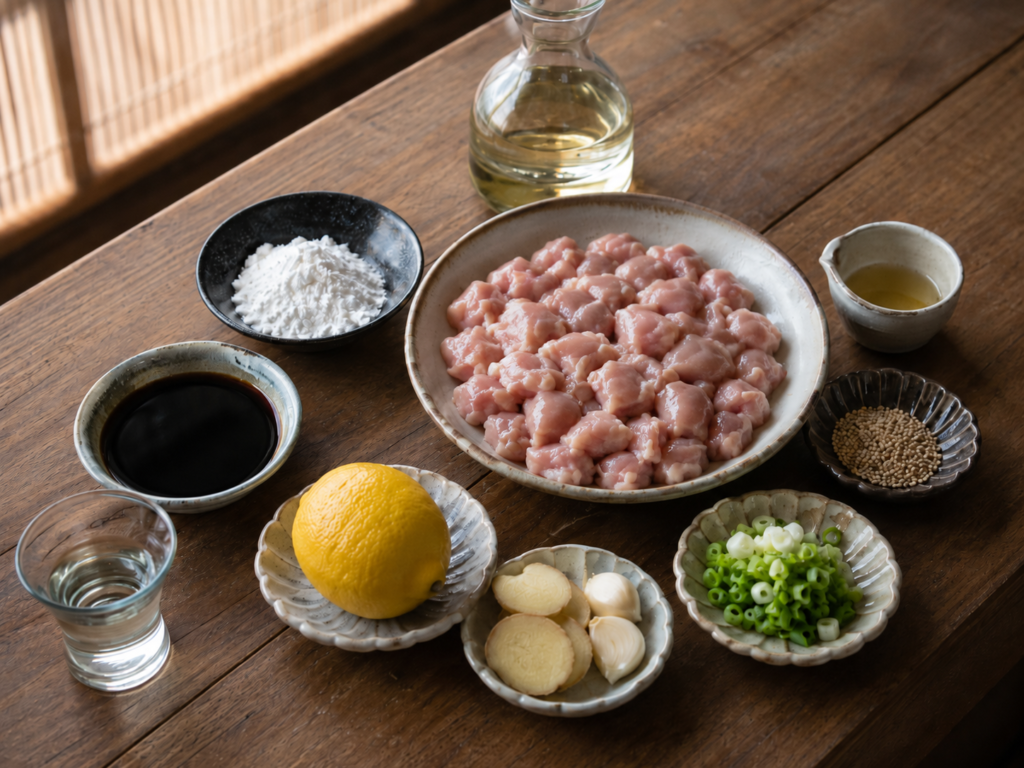
Ingredients for Japanese karaage including chicken thighs, potato starch, soy sauce, ginger, garlic, and lemon
For the Chicken Karaage
1 ½ pounds boneless, skinless chicken thighs, cut into 1 ½-inch bite-size pieces
Chicken thighs stay juicy during frying and are the most forgiving cut for karaage. Cut them evenly so they cook at the same pace.
3 tablespoons Japanese soy sauce
Soy sauce seasons the chicken and adds deep umami. Use regular Japanese soy sauce if possible. Low-sodium soy sauce can be used if preferred, though the flavor will be slightly lighter.
1 tablespoon sake
Sake adds aroma and helps round out the marinade. It is traditional in many karaage marinades.
1 teaspoon mirin, optional
Mirin adds gentle sweetness and gloss. Use only a small amount so the coating does not brown too quickly.
1 tablespoon freshly grated ginger
Ginger gives karaage its warm, clean fragrance and helps balance the richness of fried chicken.
2 cloves garlic, finely grated or minced
Garlic deepens the savory flavor. Grating helps it blend into the marinade.
½ teaspoon kosher salt, optional
Use this only if your soy sauce is mild or if you prefer a slightly more seasoned bite.
¼ teaspoon white pepper or black pepper
Pepper adds a quiet background heat without overpowering the soy-ginger flavor.
½ teaspoon toasted sesame oil, optional
Sesame oil gives the marinade a nutty aroma. A little goes a long way.
¾ cup potato starch, plus more as needed
Potato starch creates the signature light, crisp karaage coating. It should look dry and powdery on the chicken before frying.
Neutral high-heat oil, for frying
Canola, vegetable, rice bran, or peanut oil works well. Use enough oil to give the chicken room to move, usually 2-3 inches in a heavy pot.
For the Lemon Soy Dip
2 tablespoons Japanese soy sauce
The salty, umami-rich base of the dip.
1 tablespoon fresh lemon juice
Fresh lemon brightens the sauce and cuts through the richness of the fried chicken.
1 teaspoon rice vinegar
Rice vinegar adds gentle acidity without overwhelming the lemon.
1 teaspoon mirin or honey
A small amount softens the sharpness of the soy and citrus.
½ teaspoon grated ginger
Adds freshness and ties the dip back to the chicken marinade.
1 teaspoon finely sliced scallions, optional
Scallions add color, aroma, and a fresh finish.
Pinch of toasted sesame seeds, optional
Adds a nutty garnish and a little texture.
For Serving
Lemon wedges
A classic bright finish for karaage.
Finely shredded cabbage
Cabbage adds freshness and crunch beside fried chicken.
Steamed Japanese short-grain rice
Rice turns the karaage into a satisfying meal.
Japanese mayonnaise, optional
A creamy side condiment often enjoyed with fried foods.
Ingredient Notes and Smart Substitutions
Chicken thighs: Thighs are the most traditional and reliable choice for juicy karaage. Chicken breast can work, but it cooks faster and can dry out. If using breast, cut it slightly larger and monitor the internal temperature carefully.
Soy sauce: Japanese soy sauce gives the most balanced flavor. Tamari can be used as a gluten-free alternative, but check the label because not all tamari is gluten-free.
Sake substitute: If you do not cook with alcohol, use unsalted chicken broth or water with a small splash of rice vinegar. The flavor will be different but still pleasant.
Mirin substitute: Use ½ teaspoon sugar or honey if you do not have mirin. Do not add too much sweetness because sugar can darken quickly in hot oil.
Potato starch substitute: Cornstarch can work in a pinch, but potato starch gives a more classic karaage-style crispness. All-purpose flour creates a softer, heavier coating.
Garlic and ginger: Fresh is best here. Powdered versions can be used in a pinch, but the flavor will be flatter and less aromatic.
Oil: Use a neutral oil suitable for frying. Avoid strong-flavored finishing oils because they can compete with the ginger, soy, and lemon.
Lemon soy dip: For a lighter dip, add 1 tablespoon of water. For more heat, add a small pinch of shichimi togarashi or chili flakes.
Equipment You’ll Need
- Cutting board
- Sharp knife
- Mixing bowls
- Microplane or grater
- Measuring spoons
- Shallow bowl or tray for potato starch
- Heavy-bottomed pot, Dutch oven, or deep pan
- Deep-fry thermometer or instant-read thermometer
- Spider strainer, slotted spoon, or metal tongs
- Wire rack set over a baking sheet
- Paper towels for small spills, not for draining the finished chicken
- Small bowl for the dipping sauce
Step-by-Step Directions
1. Cut the chicken evenly.
Trim any large pieces of excess fat from the chicken thighs, then cut the meat into 1 ½-inch pieces. Try to keep the pieces similar in size so they cook evenly. Pat them lightly with paper towels if they seem very wet.
2. Make the marinade.
In a medium bowl, combine soy sauce, sake, optional mirin, grated ginger, garlic, pepper, optional sesame oil, and optional salt. Stir until the aromatics are evenly distributed. The marinade should smell savory, warm, and slightly bright from the ginger.
3. Marinate the chicken.
Add the chicken pieces to the marinade and toss until every piece is coated. Cover and refrigerate for 30 minutes. For a deeper flavor, marinate up to 2 hours. Avoid marinating much longer because the coating can become too wet and salty, making it harder to fry cleanly.
4. Prepare the lemon soy dip.
In a small bowl, stir together soy sauce, lemon juice, rice vinegar, mirin or honey, grated ginger, scallions, and sesame seeds. Taste and adjust with a little more lemon if you want it brighter. Set aside while you fry.
5. Set up your frying station.
Place a wire rack over a baking sheet near the stove. Add 2-3 inches of oil to a heavy pot, leaving several inches of space at the top for bubbling. Heat the oil to 340°F. Keep the thermometer clipped to the pot or check it often.
6. Coat the chicken with potato starch.
Remove chicken from the marinade, letting excess liquid drip back into the bowl. Add chicken pieces to the potato starch and press gently so each piece is fully coated. Shake off excess starch. The chicken should look pale, dry, and lightly powdery, not wet or pasty.
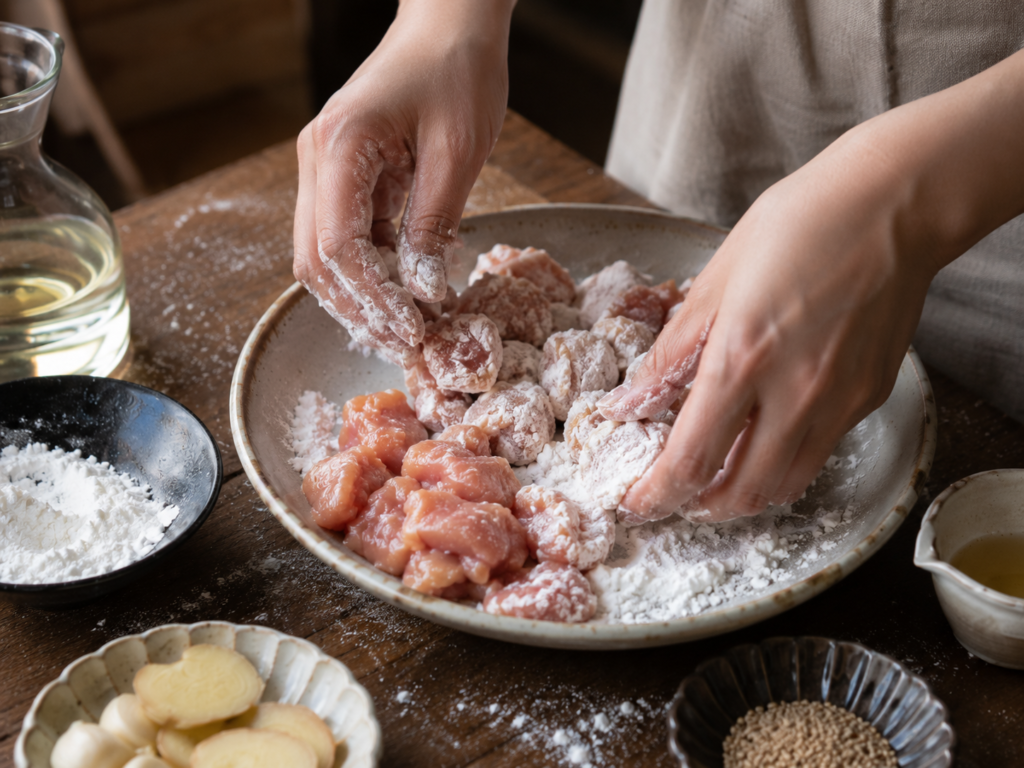
Chicken pieces being coated in potato starch for crispy Japanese karaage
7. Let the coating rest briefly.
Place the coated chicken on a tray for 5-10 minutes. This short rest lets the starch hydrate slightly, which helps create a better crust. If any wet spots appear, dust them lightly with more potato starch.
8. First fry: Cook the chicken through.
Carefully lower several chicken pieces into the 340°F oil. Do not overcrowd the pot. Fry for 3-4 minutes, turning occasionally, until the coating is lightly golden and the chicken is mostly cooked. Transfer to the wire rack. Repeat with the remaining chicken.
9. Rest between fries.
Let the chicken rest on the rack for 3-5 minutes while the oil temperature comes back up. This rest helps moisture move outward, setting the stage for a crisp second fry.
10. Second fry: crisp the coating.
Raise the oil temperature to 365°F to 375°F. Return the chicken to the oil in batches and fry for 1-2 minutes, until deeply golden and crisp. The coating should look craggy, dry, and crunchy.
11. Check doneness safely.
Use an instant-read thermometer to check the thickest piece. Chicken should reach 165°F internally. If a piece is browned but not fully cooked, return it to the oil briefly or finish it in a 350°F oven until it reaches a safe temperature.
12. Drain and serve.
Transfer finished karaage to the wire rack, not directly onto paper towels. A rack keeps air moving around the chicken so the bottom stays crisp. Serve hot with lemon soy dip, lemon wedges, shredded cabbage, rice, and optional Japanese mayonnaise.
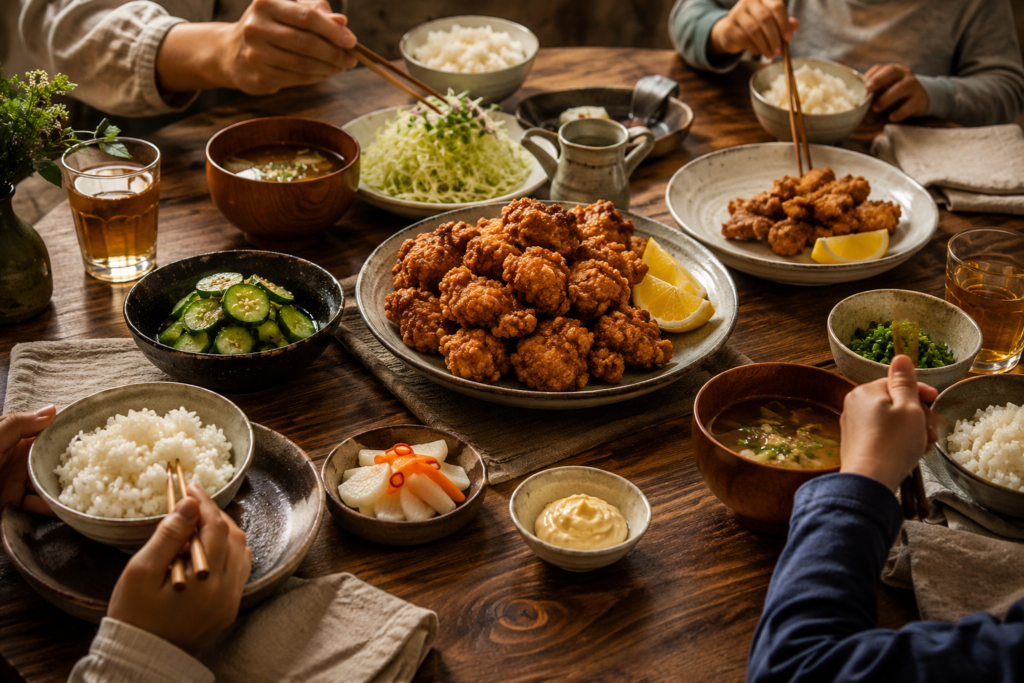
Japanese-inspired dinner table with karaage, rice, miso soup, and fresh side dishes
Pro Tips for Best Results
- Use chicken thighs for the juiciest texture.
- Cut the chicken into even pieces so everything cooks at the same pace.
- Do not skip the potato starch; it gives karaage its signature light crunch.
- Let the coated chicken rest for a few minutes before frying.
- Fry in small batches so the oil temperature does not drop too much.
- Use a thermometer for both oil temperature and chicken doneness.
- Drain on a wire rack instead of paper towels to preserve crispness.
- Keep the first fry lighter in color; the second fry is where the deep golden crunch develops.
- Serve the lemon soy dip on the side so the chicken stays crisp.
- Add lemon at the table right before eating for the freshest flavor.
Common Mistakes to Avoid
Skipping the thermometer: Color alone does not prove the chicken is safely cooked. Use an instant-read thermometer and cook poultry to 165°F.
Overcrowding the pot: Too much chicken lowers the oil temperature, which can lead to greasy, uneven coating. Fry in batches.
Leaving too much marinade on the chicken: Wet chicken can make the starch clump and fall off. Let excess marinade drip away before coating.
Using only flour: Flour creates a heavier crust. Potato starch gives the lighter, crispier texture associated with karaage.
Frying too hot, too soon: If the oil is too hot during the first fry, the coating may brown before the chicken cooks through.
Skipping the second fry: The second fry is what gives karaage its crisp, textured finish.
Draining on paper towels only: Paper towels trap steam under the chicken. A wire rack keeps the crust crisp.
Saucing the chicken too early: Dip right before eating. Pouring sauce over the karaage can soften the coating.
Flavor Variations
Spicy Karaage: Add ½ teaspoon chili flakes or a pinch of shichimi togarashi to the marinade. Serve with a lemon-chili soy dip.
Yuzu-Style Karaage: Replace part of the lemon juice in the dip with yuzu juice if available. This gives the dish a fragrant Japanese citrus note.
Garlic Lover’s Karaage: Add one extra grated garlic clove to the marinade. Keep the fry temperature steady so the garlic does not scorch.
Ginger-Forward Karaage: Increase ginger to 1 ½ tablespoons for a brighter, warmer flavor.
Sesame Karaage: Add toasted sesame seeds to the finished chicken after frying, not before, so they do not burn in the oil.
Tatsuta-Age Inspired Version: Use potato starch only and keep the marinade simple with soy sauce, sake, and ginger. The distinction between karaage and tatsuta-age can vary by household and region, but this version leans into the potato-starch style.
Air Fryer-Inspired Option: Traditional karaage is fried in oil, but you can use an air fryer for a lighter-textured adaptation. Spray-coated chicken lightly with oil and air-fry at 390°F, turning halfway, until crisp and 165°F inside. The result will not be identical, but it can still be enjoyable.
Serving Suggestions
Serve Japanese karaage with steamed rice, shredded cabbage, lemon wedges, and lemon soy dip for a simple comfort meal. The cabbage brings freshness and crunch, while the rice catches little drips of sauce and balances the salty-savory chicken.
For an izakaya-inspired table, plate karaage with cucumber salad, edamame, miso soup, pickled vegetables, and chilled barley tea. For a family-style dinner, serve it with rice bowls, sautéed greens, and a small dish of Japanese mayonnaise.
For a bento-style lunch, let the chicken cool slightly before packing, and keep the dip in a separate container. Add rice, cucumber slices, tamagoyaki, fruit, or steamed vegetables for a colorful, packed meal.
For a party platter, pile the karaage on a warm ceramic plate with lemon wedges around the edges, a small bowl of dip in the center, and scallions scattered over the top. Serve with toothpicks or small tongs so guests can easily grab a piece.
Drink pairings can stay simple: sparkling water with lemon, iced green tea, barley tea, ginger ale, or a light lager for adults who enjoy beer with fried foods.
Storage, Freezing, and Reheating
Refrigeration: Let leftover karaage cool briefly, then refrigerate within 2 hours of cooking. Store in an airtight container for 3-4 days. Keep the lemon soy dip separate so the coating does not soften.
Freezing: For best quality, freeze cooked karaage in a single layer on a baking sheet, then transfer to a freezer-safe bag or container. Freeze for up to 2-3 months for the best texture. It may remain safe longer if continuously frozen, but the coating will lose quality over time.
Reheating in the oven: Place karaage on a wire rack set over a baking sheet. Reheat at 375°F until hot and crisp, usually 10-15 minutes depending on size. Check that leftovers reach 165°F.
Reheating in the air fryer: Reheat at 350°F to 375°F for 5-8 minutes, shaking or turning halfway, until hot and crisp. Check the center of larger pieces.
Avoid microwaving if possible: The microwave will heat the chicken, but soften the coating. If using a microwave, reheat only until hot, then crisp briefly in an oven or air fryer.
Food safety note: Do not leave cooked chicken at room temperature for more than 2 hours, or more than 1 hour if the surrounding temperature is above 90°F. Reheat leftovers to 165°F before serving.
Make-Ahead Tips
You can cut the chicken and mix the marinade up to 1 day ahead, but do not marinate the chicken that long unless you prefer a stronger, saltier flavor. For the best texture, marinate 30 minutes to 2 hours.
The lemon soy dip can be made 1 day ahead and refrigerated in a covered container. Stir before serving and add scallions right before plating for the freshest look.
You can coat the chicken up to 20 minutes before frying. Let it rest uncovered on a tray while the oil heats. If the coating absorbs too much moisture, dust lightly with more potato starch.
For entertaining, complete the first fry shortly before guests arrive, then do the second fry just before serving. This gives you hot, crisp karaage without doing every step at the last second.
Frequently Asked Questions
What is Japanese karaage?
Japanese karaage is a frying method often used for bite-sized chicken pieces that are marinated, coated in flour or starch, and deep-fried until crisp. Chicken karaage is the most widely recognized version.
Is karaage the same as regular fried chicken?
Karaage is different from many Western fried chicken styles because the chicken is usually cut into small pieces, seasoned in a soy-based marinade, coated lightly in starch, and often double-fried. The coating is thinner and lighter than a heavy flour crust.
Why use potato starch for karaage?
Potato starch helps create a crisp, light, slightly craggy coating. It also keeps the crust from becoming too dense.
Can I use chicken breast instead of thighs?
Yes, but thighs are juicier and more forgiving. If using breast, avoid overcooking and check for 165°F with a thermometer.
How long should I marinate karaage?
Thirty minutes is enough for a good flavor. You can marinate for up to 2 hours for a deeper taste. Longer marinating may make the chicken too salty or wet for the starch coating.
Can I make karaage gluten-free?
You can make a gluten-free version by using gluten-free tamari instead of soy sauce and confirming that your potato starch, mirin, and other ingredients are labeled gluten-free.
Why is my karaage not crispy?
Common causes include overcrowding the oil, skipping the second fry, coating chicken while it’s too wet, or draining on paper towels instead of a wire rack.
What do you serve with karaage?
Serve karaage with steamed rice, shredded cabbage, lemon wedges, Japanese mayonnaise, cucumber salad, miso soup, pickled vegetables, or a light soy-citrus dip.
Final Thoughts
Japanese karaage is one of those recipes that reminds us how much comfort can live in small, careful details. A bowl of chicken resting in soy, ginger, and garlic. A quiet dusting of potato starch. The patient waits while the oil climbs to the right temperature. The first fry cooks the chicken gently, then the second fry brings the crunch to life. None of the steps is complicated, but each one matters, and together they create something deeply satisfying.
What makes karaage beautiful is that it does not need to be dressed up to feel special. It can sit beside rice on a Tuesday night or become the first platter everyone reaches for at a weekend gathering. It can be packed into a bento, served with cabbage and lemon, or placed at the center of an izakaya-inspired table with little bowls of pickles, soup, and dipping sauce. The dish feels casual, but the flavor carries care.
The lemon soy dip brings a bright Fly By Eats touch while still respecting the spirit of the recipe. It does not cover the chicken or compete with the marinade. Instead, it adds a clean citrus note that wakes everything up. That little squeeze of lemon, that tiny dip into soy and ginger, makes the next bite feel just as exciting as the first.
Cooking across cultures should feel curious, respectful, and grounded. This recipe does not claim to represent every version of karaage in Japan, because karaage is wonderfully varied from home to home and shop to shop. Instead, it offers an approachable, traditional-leaning version built around the flavors many people associate with chicken karaage: soy sauce, ginger, garlic, sake, potato starch, and crisp golden edges.
Make it once to learn the rhythm. Make it again to adjust the marinade, the dip, or the sides to your own table. That is the joy of a recipe like this: it invites you in, teaches you something, and rewards you with a plate of warm, crunchy chicken worth sharing.
Quick Recipe Card
Recipe Name: Japanese Karaage with Lemon Soy Dip
Description: Crispy Japanese karaage made with juicy soy-ginger marinated chicken thighs, a light potato starch coating, and a bright lemon soy dipping sauce.
Prep Time: 20 minutes
Marinating Time: 30 minutes
Cook Time: 10-12 minutes
Total Time: About 1 hour
Servings: 4
Ingredients:
For the Chicken:
- 1 ½ pounds boneless, skinless chicken thighs, cut into 1 ½-inch pieces
- 3 tablespoons Japanese soy sauce
- 1 tablespoon sake
- 1 teaspoon mirin, optional
- 1 tablespoon freshly grated ginger
- 2 cloves garlic, finely grated or minced
- ½ teaspoon kosher salt, optional
- ¼ teaspoon white pepper or black pepper
- ½ teaspoon toasted sesame oil, optional
- ¾ cup potato starch, plus more as needed
- Neutral high-heat oil, for frying
For the Lemon Soy Dip:
- 2 tablespoons Japanese soy sauce
- 1 tablespoon fresh lemon juice
- 1 teaspoon rice vinegar
- 1 teaspoon mirin or honey
- ½ teaspoon grated ginger
- 1 teaspoon finely sliced scallions, optional
- Pinch of toasted sesame seeds, optional
For Serving:
- Lemon wedges
- Shredded cabbage
- Steamed rice
- Japanese mayonnaise, optional
Instructions:
- Cut chicken thighs into even 1 ½-inch bite-size pieces.
- In a bowl, mix soy sauce, sake, mirin, ginger, garlic, pepper, sesame oil, and optional salt.
- Add chicken and toss well. Cover and refrigerate for 30 minutes, or up to 2 hours.
- In a small bowl, mix all lemon soy dip ingredients. Set aside.
- Heat 2-3 inches of oil in a heavy pot to 340°F.
- Remove chicken from marinade, letting excess drip off.
- Coat chicken pieces in potato starch, shaking off excess.
- Rest the coated chicken for 5-10 minutes.
- Fry chicken in batches at 340°F for 3-4 minutes, until lightly golden.
- Transfer to a wire rack and rest for 3-5 minutes.
- Increase oil temperature to 365°F to 375°F.
- Fry chicken again for 1-2 minutes, until crisp and deep golden.
- Check that the thickest pieces reach 165°F internally.
- Serve hot with lemon soy dip, lemon wedges, shredded cabbage, and rice.
Notes:
- Chicken thighs give the juiciest result.
- Potato starch creates the lightest, crispest coating.
- Do not overcrowd the pot.
- Drain on a wire rack to keep the coating crisp.
- Keep dipping sauce separate until serving.
Storage:
Refrigerate leftovers in an airtight container within 2 hours. Store for 3-4 days. Reheat to 165°F in an oven or air fryer for the best texture. Freeze for up to 2-3 months for the best quality.
Nutrition Disclaimer: Nutrition information, if provided, is an estimate and may vary based on ingredients and preparation methods.
References
- FoodSafety.gov. (2024, November 21). Cook to a safe minimum internal temperature. U.S. Department of Health & Human Services. https://www.foodsafety.gov/food-safety-charts/safe-minimum-internal-temperatures
- García, J. (2020, November 24). Leftovers: The gift that keeps on giving. U.S. Department of Agriculture. https://www.usda.gov/about-usda/news/blog/leftovers-gift-keeps-giving
- Just One Cookbook. (2025, April 25). Karaage (Japanese fried chicken) 唐揚げ. https://www.justonecookbook.com/karaage/
- Kikkoman Corporation. (2019, October 3). Karaage. Kikkoman Institute for International Food Culture. https://www.kikkoman.com/en/culture/foodforum/close-up-japan/33-3.html
- Kikkoman Corporation. (2024, December 19). Crispy karaage recipe (Japanese fried chicken). https://www.kikkoman.com/en/cookbook/washoku/karaage.html
- U.S. Department of Agriculture, Food Safety and Inspection Service. (2020, July 31). Leftovers and food safety. https://www.fsis.usda.gov/food-safety/safe-food-handling-and-preparation/food-safety-basics/leftovers-and-food-safety
- Usa City Tourism Association. (n.d.). Usa karaage. https://www.usa-kanko.jp/en/pages/222/
- Japanese Cooking 101. (n.d.). Karaage recipe. https://japanesecooking101.com/karaage-recipe/