
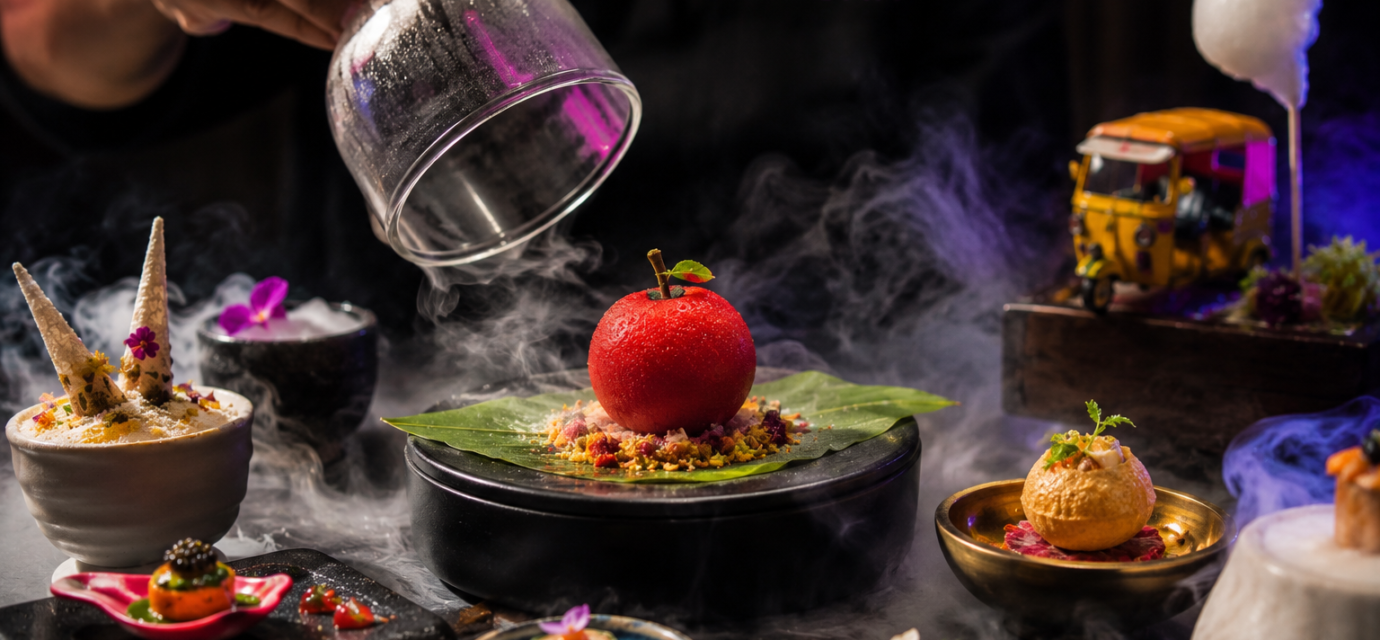
Gaggan Bangkok: The Food Theatre Where Progressive Indian Cuisine Refuses to Sit Still
Some restaurants want you to sit quietly.
Gaggan wants you to wake up.
In Bangkok, a city already famous for food that moves fast, tastes bold, and refuses to be boring, Gaggan feels right at home. It is not a soft-spoken tasting-menu restaurant. It is loud in spirit, theatrical in rhythm, playful in presentation, and built around the idea that fine dining can be more than a beautiful plate placed politely in front of you.
Gaggan’s official website describes the restaurant as “a food theatre with Progressive Indian Cuisine.” It also lists the restaurant at 68 Sukhumvit 31, Sukhumvit Road, Khlong Tan Nuea, Watthana, Bangkok.
That phrase, food theatre, says almost everything.
This is not dinner as background music.
This is dinner as performance.
Dinner as rebellion.
Dinner as memory, humor, sound, color, spice, touch, and surprise.
At its best, Gaggan asks a question that feels bigger than the restaurant itself:
What happens when Indian food is not treated as tradition locked in place, but as a living language that can shout, laugh, remix, and reinvent itself?
A closer look at Chef Gaggan Anand and the progressive Indian dining experience that helped make Gaggan one of Bangkok’s most talked-about restaurants.
Why Gaggan Feels Different
Gaggan does not seem interested in fitting neatly into the old fine-dining mold.
That is part of its power.
The restaurant’s own “About” page describes the experience as theatrical cooking, where guests are taken on a multi-sensory journey of touch, sound, lights, smell, taste, and surprise, combined like an artistic production.
That matters because food is not only tasted.
Food can be heard.
Food can be touched.
Food can make people laugh.
Food can make people uncomfortable in a good way.
Food can challenge the idea that a serious restaurant must also be stiff.
Gaggan is not built around silence and restraint. It is built around energy. The experience is meant to pull diners into the room, not leave them passively watching from the outside.
The MICHELIN Guide describes Gaggan as a one-star restaurant in Bangkok with a 14-seat L-shaped counter, where up to 25 inventive courses unfold across five theatrical acts with shifting lights, a pulsing soundtrack, and interactive energy.
That is not a typical restaurant description.
That is closer to a show.
But the key is this: the show still has to taste like something.
Theatre alone is not enough. At Gaggan, the drama works because it is rooted in a strong culinary point of view.
Progressive Indian Cuisine With a Bangkok Pulse
Gaggan is often described as progressive Indian cuisine, but that phrase deserves a little space.
Progressive does not mean forgetting where the food comes from.
It means refusing to let it stand still.
The World’s 50 Best Restaurants describes Gaggan’s menu as anchored in progressive Indian cooking, with French, Thai, and Japanese influences. It also notes that music, color, and creativity are central to the experience.
That blend makes sense in Bangkok.
Bangkok is one of the world’s great food cities because it knows how to hold intensity and precision at the same time. Street food can be unforgettable. Fine dining can be unforgettable. A dish can be humble and brilliant. A restaurant can be polished and still full of noise, spice, heat, and movement.
Gaggan sits inside that energy beautifully.
It brings Indian flavor memory into a Bangkok setting, then stretches it through global technique, humor, and performance. Thai influence gives the restaurant a sense of place. French technique adds structure. Japanese influence can be felt in precision and pacing. Indian cuisine remains the emotional center.
The result is not a quiet homage.
It is a conversation.
Sometimes it may feel like an argument.
Sometimes it may feel like a rock concert.
But it is alive.
The Chef Behind the Disruption
Gaggan Anand is part of the story because the restaurant carries so much of his personality.
The World’s 50 Best Restaurants describes him as Kolkata-born and notes that he pursued music professionally before entering the culinary world. He began with the Taj Group, later worked at elBulli in Spain alongside Ferran Adrià, and developed a love for molecular gastronomy.
That background helps explain why Gaggan feels like food and performance at the same time.
Before the kitchen, there was music.
Before the plate, there was rhythm.
Before the tasting menu, there was a sense of timing, tension, release, and spectacle.
The restaurant’s official About page describes Gaggan Anand in his own rebel language: a chef, musician, dreamer, romantic fool, and “conductor of chaos in the kitchen.”
That personality comes through in the dining room.
Gaggan does not feel like a restaurant designed by committee. It feels like the work of someone who understands that food can be deeply emotional, deeply technical, and deeply mischievous all at once.
A Restaurant That Breaks the Rules on Purpose
Fine dining often comes with invisible rules.
Sit still.
Speak softly.
Use the correct fork.
Do not touch the food.
Do not laugh too loudly.
Do not make a mess.
Gaggan challenges that culture directly.
The World’s 50 Best Restaurants notes that the restaurant has used emojis to represent courses, pushed diners to eat with their hands, and even invited them to lick the plate, all as part of Anand’s desire to disrupt and reinvent traditional fine dining.
That is what makes Gaggan such a strong Fly By Eats feature.
It gives readers something to think about beyond the question of whether a restaurant is “good.”
It asks what fine dining is allowed to be.
Can it be funny?
Can it be messy?
Can it be loud?
Can it ask people to participate instead of simply observe?
Can it honor Indian food while still breaking expectations around how Indian cuisine is presented globally?
Gaggan’s answer seems to be yes.
But not quietly.
Why Bangkok Matters
Gaggan could not feel the same in just any city.
Bangkok gives the restaurant a kind of permission.
The city understands food as movement. It understands heat, late nights, speed, crowds, markets, carts, high-end counters, and flavors that do not apologize for themselves. Bangkok is not afraid of food with personality.
Gaggan belongs there because it mirrors that confidence.
The World’s 50 Best interview with Anand after Gaggan was named The Best Restaurant in Asia 2025 includes his reflection that Bangkok is more than fine dining. He described it as cross-cultural, a place where people come and go and leave with good memories.
That line captures why Bangkok matters to this restaurant story.
Gaggan is not only Indian food in Thailand.
It is Indian food speaking through Bangkok’s global rhythm.
It is a restaurant shaped by movement, migration, performance, and the city’s appetite for bold experiences.
Recognition Without Losing the Rebellion
Gaggan has received major global attention.
The World’s 50 Best Restaurants lists Gaggan at No. 6 in 2025 and identifies it as The Best Restaurant in Asia 2025. The World’s 50 Best also reported that Gaggan took the No. 1 spot on Asia’s 50 Best Restaurants 2025, making it a record fifth time that a restaurant from Gaggan Anand reached the top position in Asia.
The MICHELIN Guide lists Gaggan as a one-star restaurant in Bangkok, describing its high-quality cooking and theatrical counter experience.
But rankings should not be the whole story.
The more interesting story is how Gaggan became recognized without becoming safe.
Some restaurants receive awards and become more controlled, more polished, more cautious. Gaggan’s identity still feels rebellious. It still leans into humor, provocation, music, and performance. It still seems to believe that food can be excellent without behaving like it is afraid to have fun.
That is why it matters.
Gaggan does not only represent success.
It represents permission.
Permission to make Indian cuisine futuristic.
Permission to make fine dining loud.
Permission to turn dinner into a roller coaster without pretending everyone has to experience food the same way.
Who Should Add Gaggan to Their Travel List?
Gaggan is not for someone who wants a quiet, predictable dinner.
It is for curious diners.
It is for travelers who want a restaurant with personality.
It is for people who enjoy tasting menus, performance, risk, humor, and sensory surprise.
It is for food lovers who want to see how Indian cuisine can be stretched through technique, global influence, and bold storytelling.
It is also for readers who understand that not every meaningful meal has to be gentle. Some meals are meant to shake the room a little.
If Central feels like geography turned into dinner, and Disfrutar feels like joy turned into a tasting menu, Gaggan feels like a spark thrown across the table.
It wants a reaction.
It wants participation.
It wants the diner to wake up and enter the story.
Before You Go
Gaggan is a highly sought-after restaurant experience, so readers should always check the official website for current reservations, menus, pricing, hours, dietary policies, and availability before planning a visit.
It is also important to understand the spirit of the restaurant before booking.
This is not a background dinner.
This is not a quiet white-tablecloth evening.
This is food theatre.
It may be playful.
It may be intense.
It may ask you to eat with your hands.
It may ask you to let go of what you thought fine dining was supposed to be.
And maybe that is the point.
Because sometimes the most memorable restaurants are not the ones that politely meet your expectations.
Sometimes they are the ones that break them wide open.
Frequently Asked Questions About Gaggan Bangkok
What is Gaggan Bangkok?
Gaggan is a Bangkok restaurant known for progressive Indian cuisine and a theatrical, multi-sensory dining experience. The restaurant’s official website describes it as a food theatre with Progressive Indian Cuisine.
Where is Gaggan located?
Gaggan is located at 68 Sukhumvit 31, Sukhumvit Road, Khlong Tan Nuea, Watthana, Bangkok 10110, Thailand.
Who is Gaggan Anand?
Gaggan Anand is a Kolkata-born chef known for progressive Indian cuisine. The World’s 50 Best Restaurants notes that he pursued music before cooking, trained with the Taj Group, and worked at elBulli in Spain with Ferran Adrià.
What type of food does Gaggan serve?
Gaggan serves progressive Indian cuisine with French, Thai, and Japanese influences. The restaurant is known for music, color, creativity, interactive presentation, and a tasting-menu experience that challenges traditional fine dining.
Does Gaggan have a Michelin star?
Yes. The MICHELIN Guide lists Gaggan as a one-star restaurant in Bangkok.
Was Gaggan named the best restaurant in Asia?
Yes. The World’s 50 Best Restaurants lists Gaggan as The Best Restaurant in Asia 2025 and No. 6 on The World’s 50 Best Restaurants 2025 list.
Is Gaggan a traditional Indian restaurant?
Gaggan is rooted in Indian cuisine, but it is not traditional in a conventional sense. It is known for progressive Indian cooking, theatrical presentation, global influences, and a sensory tasting-menu format.
References and Further Reading
- Gaggan Official Website. Used for restaurant identity, “food theatre with Progressive Indian Cuisine,” address, opening information, and reservation context.
- Gaggan Official About Page. Used for the restaurant’s multi-sensory theatre description, including touch, sound, lights, smell, taste, and surprise.
- The World’s 50 Best Restaurants, “Gaggan.” Used for 2025 ranking, chef background, progressive Indian cuisine, French, Thai, and Japanese influences, emoji menu references, hand-eating, and plate-licking dining style.
- The World’s 50 Best Restaurants, “Gaggan is The Best Restaurant in Asia for a Record Fifth Time.” Used for Asia’s 50 Best 2025 recognition and Bangkok food-culture context.
- The MICHELIN Guide, “Gaggan.” Used for the one-star listing, address, 14-seat counter, theatrical acts, lights, soundtrack, and course structure.