Central Lima: The Restaurant That Turns Peru’s Coast, Andes & Amazon Into a Dining Story
Some restaurants feed you.
Central pulls you into a country.
In Lima’s Barranco district, Central is not built around the usual idea of choosing a dish from a menu and calling it dinner. It is built around Peru itself: the coast, the Andes, the Amazon, the changing elevations, the living ingredients, and the communities connected to them.
Central’s official restaurant philosophy says it interprets the complexity of Peru’s territory through immersive tastings that celebrate the country’s diversity and “altitudinal irregularity.” It also works closely with Mater, its research center, along with local communities, artists, and researchers to explore ingredients in their natural context and document their relationship to ecosystems.
That is what makes Central feel different.
It is not only asking, “What tastes good?”
It is asking something much bigger:
How much of a country can fit into one table?
A closer look at Central in Lima and the culinary vision that helped bring global attention to Peru’s contemporary dining scene.
Why Central Feels Different
Central is refined, but it does not feel empty.
The food may be artistic. The plating may be clean and modern. The courses may arrive with precision. But the deeper experience is grounded in place.
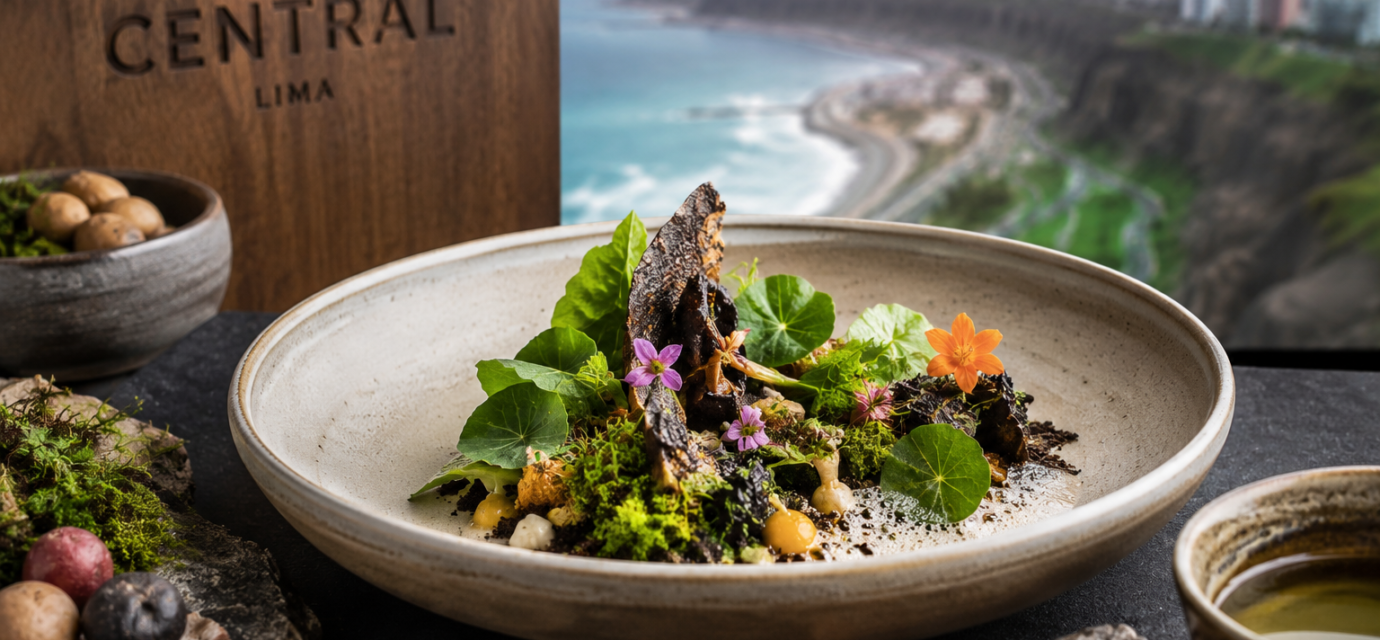
Central’s current official menu, Mundo en Desnivel, is described as a tasting menu of 12 moments and 32 preparations that travels through Peru’s coast, Andes, and Amazon. Each step explores a different ecosystem while connecting ingredients, seasons, and territories.
That wording matters because Central is not simply making creative food inspired by Peru.
It is building a map.
A course might point toward the sea.
Another might climb into the mountains.
Another might move into the forest.
The meal becomes vertical, not just seasonal. It teaches the diner to think about altitude, climate, biodiversity, and culture as part of flavor.
That is a rare kind of storytelling.
Mater: The Research Behind the Plate
A major reason Central feels so meaningful is its close relationship with Mater.
Mater describes itself as a network of interconnections that brings together interdisciplinary knowledge about the megadiversity of the Peruvian territory. Central’s official website describes Mater as a research center dedicated to exploring, documenting, and making visible Peru’s territorial megadiversity, led by Malena Martínez, Virgilio Martínez, and Pía León.
This gives Central’s food a different kind of weight.
A dish is not only there because it looks beautiful.
It is there because someone studied a landscape.
Someone listened to local knowledge.
Someone considered where an ingredient grows, who understands it, what season shapes it, and what story it carries.
For readers, that is where the restaurant becomes more than a reservation. It becomes a lesson in paying attention.
Central reminds us that ingredients are not just products.
They are relationships.
Peru as a Vertical Landscape
Most people think about countries horizontally.
North to south.
City to city.
Region to region.
Central asks diners to think vertically.
Peru makes that possible because the country holds an extraordinary ecological contrast: Pacific coastline, high Andes, valleys, forests, and Amazonian territories. Central’s tasting menu uses those contrasts as its structure, moving through different ecosystems rather than flattening Peruvian cuisine into one familiar flavor.
That is powerful because Peruvian cuisine is often introduced through famous dishes like ceviche, lomo saltado, or anticuchos. Those dishes matter. They are beloved for a reason. But Central opens a wider conversation.
What does the ocean taste like when the plate is not trying to be obvious?
What does altitude change in a plant, root, tuber, grain, herb, or fruit?
What happens when the Amazon is treated not as an exotic backdrop, but as a living source of knowledge?
Central does not reduce Peru to a postcard.
It lets Peru stay complex.
The Chefs and the Vision
Central is closely associated with chefs Virgilio Martínez and Pía León.
The World’s 50 Best Restaurants notes that Virgilio Martínez opened Central in Lima in 2008 with a vision for fine dining rooted in Peruvian ingredients and cooking techniques. Pía León joined in 2009, later becoming head chef and helping build what became the Central experience.
That partnership matters because Central does not feel like a restaurant built only around one person’s imagination. It feels like a collaborative ecosystem.
There is the kitchen.
There is Mater.
There are producers.
There are researchers.
There are communities.
There are landscapes.
There are ingredients that carry far more history than any menu description can fully hold.
This is one reason Central has become so important in global restaurant conversations. It shows that contemporary cuisine does not have to abandon cultural roots to feel modern.
It can become modern by going deeper.
Recognition Without Reducing the Story to Awards
Central received extraordinary global recognition when it was voted The World’s Best Restaurant in 2023 by The World’s 50 Best Restaurants.
That honor brought even more attention to Lima and to Peru’s broader culinary reputation. But for Fly By Eats readers, the more meaningful question is not only whether Central has awards.
The question is why the restaurant matters.
Awards can tell us a restaurant is respected.
Rankings can tell us a restaurant is influential.
But they cannot fully explain what it feels like to sit at a table and realize that a meal is trying to translate coast, mountain, forest, climate, and memory into something edible.
Central matters because it turns geography into emotion.
It turns research into hospitality.
It turns Peru’s biodiversity into a dining experience that asks the guest to slow down and notice the world behind the plate.
What Stands Out on the Plate
Central’s food is not meant to be understood only as a series of pretty courses.
The experience stands out because every detail points back to territory.
Readers should expect a restaurant story built around:
Courses inspired by Peru’s changing elevations.
Ingredients tied to specific ecosystems, seasons, and territories.
Modern presentation that feels clean, intentional, and deeply connected to place.
A tasting menu that turns geography into storytelling.
A dining experience shaped by research, biodiversity, and cultural memory.
That makes Central especially strong for readers who want food with meaning. It is not only about eating something delicious. It is about being asked to see Peru differently.
Why Lima Is the Right Home for Central
Lima is one of the world’s great food cities because it holds so many layers at once.
It is coastal, urban, historic, creative, and deeply connected to Peru’s regional diversity. Barranco, where Central is located, adds another layer: art, movement, color, and a neighborhood feeling that makes the restaurant’s intellectual ambition feel less sterile and more alive.
Central’s location in Barranco matters because the restaurant is not just speaking to global fine dining. It is speaking from Peru.
That difference is important.
This is not a restaurant borrowing Peru as a theme.
It is a restaurant working from inside Peru’s landscapes, questions, and food identity.
Who Should Add Central to Their Travel List?
Central belongs on the radar of travelers who want food to teach them something.
It is a strong fit for people who care about ingredients, biodiversity, culture, research, ecology, and the stories behind what lands on the table.
This is not the right restaurant for someone looking only for a casual meal or familiar comfort food. It is better suited for curious diners who enjoy tasting menus, thoughtful pacing, and food that comes with a deeper point of view.
If you are the kind of person who wants to understand a country through food, Central gives you a reason to slow down.
It asks you to pay attention.
And that may be the most valuable part of the experience.
Before You Go
Central is a highly acclaimed tasting-menu restaurant, so readers should always check the official website for current reservations, menu details, dietary notes, prices, and policies before planning a visit.
But even without a reservation, Central offers something worth carrying.
It reminds us that food can be a map.
It can be research.
It can be memory.
It can be a conversation between land and people.
It can turn a table into a country.
And once you start thinking about dinner that way, the question becomes bigger than whether the meal was beautiful.
The real question is:
What did it help you notice?
Frequently Asked Questions About Central Lima
What is Central in Lima?
Central is a contemporary Peruvian restaurant in Barranco, Lima, known for tasting menus that interpret Peru’s coast, Andes, Amazon, ecosystems, and altitudinal diversity. Central works closely with Mater, its research center, to explore ingredients in their natural context.
Where is Central located?
Central is located in Barranco, Lima, Peru. The World’s 50 Best Restaurants lists Central as a Lima restaurant and describes it as one of the major global references for contemporary Peruvian dining.
What is Central’s tasting menu about?
Central’s official menu, Mundo en Desnivel, is described as a tasting menu of 12 moments and 32 preparations that travels through the diverse and changing Peru: coast, Andes, and Amazon. Each step explores a different ecosystem and connects ingredients, seasons, and territories.
What is Mater?
Mater is a research center connected to Central that explores, documents, and makes visible the megadiversity of the Peruvian territory. It is led by Malena Martínez, Virgilio Martínez, and Pía León.
Who are the chefs behind Central?
Central is closely associated with Virgilio Martínez and Pía León. The World’s 50 Best Restaurants notes that Martínez opened Central in 2008 and that León joined in 2009, later becoming head chef and helping shape the Central experience.
Was Central named the best restaurant in the world?
Yes. Central was voted The World’s Best Restaurant in 2023 by The World’s 50 Best Restaurants.
What type of food does Central serve?
Central serves contemporary Peruvian cuisine through immersive tasting menus inspired by Peru’s biodiversity, ecosystems, altitudes, seasons, and territories.
References and Further Reading
- Central Official Website. Used for Central’s philosophy, connection with Mater, ecosystem approach, and focus on Peru’s altitudinal diversity.
- Central Official Menu. Used for Mundo en Desnivel, the 12 moments and 32 preparations, and the tasting menu’s focus on coast, Andes, Amazon, ecosystems, ingredients, seasons, and territories.
- Mater. Used for Mater’s role as a network that articulates interdisciplinary knowledge about Peru’s megadiversity.
- Central Official Website, Mater section. Used for Mater’s research-center role and leadership by Malena Martínez, Virgilio Martínez, and Pía León.
- The World’s 50 Best Restaurants, Central. Used for Central’s 2023 World’s Best Restaurant recognition and background on Virgilio Martínez and Pía León.