Moroccan Cuisine: The Table Where Spice, Patience & Welcome Come Together
Moroccan cuisine does not rush to impress you.
It draws you in slowly.
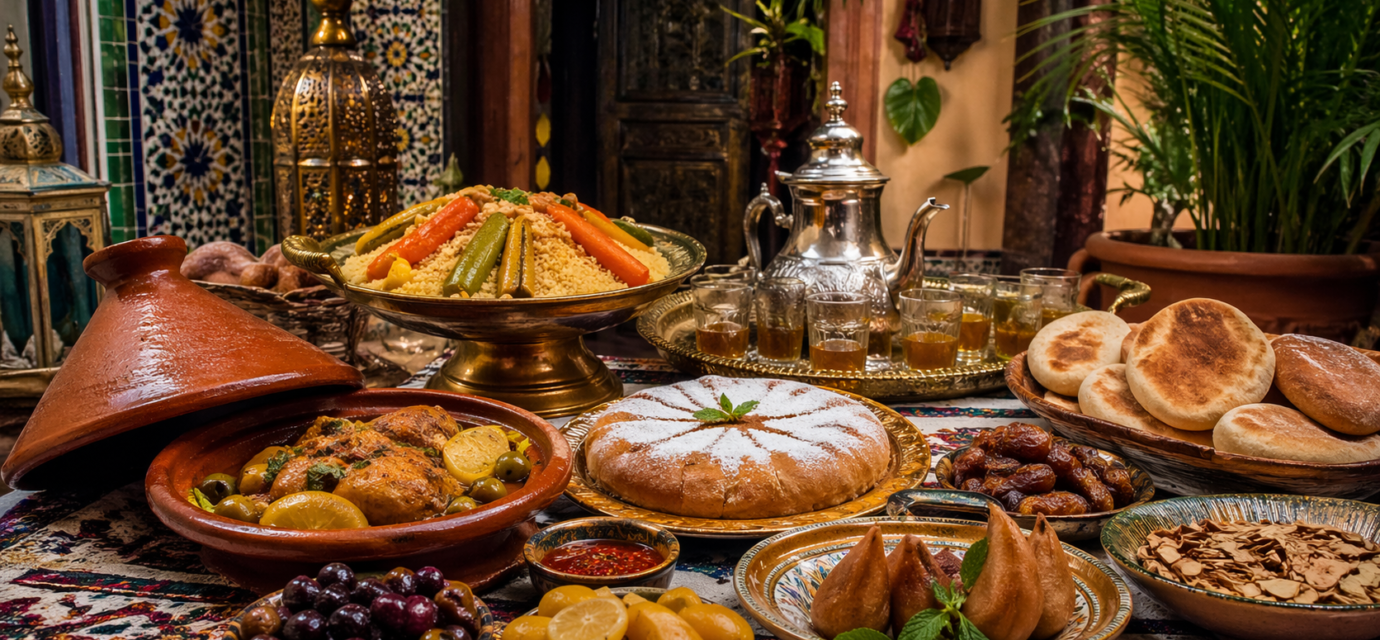
First, with fragrance. Then with color. Then with steam rising from a tagine, bread placed close enough to share, couscous fluffed with care, and mint tea poured like welcome has its own rhythm.
Moroccan food is one of those cuisines people sometimes think they understand after tasting one tagine or one plate of couscous. But the truth is much richer. Morocco’s table carries Amazigh, Arab-Andalusian, and Jewish culinary traditions, shaped by geography, trade, family rituals, markets, and everyday home cooking. Morocco’s official tourism office describes Moroccan cuisine as a culinary heritage rooted in cultural variety, with dishes such as couscous, tajine, pastilla, mrouzia, and r’fissa among its emblematic foods.
This is a cuisine of patience and layering.
Steam matters.
Spice matters.
Texture matters.
Presentation matters.
And hospitality matters so much that a glass of tea can feel like a statement of values.
Moroccan cuisine does not rush to impress you.
It draws you in slowly.
First, with fragrance. Then with color. Then with steam rising from a tagine, bread placed close enough to share, couscous fluffed with care, and mint tea poured like welcome has its own rhythm.
Moroccan food is one of those cuisines people sometimes think they understand after tasting one tagine or one plate of couscous. But the truth is much richer. Morocco’s table carries Amazigh, Arab-Andalusian, and Jewish culinary traditions, shaped by geography, trade, family rituals, markets, and everyday home cooking. Morocco’s official tourism office describes Moroccan cuisine as a culinary heritage rooted in cultural variety, with dishes such as couscous, tajine, pastilla, mrouzia, and r’fissa among its emblematic foods.
This is a cuisine of patience and layering.
Steam matters.
Spice matters.
Texture matters.
Presentation matters.
And hospitality matters so much that a glass of tea can feel like a statement of values.
Moroccan cuisine does not rush to impress you.
It draws you in slowly.
First, with fragrance. Then with color. Then with steam rising from a tagine, bread placed close enough to share, couscous fluffed with care, and mint tea poured like welcome has its own rhythm.
Moroccan food is one of those cuisines people sometimes think they understand after tasting one tagine or one plate of couscous. But the truth is much richer. Morocco’s table carries Amazigh, Arab-Andalusian, and Jewish culinary traditions, shaped by geography, trade, family rituals, markets, and everyday home cooking. Morocco’s official tourism office describes Moroccan cuisine as a culinary heritage rooted in cultural variety, with dishes such as couscous, tajine, pastilla, mrouzia, and r’fissa among its emblematic foods.
This is a cuisine of patience and layering.
Steam matters.
Spice matters.
Texture matters.
Presentation matters.
And hospitality matters so much that a glass of tea can feel like a statement of values.
A lively look at Moroccan food culture, traditional dishes, street food, and everyday eating moments.
What Gives Moroccan Cuisine Its Depth?
Moroccan cuisine is not powerful because it is loud.
It is powerful because it knows how to build harmony.
A good Moroccan meal often carries contrast beautifully. Sweet and savory can sit together naturally. Meat can meet dried fruit without feeling forced. Cinnamon can warm a dish without turning it into dessert. Preserved lemon can brighten slow-cooked chicken. Olives can bring salt and depth. Saffron, cumin, coriander, turmeric, paprika, ginger, and ras el hanout can create fragrance without overwhelming the food.
The Moroccan National Tourist Office describes Moroccan cuisine as drawing originality from a combination of Berber, Arab-Andalusian, and Jewish culinary traditions, with spices such as cinnamon, coriander, saffron, cumin, and ras el hanout forming part of the country’s sensory food culture.
That is why Moroccan food deserves more than the word “spicy.”
Spicy is too small.
Moroccan cuisine is aromatic, patient, layered, generous, textured, bright, earthy, sweet, savory, and deeply social.
Morocco’s Cuisine Is Built on Blending, Not Flattening
One of the most beautiful things about Moroccan food is the way it blends influences without losing its center.
This is not a cuisine confused by complexity. It thrives on it.
Morocco’s foodways have been shaped by Indigenous Amazigh traditions, Arab influence, Andalusian refinement, Jewish culinary contributions, trade routes, regional ingredients, and the daily imagination of cooks who know how to turn simple ingredients into something memorable.
That matters because Moroccan cuisine should never be reduced to a generic “North African spice” label.
The cuisine is more specific than that.
It has its own rhythm.
Its own hospitality.
Its own regional personality.
Its own table language.
Moroccan cooking is impressive not because it throws every spice into a pot. It is impressive because it understands proportion. It knows when to soften, when to brighten, when to sweeten, when to slow down, and when to let fragrance do the first talking.
Tagine: More Than a Dish, More Like a Way of Thinking
Ask people what they know about Moroccan food, and tagine is usually one of the first answers.
That makes sense.
Tagine is one of Morocco’s most recognizable culinary symbols. But it deserves better than a quick mention.
A tagine refers to both the conical cooking vessel and the dish prepared inside it. The shape matters because it helps trap steam and return moisture to the food as it cooks. The result is tenderness, aromatic depth, and slow flavor development.
But tagine is not only about cookware.
It is a way of thinking.
It asks the cook to slow down. It gives ingredients time to soften into one another. It allows meat, vegetables, spices, fruit, olives, herbs, and preserved lemon to become something more than separate parts.
A chicken tagine with preserved lemon and olives has a completely different mood from a lamb tagine with prunes and almonds. A vegetable tagine can feel earthy and comforting. A fish tagine near the coast may bring brightness, herbs, and sea air into the story.
The flexibility is part of the beauty.
Tagine can be rustic.
It can be elegant.
It can be everyday.
It can be celebratory.
But at its best, it always feels like food made with time.
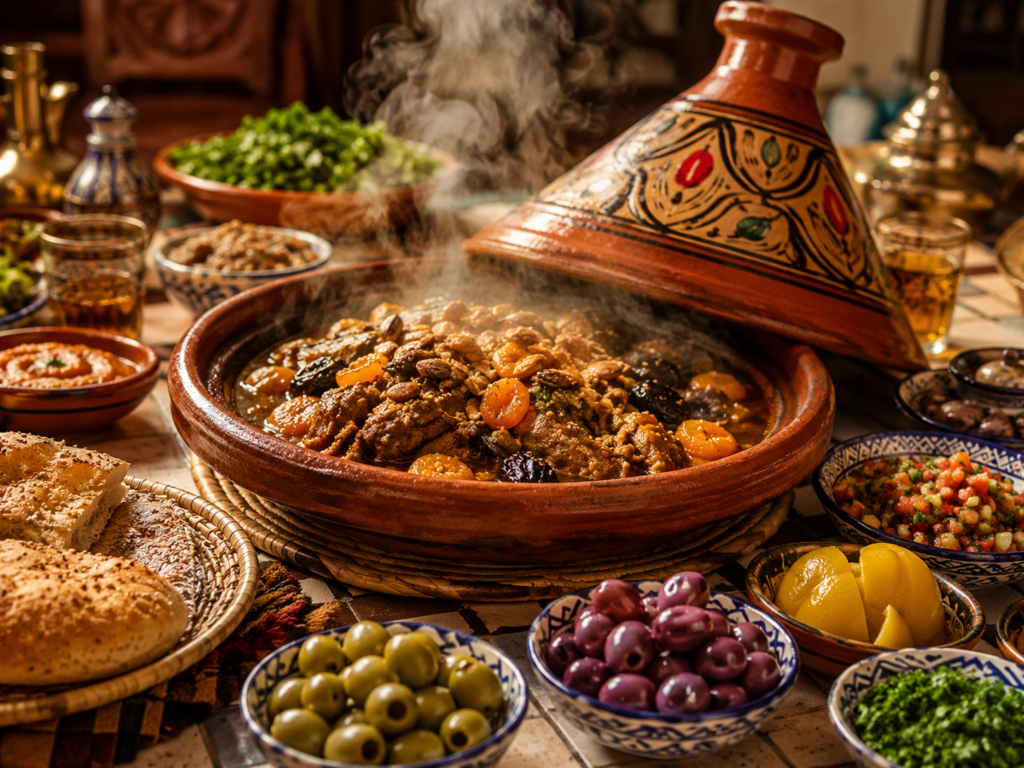
Tagine is one of Morocco’s most recognizable dishes, built around slow cooking, fragrance, tenderness, and shared eating.
Couscous: The Staple of Solidarity
Couscous deserves to be treated with care.
Across the Maghreb, couscous is more than a staple. It is a food of memory, family, skill, and community. UNESCO inscribed the knowledge, know-how, and practices related to the production and consumption of couscous on the Intangible Cultural Heritage list, recognizing the shared heritage of Algeria, Mauritania, Morocco, and Tunisia.
That recognition matters because couscous is not only a dish.
It is a practice.
It is technique.
It is rhythm.
It is memory passed through hands.
UNESCO describes couscous as a dish connected to weddings, parties, family reunions, ordinary meals, special gatherings, joy, sorrow, and traditions passed from generation to generation.
Properly prepared couscous should feel light, tender, and separate. Not heavy. Not clumped. Not lifeless.
It becomes a soft foundation for vegetables, broth, chickpeas, meat, herbs, and the slow-building flavor Moroccan cooking does so well.
If tagine feels like concentrated warmth, couscous feels like a wider table.
It feeds hunger, yes.
But it also feeds belonging.
Pastilla, Harira, R’fissa & the Genius of Contrast
To appreciate Moroccan cuisine fully, you have to look beyond the most famous dishes.
Pastilla is one of Morocco’s most intriguing foods. It often combines delicate pastry, savory filling, warm spice, and a sweet finish. That sweet-savory contrast is not random. It is part of the broader Moroccan talent for balance.
Harira brings another kind of comfort. This beloved soup is often associated with Ramadan, but its warmth reaches beyond one season. Morocco’s official tourism office describes Marrakech’s food scene as including harira, a bean soup with pasta and lentils, alongside dates and honey delights traditionally prepared for Ramadan.
R’fissa brings depth and home-centered richness, often built around chicken, lentils, spices, and layers of bread or pastry. It is the kind of dish that feels deeply cared for, the kind of food that tells you someone planned ahead.
Then there are breads, olives, salads, pastries, preserved lemons, almonds, sesame sweets, and small dishes that build the Moroccan table into something textured and generous.
A Moroccan meal may move from earthy to bright, from soft to crisp, from savory to sweet, from fragrant to cooling.
That movement is part of the pleasure.
Moroccan Markets: Where the Senses Wake Up
Moroccan cuisine also lives in the market.
The souk is not just a place to shop. It is part of the culinary imagination.
Spice stalls, olives, dried fruit, herbs, preserved goods, breads, pastries, fresh produce, and tea glasses all help shape the way food is seen, smelled, and remembered.
Morocco’s tourism office describes the souk as a “journey of senses,” where spice sellers create a striking picture of colors, from paprika red to cumin beige, turmeric yellow, and green aniseed.
That description matters because Moroccan food is visual before it is tasted.
The colors prepare you.
The aromas slow you down.
The market reminds you that cuisine is not only what happens in the kitchen. It begins with the choosing, the bargaining, the walking, the smelling, the touching, the waiting, and the gathering.
Mint Tea: The Emotional Language of Hospitality
Few beverages communicate welcome the way Moroccan tea does.
Moroccan mint tea is not simply a drink at the end of a meal. It is part of the social rhythm of hospitality. It gives people a reason to pause. It makes room for conversation. It turns a visit into something warmer.
The Moroccan National Tourist Office notes that afternoon tea is an icon of traditional Moroccan beverages and connects Moroccan culinary tradition with conviviality, sharing, and gathering around the table.
That is why writing about Moroccan tea only as a flavor misses the deeper meaning.
The pouring style matters.
The glass matters.
The sweetness matters.
The repetition matters.
Tea becomes a way of saying: stay, sit, breathe, you are welcome here.
In a world where so many food experiences feel rushed or transactional, Moroccan tea culture offers something different. It reminds us that hospitality is not always loud. Sometimes it is poured slowly from above the glass.
A closer look at Moroccan tea, home cooking, and the hospitality traditions that make Moroccan cuisine feel so welcoming.
Popular Moroccan Dishes to Know
Tagine
A slow-cooked Moroccan dish prepared in a conical vessel, often layered with spices, vegetables, olives, preserved lemon, meat, fish, or dried fruit.
Couscous
A staple grain dish with deep cultural meaning across the Maghreb, often served with vegetables, broth, chickpeas, and meat.
Pastilla
A flaky pastry known for its sweet-savory balance, often combining savory filling with warm spice and a sweet finishing touch.
Harira
A comforting soup made with pulses, tomatoes, herbs, and warming spices. It is especially associated with Ramadan but enjoyed more broadly.
R’fissa
A rich dish often built with shredded bread or pastry, chicken, lentils, and spiced broth.
Mrouzia
A sweet-savory Moroccan dish often associated with lamb, raisins, almonds, honey, and warm spices.
Mint Tea
A beloved Moroccan drink tied to welcome, conversation, and social connection.
How Geography and Daily Life Shape Moroccan Food
Moroccan cuisine is deeply regional.
Coastal areas bring seafood and ocean influence.
Interior cities carry long histories of trade, craft, refinement, and market culture.
Mountain and rural areas preserve food traditions tied closely to local rhythms, grains, breads, olive oil, herbs, seasonal produce, and community cooking.
Desert and oasis regions bring their own relationship to preservation, dates, grains, tea, hospitality, and endurance.
This matters because Moroccan cuisine does not live only in polished restaurants. It lives in home kitchens, market lanes, neighborhood bakeries, family gatherings, celebrations, courtyards, and tea poured for guests.
That is why even famous Moroccan dishes still feel grounded.
They come from lived patterns.
They come from repetition.
They come from memory.
How to Explore Moroccan Cuisine Respectfully
Moroccan cuisine deserves curiosity without exoticizing.
Avoid language that turns Moroccan culture into spectacle.
Be specific about traditions and influences. Saying “North African” alone does not tell the full story.
Do not reduce the cuisine to spice intensity. Moroccan cooking is about balance, aroma, texture, patience, and hospitality.
Include tea culture and shared meals, not only main dishes.
Treat couscous and tagine as culturally meaningful foods, not generic restaurant labels.
Recognize the role of Amazigh, Arab-Andalusian, Jewish, regional, family, and market traditions in shaping Morocco’s table.
Most importantly, remember that Moroccan food is not only something to photograph.
It is something to receive.
Before You Leave This Table
Morocco has a way of making one dish lead to another.
One aroma opens the next question.
One spoonful of couscous leads to a story about family.
One tagine lid lifts and suddenly the whole table changes.
One glass of tea makes you feel invited to stay longer than planned.
And once you understand that Moroccan cuisine is built on contrast, patience, memory, and welcome, you start to wonder what else might be waiting under the lid of the next tagine, in the next market lane, or in the next glass poured slowly from high above the rim.
Frequently Asked Questions About Moroccan Cuisine
What is Moroccan cuisine known for?
Moroccan cuisine is known for tagine, couscous, pastilla, harira, r’fissa, mint tea, preserved lemon, olives, dried fruit, warm spices, breads, pastries, and a strong culture of hospitality.
What makes Moroccan food unique?
Moroccan food is unique because it blends Amazigh, Arab-Andalusian, Jewish, regional, and trade-influenced traditions while maintaining a strong identity built around balance, fragrance, patience, and shared meals. Morocco’s official tourism office highlights Berber, Arab-Andalusian, and Jewish culinary traditions as part of the country’s food heritage.
What is a tagine?
A tagine is both a conical cooking vessel and the slow-cooked dish prepared inside it. Tagines often include meat, fish, vegetables, preserved lemons, olives, dried fruit, and aromatic spices.
Why is couscous important in Moroccan culture?
Couscous is important because it is connected to family, social gatherings, tradition, and shared heritage. UNESCO recognizes the knowledge, know-how, and practices related to couscous as intangible cultural heritage shared by Algeria, Mauritania, Morocco, and Tunisia.
Is Moroccan food very spicy?
Moroccan food is usually more aromatic than aggressively spicy. It often uses spices such as cumin, coriander, saffron, cinnamon, turmeric, ginger, paprika, and ras el hanout to create depth, warmth, and fragrance.
Why is Moroccan mint tea important?
Moroccan mint tea is important because it is tied to hospitality, welcome, conversation, and social connection. Morocco’s tourism office describes tea as an icon of traditional Moroccan beverages and connects Moroccan culinary tradition with sharing and conviviality.
References and Further Reading
Moroccan National Tourist Office, “The Welcoming Moroccan Gastronomy.” Used for Moroccan culinary heritage, emblematic dishes, spice culture, souk culture, tea, sharing, and hospitality.
UNESCO, “Knowledge, Know-How and Practices Pertaining to the Production and Consumption of Couscous.” Used for couscous cultural heritage recognition and its connection to family, community, memory, and shared Maghreb traditions.