Not All Restaurants Win the Same: What Din Tai Fung Teaches About Profitable Restaurant Concepts, Guest Experience, and the Power of Consistency
A Restaurant Is Never Just a Restaurant.
Some restaurants are built to impress. Some are built to move quickly. Some are designed to feel like a neighborhood ritual, while others become destination dining experiences people plan their entire day around.
But the restaurants that last usually have something deeper working behind the scenes.
They are not simply selling food. They are selling trust, rhythm, clarity, comfort, memory, and the feeling that every visit will be worth the time, money, and anticipation.
That is why Din Tai Fung has become such a fascinating case study. On the surface, it is a globally loved Taiwanese restaurant known for xiao long bao, the delicate soup dumplings served hot in bamboo steamers. But underneath the dumplings is something much bigger: a carefully built restaurant system rooted in consistency, guest experience, hospitality, operational discipline, and cultural identity.
Din Tai Fung’s official history says the brand began in Taipei in 1958 as a cooking oil shop founded by Bing-Yi Yang and Pen-Mei Lai. In 1972, the couple began making and selling xiao long bao, and those dumplings became so popular that the oil business eventually transformed into a full restaurant brand. Today, Din Tai Fung reports more than 165 locations across 13 countries, and its Hong Kong branch has been awarded a Michelin star five times.
That kind of growth does not happen by accident.
It happens when a restaurant knows exactly what it is, what it refuses to compromise, and how it wants people to feel from the moment they walk in.
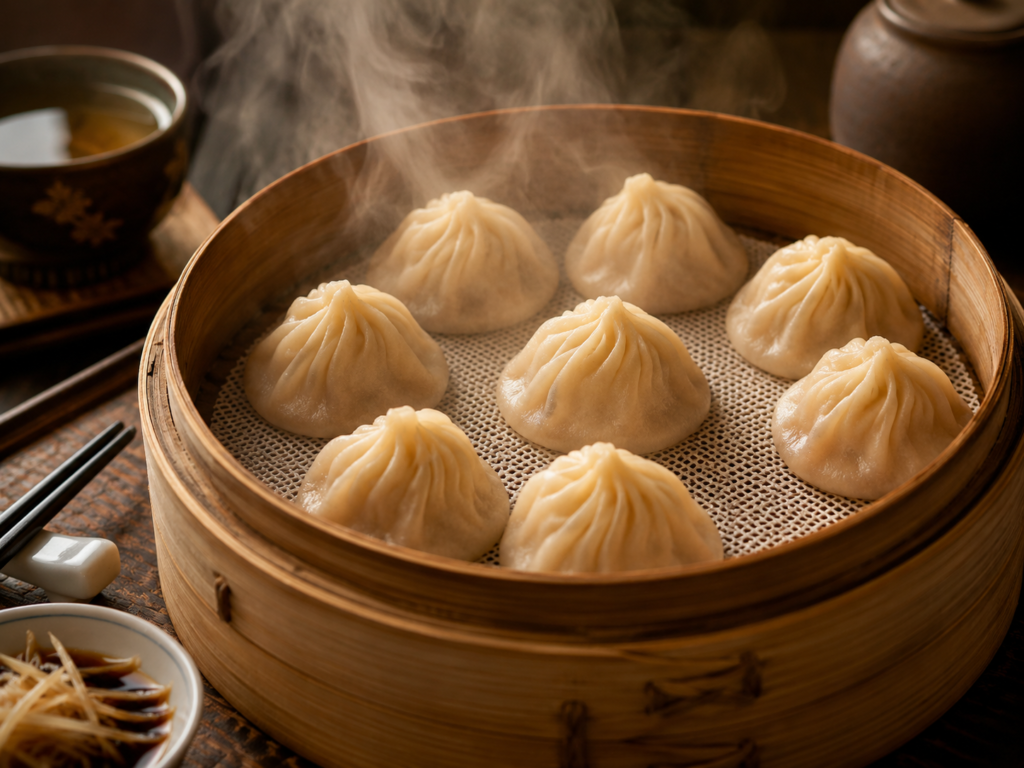
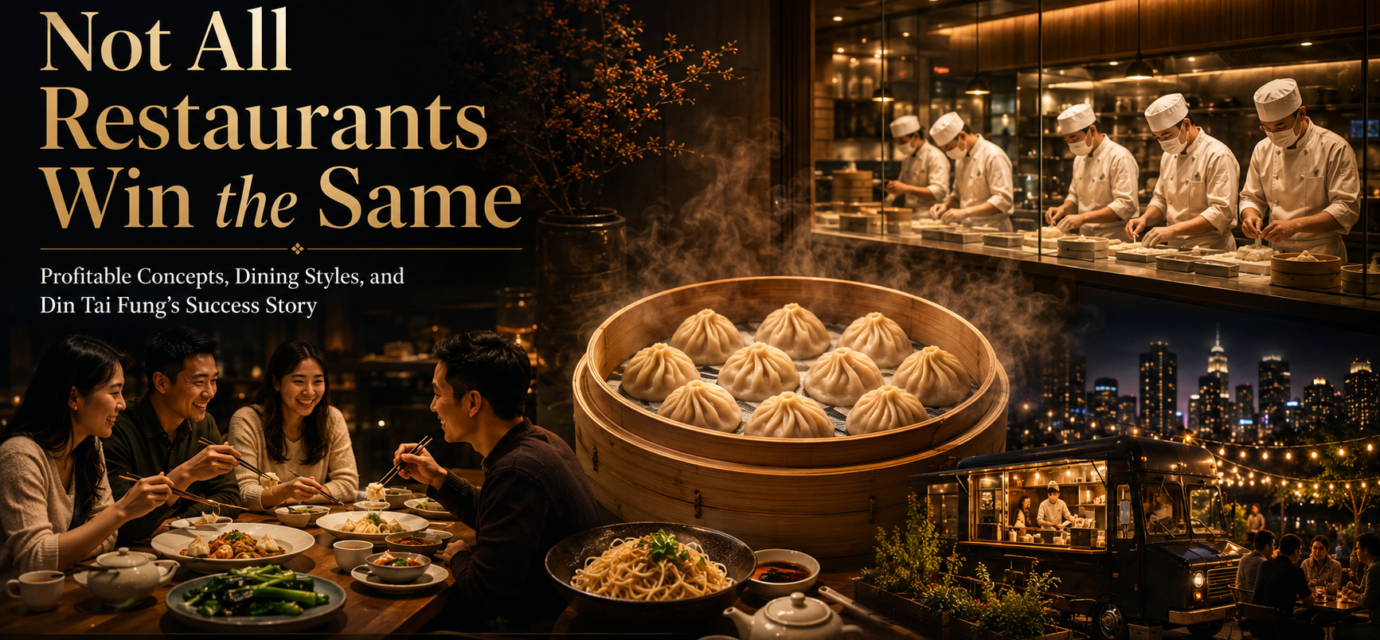
Steamed xiao long bao in a bamboo basket with warm restaurant lighting.
Why Restaurant Concepts Matter More Than People Think
When people talk about restaurants, they often focus on the food first. That makes sense. A memorable dish can pull someone across town. A signature flavor can become part of a city’s identity. A beautiful plate can stop someone mid-scroll.
But the concept behind the food shapes everything.
A fine dining restaurant, a food truck, a café, a fast casual bowl shop, a family-style diner, and a ghost kitchen may all serve excellent food, but they do not operate the same way. They have different labor needs, customer expectations, price points, dining times, menu structures, and profit challenges.
Toast’s restaurant industry guide explains that restaurants are commonly categorized by price point, atmosphere, and service style. DoorDash’s merchant guide also highlights a wide range of restaurant models, from cafés and diners to ghost kitchens and food trucks, each with different ways to attract customers and stay profitable.
That is why the question is not always, “What is the best restaurant concept?”
A better question is:
What kind of restaurant experience can this business deliver consistently, profitably, and memorably?
That one question changes everything.
The Restaurant Industry Is Growing, But It Is Not Getting Easier
The restaurant industry still has an enormous opportunity. The National Restaurant Association projects U.S. restaurant and foodservice sales will reach $1.55 trillion in 2026, with operators also expected to add about 100,000 jobs. The same report notes that operators are looking for technology that improves efficiency and strengthens guest connections.
That is encouraging, but it also tells a more serious story.
Restaurants are still facing pressure from food costs, labor needs, rent, insurance, customer spending habits, delivery demands, and competition from every direction. A beautiful menu is not enough. A viral dish is not enough. Even a strong opening month is not enough.
The restaurants that win are usually the ones that understand their model deeply.
They know how many people they need on the floor. They know which menu items carry the experience. They know when guests are most likely to come in. They understand how to make the meal feel special without making the operation impossible to manage.
That is where Din Tai Fung becomes such a powerful lesson.
Din Tai Fung Did Not Build Its Reputation on Noise
Din Tai Fung’s success is easy to admire because it does not feel random. It feels disciplined.
The brand’s story began humbly, but its growth has been shaped by something customers can feel: precision. The dumplings are not treated like an afterthought. They are the center of the experience. Guests see the craft. They see the team working behind glass. They see the folds, the steam, the care, and the repetition.
That visual rhythm becomes part of the meal.
Din Tai Fung is not just serving dumplings. It is letting guests witness the labor and artistry behind them.
Placer.ai describes Din Tai Fung as having the restaurant industry’s highest average unit volume at $27.4 million per location, nearly double the next closest competitor in the cited comparison. Placer.ai also notes that the brand benefits from large footprints, strong pricing power, and consistent traffic.
Bloomberg also reported that Din Tai Fung generates an annual average of $27.4 million per U.S. location, citing industry researcher Technomic, and described the brand as America’s top-earning restaurant chain.
Those numbers are impressive, but the deeper lesson is not “make dumplings and get rich.”
The lesson is that a focused concept, executed with discipline, can become more powerful than a scattered concept trying to please everyone.
Learn the story behind the Din Tai Fung legacy of soup dumplings
What Makes Din Tai Fung Feel Different?
Din Tai Fung works because the experience is layered.
It is casual enough to feel approachable, polished enough to feel special, and consistent enough to feel trustworthy. That combination is harder to build than it looks.
Here is what stands out:
1. The Signature Product Is Clear
Many restaurants struggle because they try to be too many things at once. Din Tai Fung does not have that problem. Even with a broader menu, xiao long bao remains the emotional anchor.
Guests know what they came for.
That kind of clarity matters. A signature item gives people a reason to remember the restaurant, recommend it, photograph it, and return for it.
2. The Craft Is Visible
Watching dumplings being folded behind glass turns production into storytelling.
It gives customers a sense that the meal is made with care, not simply assembled in the back. In a world where diners are increasingly drawn to experiences, transparency becomes part of the value.
3. The Menu Feels Familiar But Still Special
Din Tai Fung has a menu that welcomes different kinds of diners. Someone can come for soup dumplings, noodles, rice, greens, buns, wontons, or shareable plates. The experience feels exciting without being intimidating.
That balance is one reason the concept travels well.
4. Consistency Builds Trust
A customer who has visited one Din Tai Fung location expects the same level of care at another. That does not mean every meal is identical in feeling, but the brand promise is clear.
Consistency is not boring when it protects the guest experience.
5. The Restaurant Becomes a Destination
People wait. People plan. People bring family. People take photos. People talk about it afterward.
That is destination power, and it is one of the most valuable things a restaurant can build.
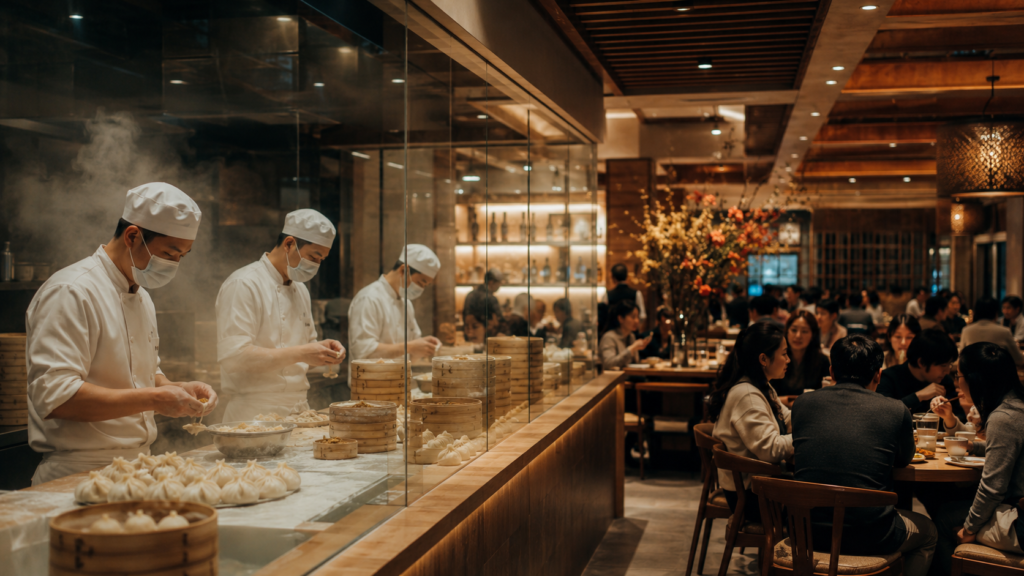
Modern dumpling restaurant with chefs folding xiao long bao behind glass.
What Restaurant Owners Can Learn From Din Tai Fung
Din Tai Fung is not a copy-and-paste blueprint for every restaurant. A small café, soul food kitchen, Caribbean takeout counter, taco truck, bakery, or farm-to-table restaurant does not need to imitate its menu or scale.
But every restaurant can learn from the strategy behind the success.
Know the Concept Before You Build the Menu
A restaurant concept should answer clear questions:
Who is this for?
What feeling should guests leave with?
What dish or experience will people remember?
Can the team repeat this experience on a busy Friday night?
Does the menu match the staffing, equipment, space, and price point?
A concept that looks exciting online but cannot operate smoothly in real life will eventually wear the team down.
Protect the Signature Experience
Every strong restaurant needs something people associate with it. That could be handmade dumplings, smoked brisket, a signature sauce, a seasonal pie, a family-style Sunday plate, a perfect breakfast sandwich, or a tableside ritual.
The signature experience should be easy to explain and hard to forget.
Make Operations Part of the Brand
Guests may not see every checklist, training guide, prep system, cleaning routine, vendor standard, or service meeting. But they feel the results.
They feel that when the food comes out right. They feel that when the service is calm. They feel when the dining room flows. They feel that the restaurant has thought through the small things.
Good systems create good feelings.
Do Not Confuse Popularity With Profitability
A packed dining room can still lose money if labor, waste, rent, food cost, and pricing are not managed carefully. Profitability is not only about demand. It is about structure.
Some of the most profitable restaurant concepts are not the flashiest. They often have focused menus, strong repeat demand, efficient prep, smart staffing, and clear customer expectations.
Hospitality Is Still the Advantage
Technology matters. Delivery matters. Online menus matter. Social media matters. But hospitality is still what people remember.
A guest may come for the dumplings, the coffee, the sandwich, the curry, the fried chicken, or the dessert. But they come back because the experience made them feel cared for.
3 Most Profitable Restaurant Types (From 20+ Years Experiences)
The Customer Experience Lesson: People Come Back to Places That Feel Intentional
The best restaurants make guests feel like nothing is accidental.
The lighting fits the food.
The menu fits the concept.
The staff understands the flow.
The signature dish has a reason to exist.
The wait, if there is one, feels worth it.
The brand knows what it wants to be.
That is what Din Tai Fung does well. It turns a simple idea, soup dumplings made with care, into a full dining experience.
For Fly By Eats readers, that is the beautiful part of studying restaurants like this. You begin to see dining differently. You notice the details behind the details. You start paying attention to how a restaurant welcomes you, moves you, feeds you, and sends you back into the world with a story.
A profitable restaurant is not always the loudest restaurant.
Sometimes it is the one who quietly gets the fundamentals right over and over again.
How Din Tai Fung’s Soup Dumplings Took Over The World
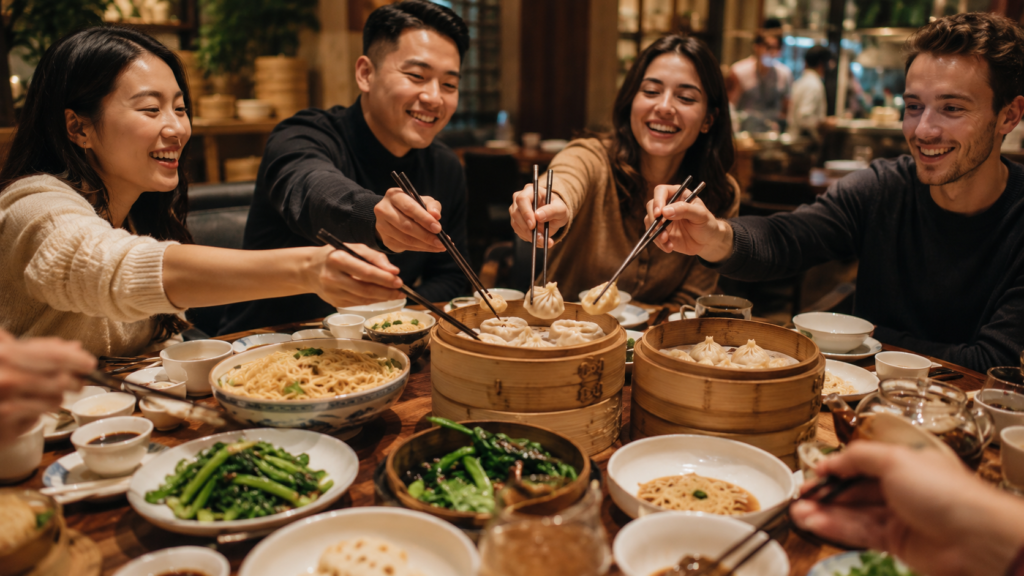
Diners sharing dumplings, noodles, tea, and vegetables at a warm restaurant table.
Final Takeaway: The Best Restaurant Concepts Know Their Lane
Din Tai Fung’s success is not only about xiao long bao. It is about discipline, identity, hospitality, and the courage to protect a standard.
That is the lesson for restaurant lovers, future owners, food creators, and anyone who enjoys understanding why certain places become unforgettable.
A strong restaurant concept does not need to chase every trend. It does not need to be everything to everyone. It needs to know its purpose, serve its guests well, and deliver the same feeling with enough care that people want to return.
The next great restaurant story may not come from the biggest menu or the loudest marketing campaign.
It may come from a place that understands one simple truth:
When food, systems, culture, and hospitality work together, a restaurant becomes more than a business.
It becomes a memory people are willing to wait for.
Question?
What makes a restaurant unforgettable to you: the food, the service, the atmosphere, the story behind it, or the feeling you have when you leave?
References
- Crane, B. (2025, October 7). How Din Tai Fung became America’s top-earning restaurant chain. Bloomberg. https://www.bloomberg.com/news/features/2025-10-07/din-tai-fung-and-its-viral-tiktok-dumplings-will-expand-more-in-2026
- Din Tai Fung. (n.d.). Discover. Retrieved May 27, 2026, from https://dtf.com/en-us/discover
- McCarthy, A. (2024, May 16). The most 18 popular restaurant types explained. DoorDash for Merchants. https://merchants.doordash.com/en-us/blog/types-of-restaurants
- National Restaurant Association. (2026, February 11). State of the restaurant industry 2026. https://restaurant.org/research-and-media/research/research-reports/state-of-the-industry/
- Placer.ai. (2025, August 5). Din Tai Fung: Sky high average-unit-volume is a recipe for success. https://www.placer.ai/anchor/articles/din-tai-fung-sky-high-average-unit-volume-is-a-recipe-for-success
- Restaurant Business Online. (2025, June 6). This soup dumpling chain has the industry’s highest AUVs, and it’s not even close. https://www.restaurantbusinessonline.com/financing/soup-dumpling-chain-has-industrys-highest-auvs-its-not-even-close
- Rocklin, M. (2025, April 21). The complete guide to types of restaurants: Different restaurant types. Toast. https://pos.toasttab.com/blog/on-the-line/types-of-restaurants