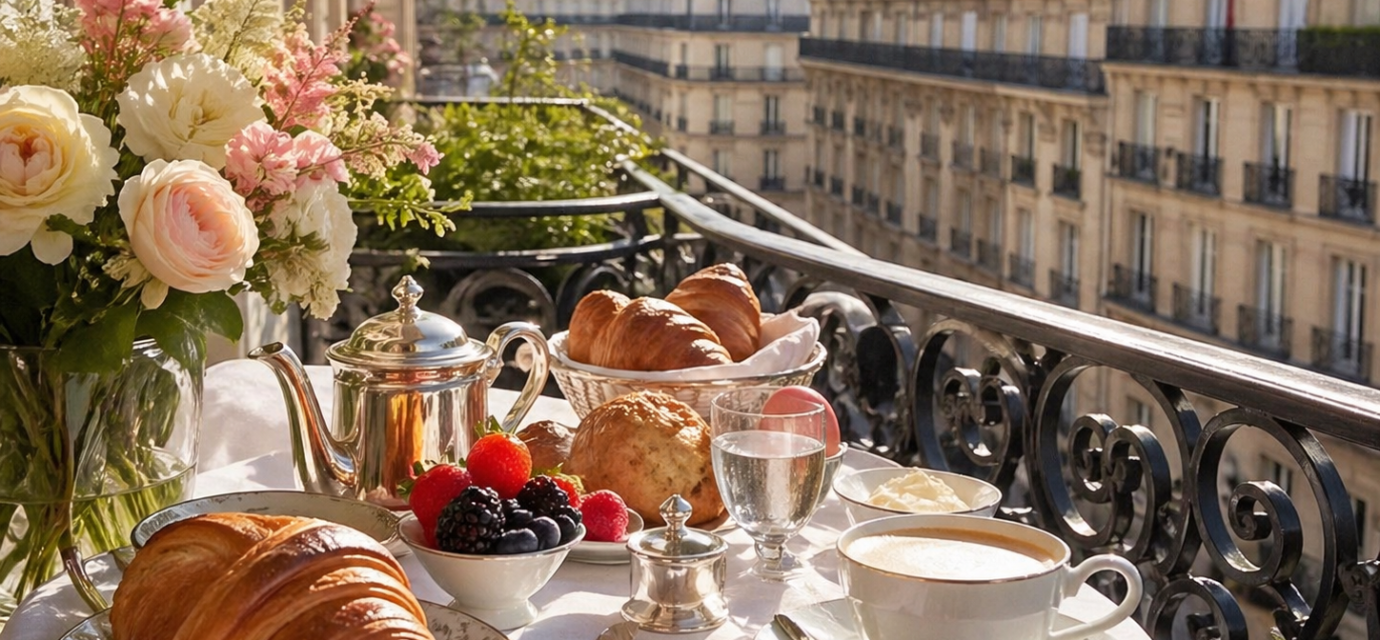
Romantic Parisian Breakfast on the Balcony: A Soft Morning Made for Croissants, Coffee, and Slow Living
There is something about a Parisian balcony breakfast that feels softer than ordinary morning food.
Maybe it is the way the light falls across the table before the city fully wakes up. Maybe it is the sound of a spoon touching a coffee cup, the buttery edge of a croissant breaking into delicate flakes, or the quiet feeling of sitting above the street while the world below begins to move.
A romantic Parisian breakfast does not need to be loud, expensive, or overdone. Its beauty lives in restraint. A warm croissant. A small bowl of berries. A glass of orange juice. A cup of coffee is held with both hands. Fresh flowers resting beside the plate, not because they are necessary, but because they remind us to feel intentional in the morning.
That is the heart of this scene. It is not just breakfast. It is a pause.
What Makes a French Breakfast Feel So Different?
The classic French petit déjeuner is often lighter, sweeter, and simpler than many American or English-style breakfasts. Instead of a large savory plate, it often centers on bread, pastries, butter, jam, coffee, tea, hot chocolate, or café au lait. Taste France describes French breakfast as rooted in simplicity, quality ingredients, baguette, tartines, croissants, pain au chocolat, and other pastries, with many French breakfasts leaning towards sweet rather than savory.
That simplicity is exactly what makes it feel elegant.
A croissant is not just a pastry sitting beside coffee. It represents craft. The modern croissant is closely tied to laminated dough, where butter is folded into dough again and again to create thin layers that rise into a crisp, airy, flaky texture. The Institute of Culinary Education notes that the documented path of the croissant points to Austrian entrepreneur August Zang’s Viennese bakery in Paris in 1839, where kipferl and Viennese pastries inspired French bakers to develop their own versions.
So when a croissant lands on a small balcony table in Paris, it carries more than butter. It carries migration, adaptation, craft, and time.
Watch how layers of butter and dough become the flaky croissant we associate with French mornings.
Croissant Masterclass with Scott Megee
The Balcony Is Part of the Meal
A Parisian balcony changes the mood of breakfast because it turns the meal into an experience. The food is still simple, but the setting gives it a story.
The balcony invites you to look outward. You notice rooftops, window boxes, soft curtains, narrow streets, pale stone buildings, and the gentle rhythm of people beginning their day. Paris is known for its neighborhoods, landmarks, art, culture, and layered sense of place, from Montmartre to the Latin Quarter, Notre-Dame, the Eiffel Tower, and the Louvre.
That is why this kind of breakfast feels so memorable. It is not only about eating. It is about belonging to a moment long enough to actually feel it.
A romantic breakfast like this also reminds us that food can be emotional without being complicated. We often think romance requires candles, grand gestures, or a perfect table. But sometimes romance is simply taking the time to sit together before the day becomes busy. Sometimes it is sharing the last bite of pastry. Sometimes it is silence that feels comfortable instead of empty.
What to Put on a Paris-Inspired Balcony Breakfast Table
To recreate this mood at home, focus on quality, texture, and presentation rather than quantity.
Start with one beautiful pastry, such as a croissant, pain au chocolat, brioche, or a small fruit tart. Add a slice of baguette or tartine with butter and jam. The baguette itself is culturally meaningful in France. UNESCO recognizes the artisanal know-how and culture of baguette bread, noting that baguettes are made with simple ingredients and are part of everyday French food practices, including family meals, restaurants, and visits to bakeries.
Then add something fresh. Strawberries, raspberries, blackberries, sliced orange, or grapes bring color and brightness to the table. A small dish of yogurt with honey can soften the meal without making it heavy.
For drinks, coffee is the natural star. A small espresso, café crème, café au lait, or even black tea can work beautifully. If you want a softer morning feeling, serve coffee in a ceramic cup instead of a travel mug. It changes the pace immediately.
Finish the table with one small detail that feels human: a folded napkin, a handwritten note, a small vase of flowers, or a book left open beside the plate. These details do not need to be expensive. They simply tell the reader, guest, or loved one: this morning was not rushed.
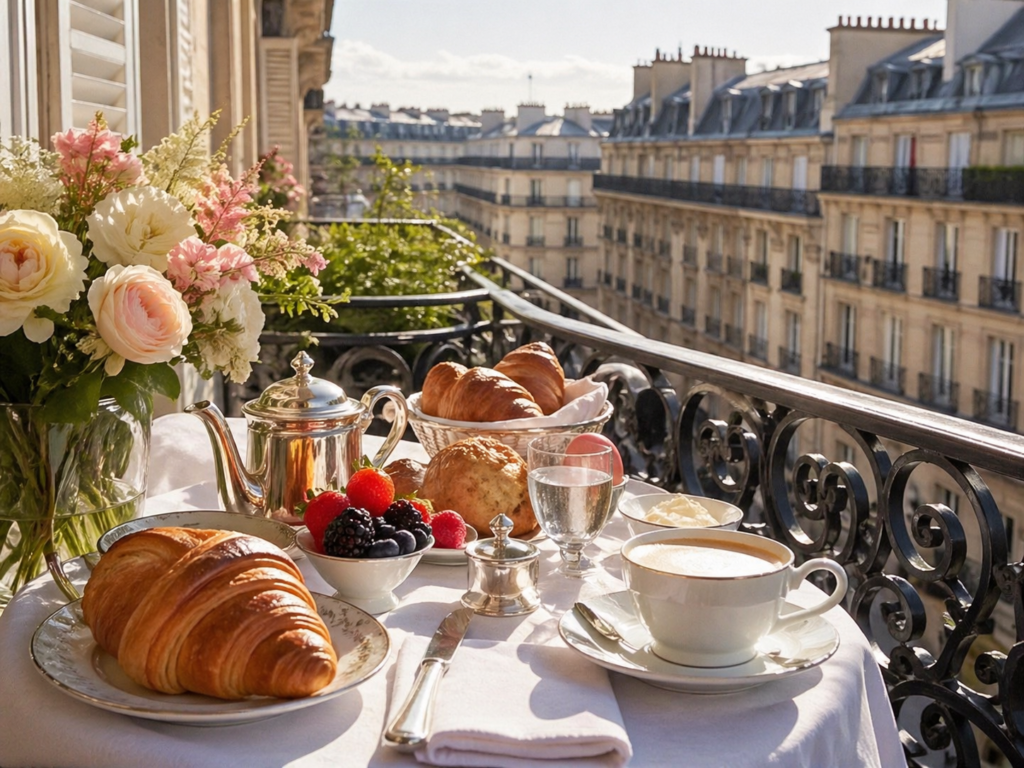
Romantic Parisian breakfast on a balcony with croissants, coffee, fruit, flowers, and soft morning light.
The Emotional Beauty of Eating Slowly
A Parisian breakfast on the balcony feels romantic because it gives permission to slow down.
In many cultures, breakfast has become something we rush through. We eat while checking emails, answering messages, packing bags, or mentally preparing for everything waiting on us. But a meal like this asks a different question: what if the morning did not have to begin with pressure?
The French gastronomic tradition is often connected to social practice, celebration, and meaningful moments shared around food. UNESCO describes the gastronomic meal of the French as a customary social practice tied to important moments in people’s lives.
A balcony breakfast takes that idea and makes it intimate. It turns a regular morning into a small celebration. Not a wedding. Not a holiday. Not a major event. Just the celebration of being present.
That is the value Fly By Eats can bring to readers: not just telling them what food looks like, but helping them understand why it feels the way it does.
How to Create the Feeling Anywhere
You do not need to be in Paris to create a Parisian breakfast moment. The goal is not to fake luxury. The goal is to make the morning feel cared for.
Choose a peaceful spot near a window, patio, porch, balcony, or small table. Use real dishes if you can. Warm the pastry slightly. Pour the coffee slowly. Add fruit for color. Turn off the television. Let the light be part of the setting.
If you are serving this for someone else, keep it personal. Add their favorite jam. Pick flowers in their favorite color. Play soft French café music in the background. If you are making it for yourself, let it still feel special. Self-care does not always need to be complicated. Sometimes it looks like giving yourself five extra minutes to enjoy what is in front of you.
Cozy French Boulangerie Morning 🍞| Relaxing Jazz Piano & Bakery Ambience in Paris
A Breakfast That Feels Like a Memory
The most beautiful part of a romantic Parisian breakfast is that it feels like something you remember before it is even over.
The flaky croissant. The warm coffee. The fruit shines in the morning light. The flowers are leaning gently toward the plate. The balcony opens toward the city. The feeling that, for once, breakfast was not just something to finish before the day began.
It was the beginning.
And maybe that is why Paris keeps appearing in our food imagination. Not because every moment is perfect, but because the best Paris-inspired meals remind us to notice life while it is still happening.
So pour the coffee. Break the croissant. Sit close to the light.
Let the morning feel like it matters.
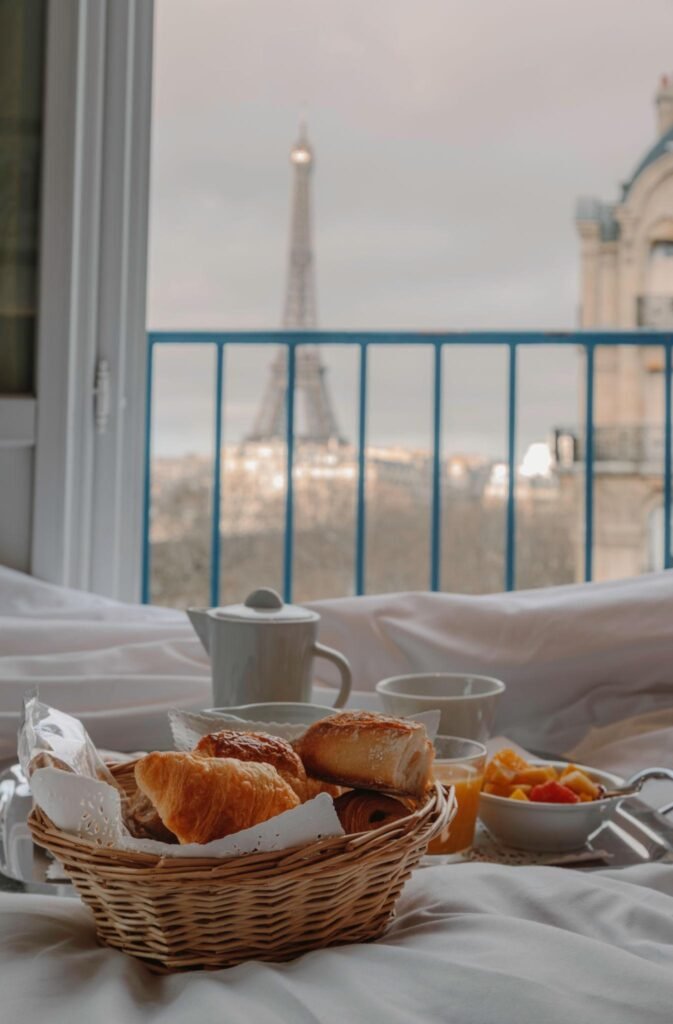
A simple breakfast becomes unforgettable when it is made with presence
Reader Takeaway
A romantic Parisian breakfast is more than a pretty table with croissants and coffee. It is a gentle reminder that food can create atmosphere, connection, and memory when we give it enough room to breathe. French breakfast culture often celebrates simplicity through bread, pastries, butter, jam, coffee, and other light morning comforts, proving that a meal does not have to be excessive to feel meaningful.
What makes this balcony moment special is the way it turns everyday ingredients into an experience. A flaky croissant, warm coffee, fresh fruit, and soft morning light become an invitation to slow down, look around, and feel present. Even the baguette, one of France’s most beloved daily foods, carries cultural importance through its artisanal tradition and simple ingredients.
At its heart, this breakfast is not only about Paris. It is about the beauty of intentional living. Whether enjoyed on a balcony, beside a kitchen window, or at a small table with someone you love, a Paris-inspired breakfast can turn an ordinary morning into something tender, thoughtful, and unforgettable. French food culture is deeply connected to shared moments and the pleasure of gathering around the table, which is exactly the feeling this breakfast invites readers to recreate in their own lives.
Explore More on Fly By Eats
For more cozy food stories, cultural flavor, recipe inspiration, and kitchen lifestyle ideas, explore Fly By Eats and discover how food can turn simple moments into something worth remembering.
References
- Taste France Magazine. What Do the French Really Eat for Breakfast? A Look Inside “Petit Déjeuner.” This source was used for cultural context on traditional French breakfast habits, including coffee, café au lait, bread, butter, jam, croissants, and viennoiseries.
- UNESCO Intangible Cultural Heritage. Artisanal Know-How and Culture of Baguette Bread. This source was used to support the cultural importance of baguette bread in France and its connection to daily food traditions.
- UNESCO Intangible Cultural Heritage. Gastronomic Meal of the French. This source was used to support the article’s discussion of French food culture as a social practice centered on gathering, celebration, and meaningful shared meals.
- Institute of Culinary Education. A Brief History of the Croissant, From Austrian Kipferl to Layered French Luxury. This source was used for historical background on the croissant, including its connection to the Austrian kipferl and August Zang’s Viennese bakery in Paris.
- UNESCO Multimedia Archives. Artisanal Know-How and Culture of Baguette Bread, France. This source was used for additional details about traditional baguette ingredients, production knowledge, and cultural significance.