Affiliate Disclosure: This article may contain affiliate links. If you choose to listen or sign up through one of the music links below, Fly By Eats may earn a small commission at no extra cost to you. We only share links that fit the reader experience and cultural theme of the article.
There are cities you visit, and then there are cities that seem to play through you long after you leave. New Orleans is one of those places.
It does not introduce itself quietly. It arrives with brass in the street, steam rising from a dark pot of gumbo, laughter rolling from a corner table, and a rhythm that feels older than the buildings around it. In New Orleans, food is rarely just food, and music is rarely just background sound. They are both memories. They are both survival. They are both invitations.
That is why the pairing of gumbo and jazz feels so natural. One comes from the pot. The other comes from the horn, the drum, the voice, the parade, the street, and the room. But both are built through layering. Both depend on timing. Both carry the fingerprints of many people, many histories, and many cultures that met, struggled, adapted, and created something unforgettable.
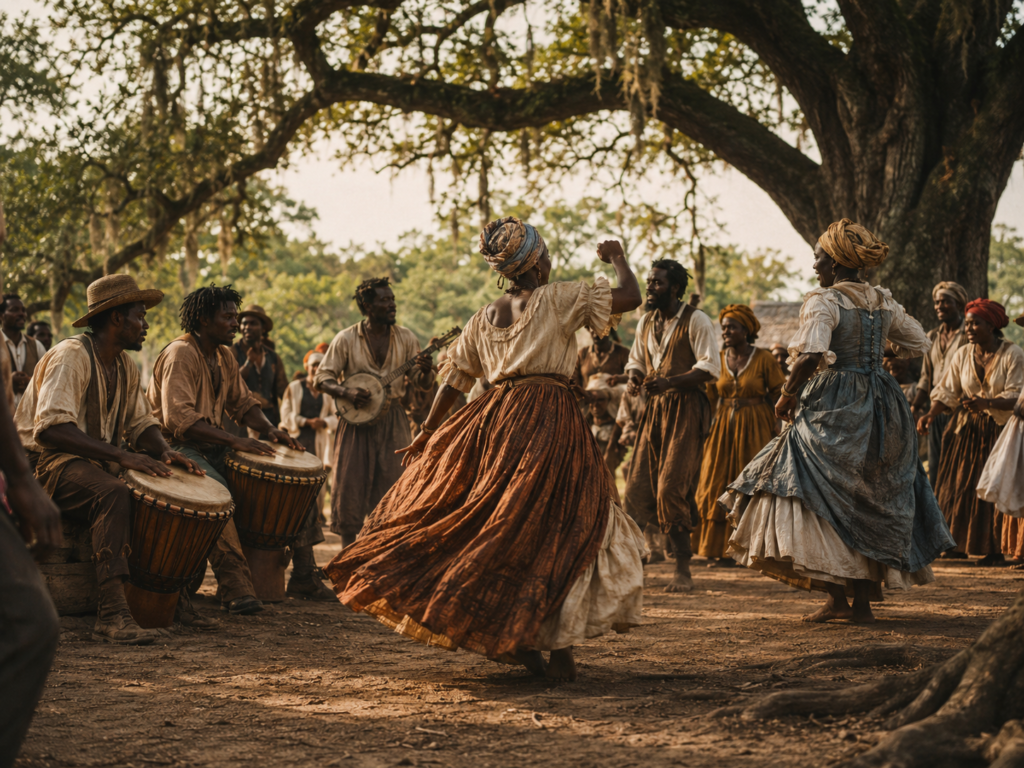
The National Park Service describes early New Orleans jazz as the result of the city’s cultural interaction, ethnic diversity, African rhythmic traditions, brass bands, ragtime, blues, dance music, and neighborhood life. Congo Square, where African and African-descended people gathered for music and dance, remains one of the deepest cultural touchpoints in that story.
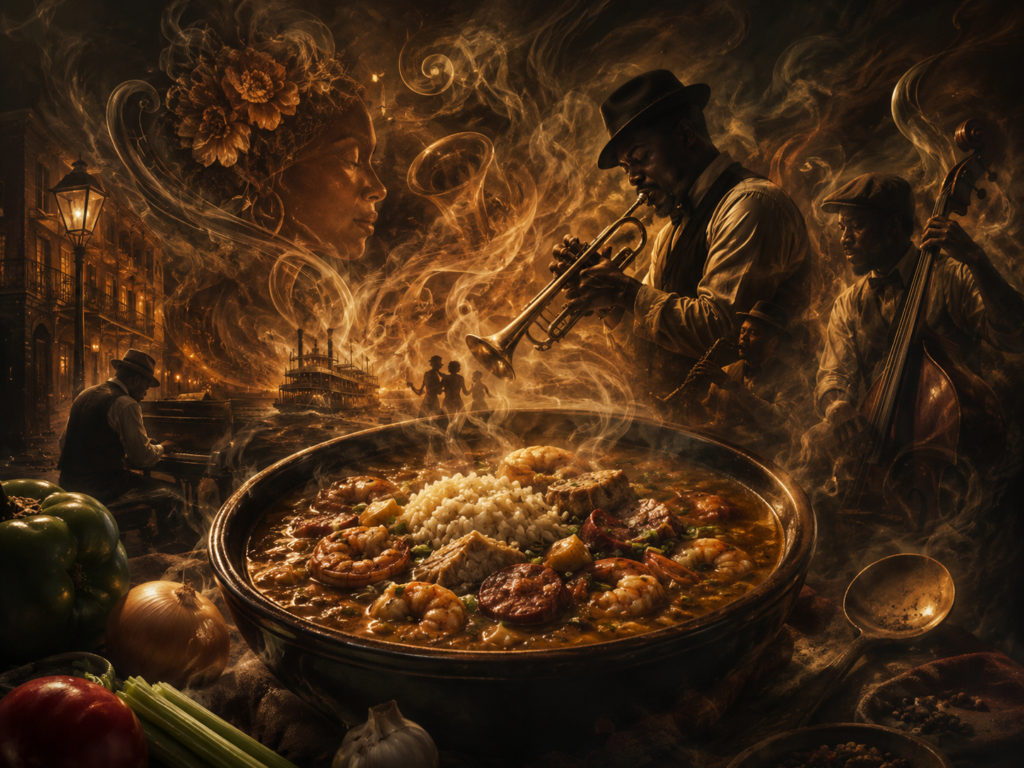
A steaming bowl of New Orleans gumbo beside a brass instrument, representing Louisiana food and jazz culture.
Jazz Gumbo: From Congo Square to the NOLA Groove
Why Gumbo and Jazz Belong in the Same Conversation
Gumbo and jazz are not identical, but they understand each other.
A good gumbo begins with patience. The roux has to deepen slowly. The aromatics need time to soften. The seafood, sausage, chicken, okra, filé, herbs, and stock have to find their balance. Rush it, and you taste the hurry. Respect it, and the pot starts telling a story.
Jazz works in a similar way. It may sound spontaneous, but underneath the freedom is knowledge, listening, structure, and feeling. One musician offers a phrase, another answers it, the rhythm section holds the room together, and suddenly the song becomes more than notes. It becomes a conversation.
That is the beauty of New Orleans culture. The city understands that mixture does not have to mean confusion. It can mean depth. It can mean memory. It can mean many voices keeping their character while contributing to one living whole.
The Smithsonian’s National Museum of American History explains that New Orleans cuisine has often been simplified as mostly French or Spanish, but the city’s food culture was also shaped by West African, Caribbean, Latin American, and other global influences. Gumbo and jambalaya are specifically noted as dishes deeply shaped by West African and Caribbean culinary traditions.
That matters because gumbo is not just a cozy bowl. It is a cultural archive.
The Cultural Roots: Congo Square, Brass Bands, and the New Orleans Beat
To understand the sound of New Orleans, you have to understand that jazz did not simply appear in a nightclub one night. It grew through public life.
It moved through Congo Square. It moved through spiritual practice, dance, call-and-response, parade culture, brass bands, mutual aid societies, funerals, celebrations, and neighborhood gatherings. The National Park Service notes that African dance and drumming traditions were documented in New Orleans, with Congo Square becoming famous for African dances and the preservation of African musical and cultural elements.
That public, communal nature still matters. In New Orleans, music is not locked away from everyday life. It walks. It mourns. It celebrates. It feeds people emotionally the way gumbo feeds them physically.
The second line tradition is one example. The National Park Service connects second-line culture to community participation in parades, especially through African American mutual aid and benevolent societies. These processions helped turn music into a moving public expression of grief, joy, dignity, and belonging.
That is why New Orleans jazz often feels like it is carrying more than melody. It carries footsteps. It carries names. It carries neighborhoods. It carries people who know how to turn hardship into sound without letting joy disappear.
Cultural Atmosphere History
Gumbo Is Not One Thing, And That Is the Point
One of the most honest things you can say about gumbo is that there is no single version that belongs to everyone.
Some families make seafood gumbo. Some make chicken and sausage gumbo. Some use okra. Some rely on filé. Some make it dark and smoky. Some make it lighter and more brothy. Some serve it for holidays, some for Sunday dinner, and some whenever the weather or the spirit calls for it.
Smithsonian Magazine notes that gumbo has long been a broad word rather than one narrow formula, pointing to old New Orleans cookbooks that included many different gumbo recipes. The same source also discusses possible roots of the word through West African Bantu languages associated with okra and Choctaw words connected to ground sassafras leaves.
That range should not be treated as a problem. It is part of gumbo’s truth.
Gumbo reflects place, season, family, migration, survival, and availability. It can be elegant, humble, festive, smoky, seafood-rich, sausage-heavy, or full of whatever the cook knows how to honor. The real question is not, “Which gumbo is the only authentic one?” The better question is, “Whose story is this pot telling?”
The Black Culinary Genius Behind New Orleans Foodways
Any serious conversation about New Orleans food culture has to honor the Black chefs, home cooks, authors, restaurant owners, and culture keepers whose labor shaped how the world understands Creole and Southern cooking.
Chef Lena Richard is an important figure. The Smithsonian’s National Museum of American History highlights Richard as a professional chef and cookbook author who pushed back against harmful stereotypes that treated Black culinary skill as instinct instead of expertise. Her work emphasized training, testing, authorship, and the professional knowledge behind Creole cuisine.
Chef Leah Chase is another essential name. Known as the Queen of Creole Cuisine, Chase helped bring New Orleans Creole cooking to international attention. The Smithsonian notes her famous reflection that civil rights leaders “changed the world over a bowl of gumbo” at Dooky Chase’s restaurant.
That sentence alone says so much. Gumbo was not only nourishment. It was a meeting place. It was a strategy. It was comfort. It was a community under pressure.
That is the deeper reason this dish deserves more than a quick description. In New Orleans, gumbo can sit at the crossroads of food, race, politics, hospitality, artistry, and memory.
How New Orleans’ Best Gumbo is Made | Made to Order | Bon Appétit
What “Jazz Gumbo” Really Means
“Jazz gumbo” is not just a cute phrase. It is a powerful metaphor.
The National Park Service has used “Making a Jazz Gumbo” as a cultural program that combines live music with a cooking demonstration, directly connecting the metaphors of jazz and gumbo ingredients. In the 2025 Louisiana Culture Fest listing, the program featured musician Richard “Piano” Scott and Dianne “Gumbo Marie” Honoré, inviting audiences to see, hear, smell, and taste the performance.
That kind of programming works because gumbo and jazz both help people understand New Orleans through the body. You do not only read about them. You smell, hear, taste, and feel them.
A roux changes color. A horn bends a note. A drummer shifts the pulse. A cook adjusts the seasoning. Someone at the table says, “That’s it.” Someone on the dance floor starts moving before they realize they are moving.
That is New Orleans.
How to Experience New Orleans Gumbo and Jazz at Home
You do not have to be in the French Quarter to let the spirit of New Orleans shape your kitchen. A gumbo night at home can become more than dinner when you treat it like a full cultural experience: warm food, layered music, good conversation, and a table that invites people to slow down.
Start with the right pace. Put on New Orleans jazz while you prep the ingredients. Let brass, piano, bass, drums, and soulful vocals keep you company while you chop the holy trinity of onion, celery, and bell pepper. Let the music remind you not to rush the roux. Let the simmering become part of the evening instead of something you are trying to hurry through.
Part of the beauty of New Orleans gumbo and jazz is that both are built in layers. The roux deepens. The stock grows richer. The rhythm settles in. The room starts to feel warmer. By the time the gumbo reaches the table, the meal has already begun telling a story.
Use these listening options while you cook, serve, or settle into the evening:
- Listen on Spotify: Explore New Orleans jazz and gumbo-night listening on Spotify
- Watch and listen on YouTube: Discover New Orleans jazz performances and cultural music videos on YouTube
- Listen on Apple Music: Create a New Orleans-inspired jazz dinner playlist on Apple Music
For a gumbo night at home, build the experience with intention:
- Start with sound: Play traditional New Orleans jazz, brass band music, piano blues, or second-line-inspired grooves while the gumbo cooks.
- Build the table: Serve gumbo with white rice, French bread, hot sauce, scallions, and something cold to drink.
- Make room for story: Ask guests what dish reminds them of home, family, celebration, or comfort.
- Keep it relaxed: Gumbo is not about perfection. It is about gathering, flavor, and letting the pot bring people closer.
Reader tip: Start with something lively while cooking, then shift into slower piano jazz, blues, or brass-led ballads once the gumbo reaches the table. Like the dish itself, the best New Orleans soundtrack has warmth, depth, rhythm, and a little surprise.
Make it a full Fly By Eats night: Serve the gumbo hot, dim the lights, put on a New Orleans jazz playlist, and let the evening move at the pace of the city, soulful, unhurried, and full of flavor.
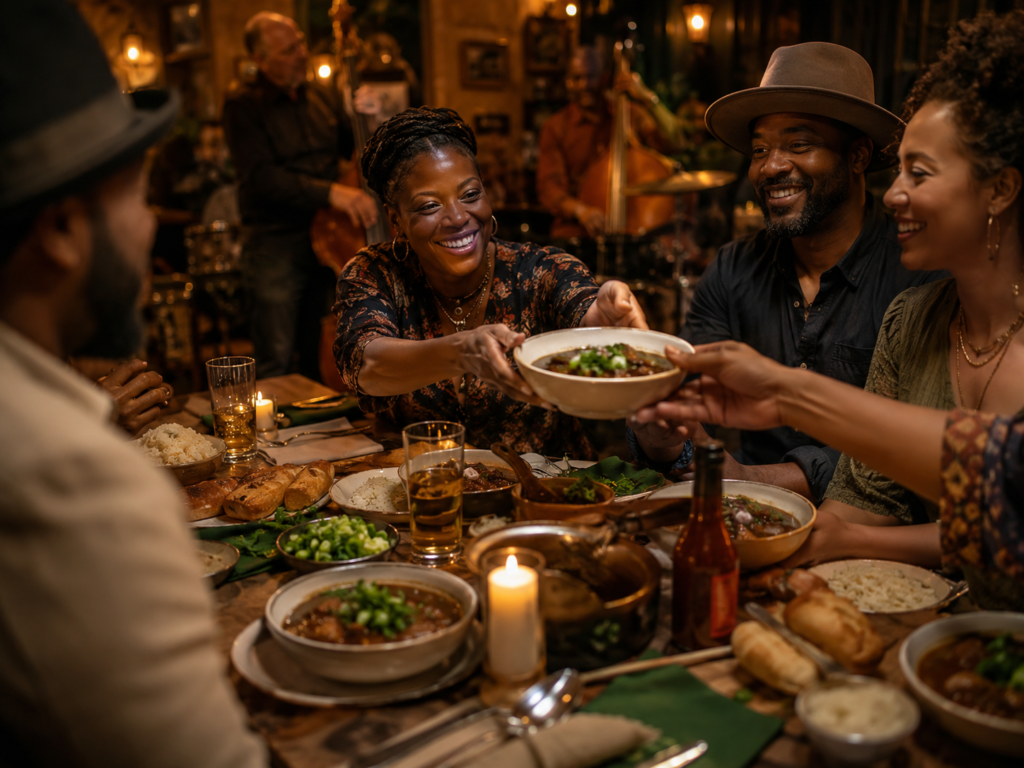
A warm gumbo dinner table with friends sharing bowls of New Orleans gumbo.
Experience Add-On
- What to Serve With Gumbo: white rice, potato salad, French bread, cornbread, hot sauce, pickled vegetables, or a simple green salad.
- Best Music Pairing: New Orleans traditional jazz while cooking, brass band music while serving, and slower blues or piano jazz as the table settles.
- Best Occasion: Sunday dinner, Mardi Gras season, cultural food night, music-themed gathering, family storytelling night, or a cozy cold-weather meal.
Congo Square with Bruce Sunpie Barnes – Preservation Hall Lessons
Why This Pairing Still Feels So Powerful
New Orleans gumbo and jazz endure because they do not ask culture to be simple.
They allow complexity. They allow contradiction. They allow joy and sorrow to sit at the same table. They remind us that some of the most beautiful things in the world are made by people who had to create beauty with what they had, where they were, and who they loved.
Gumbo teaches patience. Jazz teaches listening. New Orleans teaches that culture is not preserved by freezing it in place. It stays alive when people cook it, play it, dance it, question it, share it, and pass it forward with respect.
So when a bowl of gumbo meets a New Orleans groove, it is not just dinner with music.
It is a city speaking in two languages at once.
One language rises from the pot.
The other rises from the horn.
And somehow, both say: come closer.
References
- Bramen, L. (2010, February 3). Gumbo: The superest bowl of all? Smithsonian Magazine. https://www.smithsonianmag.com/arts-culture/gumbo-the-superest-bowl-of-all-79259353/
- Britannica Editors. (2026, May 26). Jazz. Encyclopaedia Britannica. https://www.britannica.com/art/jazz
- Brown, A. (Interviewer). (2010, November 7). Jason Marsalis [Interview transcript]. Smithsonian Jazz Oral History Program NEA Jazz Master interview, Archives Center, National Museum of American History. https://jazzday.com/media/AC0808_Marsalis_Jason_Transcript.pdf
- Doleac, B. (2013). Strictly second line: Funk, jazz, and the New Orleans beat. Ethnomusicology Review, 18. https://ethnomusicologyreview.ucla.edu/journal/volume/18/piece/699
- Jazz at Lincoln Center. (n.d.). What is jazz? Retrieved June 4, 2026, from https://jazz.org/education/school-programs/let-freedom-swing/what-is-jazz/
- National Museum of American History. (n.d.). Jazz. Smithsonian Music. Retrieved June 4, 2026, from https://music.si.edu/story/jazz
- National Park Service. (2022, November 11). Making a jazz gumbo. New Orleans Jazz National Historical Park. https://www.nps.gov/planyourvisit/event-details.htm?id=AAC1F013-03A6-7595-C2E634AD57F572EA
- National Park Service. (2026, April 14). French Quarter—American Folklife Center 50th anniversary celebration. Jean Lafitte National Historical Park and Preserve. https://www.nps.gov/planyourvisit/event-details.htm?id=E9840D07-C1AB-9768-7A2D80569F68A790
- New Orleans Jazz & Heritage Foundation. (2025, October 16). Music lineup announcement for Tremé Creole Gumbo Festival 2025. https://www.jazzandheritage.org/music-lineup-announcement-for-treme-creole-gumbo-festival-2025/
- Real Bigmista. (n.d.). Jazz Gumbo: From Congo Square to the NOLA Groove | New Orleans jazz story (feat. Jason Marsalis) [Video]. YouTube. Retrieved June 4, 2026, from https://www.youtube.com/watch?v=5dy7ea8__xI
- Young, A. R. (2018, March 11). 300 years and counting: A new look at New Orleans and “Creole cuisine”. National Museum of American History. https://americanhistory.si.edu/explore/stories/300-years-and-counting-new-look-new-orleans-and-creole-cuisine
- Apple. (n.d.). Apple Music. Retrieved June 4, 2026, from https://www.apple.com/apple-music/
- Spotify. (n.d.). Spotify Premium. Retrieved June 4, 2026, from https://www.spotify.com/us/premium/
- Spotify Support. (n.d.). Listen offline. Retrieved June 4, 2026, from https://support.spotify.com/us/article/listen-offline/
- YouTube Music. (n.d.). YouTube Music. Retrieved June 4, 2026, from https://music.youtube.com/