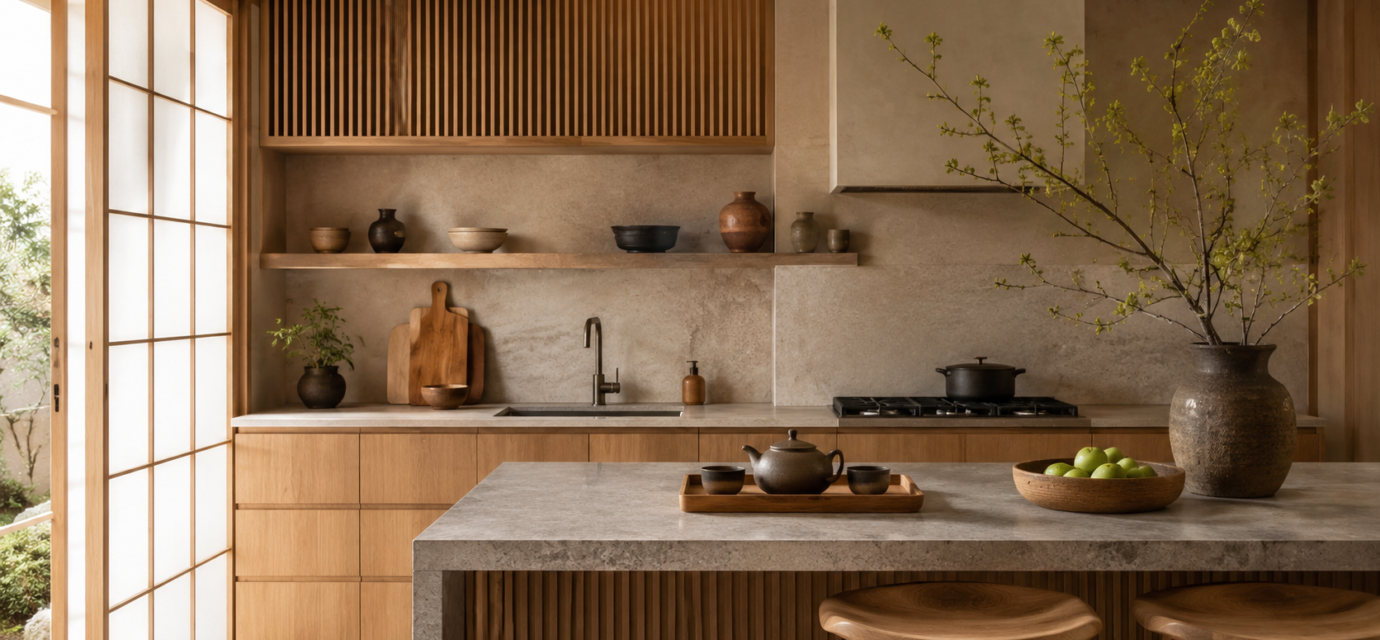
Japanese and Japandi Kitchen Design That Turns Simplicity Into Something Rich and Soulful
A Kitchen That Feels Like a Deep Breath
Some kitchens try to impress you the moment you walk in. A Japanese or Japandi kitchen does something quieter.
It slows the room down.
It gives your eyes somewhere soft to land. It lets wood grain, shadow, stone, handmade ceramics, and open space speak without forcing everything to compete for attention. This is what makes Japanese and Japandi kitchen design so powerful. It is not about having less just to look trendy. It is about choosing better, living lighter, and creating a kitchen that supports the way real people cook, gather, clean, breathe, and return home.
Japandi design is often described as a thoughtful blend of Japanese minimalism and Scandinavian warmth. Vogue’s design coverage explains Japandi as a natural meeting point between two traditions that value tranquility, nature, function, craftsmanship, texture, balance, and serenity. Designers cited in that piece also connect the style to natural light, useful objects, earthy materials, and uncluttered spaces that still feel honest and human.
For Fly By Eats, this style fits beautifully because food is not only about recipes. It is about atmosphere. It is about the room where morning tea is poured, rice is rinsed, vegetables are chopped, soup simmers, and someone leans against the counter telling a story before dinner.
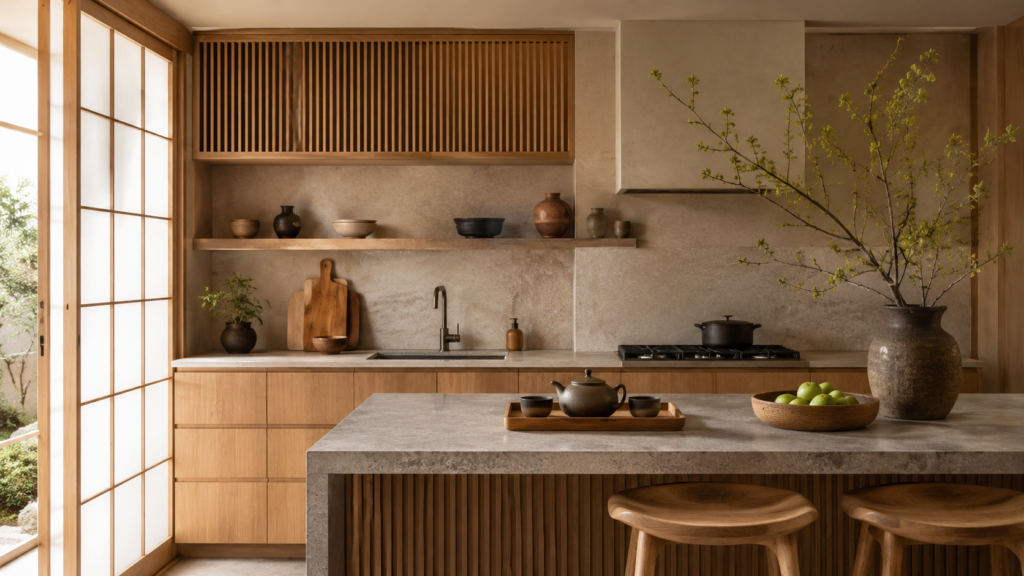
Japandi kitchen design with natural wood cabinets, soft lighting, stone counters, and a calm minimalist layout.
What Makes a Kitchen Feel Japanese or Japandi?
A Japanese-inspired kitchen is not simply a kitchen with bamboo accessories or paper lanterns. At its best, it is guided by intention, restraint, usefulness, and respect for materials.
Japandi takes that foundation and blends it with Scandinavian comfort. The result is a kitchen that feels clean but not cold, minimal but not empty, elegant but not untouchable.
The most important features usually include:
- Natural wood, stone, ceramic, linen, bamboo, clay, or textured plaster
- Low-contrast colors such as warm white, oatmeal, mushroom, soft gray, taupe, charcoal, clay, and muted green
- Hidden or highly organized storage
- Handleless, flat-front, or very simple cabinetry
- Soft lighting instead of harsh glare
- Fewer countertop objects, chosen with purpose
- Everyday beauty through bowls, mugs, trays, cutting boards, and tools that are actually used
- A quiet relationship with nature through light, plants, views, natural textures, and seasonal details
This style works because it respects both beauty and function. The National Kitchen & Bath Association’s 2026 kitchen trend reporting points toward many ideas that naturally align with Japandi design, including organic and earthy aesthetics, seamless design, material sophistication, storage maximization, health and wellness, and multi-purpose kitchen hubs.
The Cultural Heart Behind the Style
Japanese kitchens have a long and practical history. Japan Objects notes that Japanese cooking spaces evolved over time as fire and water were brought together into one functional household area, and by the late 19th century, kitchen spaces were found in most Japanese residences.
That matters because Japanese kitchen design has never been only about appearance. It has also been about rhythm, movement, household structure, cooking habits, and storage.
One of the most meaningful design concepts to understand is ma, often understood as pause, gap, or negative space. JAPAN HOUSE Los Angeles explains that ma is not simply emptiness. It is the meaningful space between things, and in Japanese homes, it can be seen through clean surfaces, carefully chosen objects, and open space that gives the room room to breathe.
In a kitchen, ma might look like a clear counter after breakfast. It might be one ceramic bowl on an open shelf instead of twenty decorative pieces. It might be a clean wall, a quiet corner, or the space around a dining table that allows people to move without feeling crowded.
Another important idea is wabi-sabi, a Japanese aesthetic often connected to simplicity, authenticity, imperfection, and the beauty of natural change. Japan Objects describes wabi-sabi as difficult to translate, but rooted in classical Japanese aesthetics and connected to simplicity, authenticity, tea ceremony, gardens, poetry, and life away from excess consumption.
In a Japandi kitchen, wabi-sabi can show up through a handmade mug that is slightly uneven, a wooden cutting board that has aged beautifully, a stone counter with natural variation, or a linen towel that softens with every wash.
This Japanese Kitchen Philosophy Will Change How You See Your Home
Why Japandi Kitchens Feel So Good in Real Life
A Japandi kitchen feels peaceful because it removes visual noise without removing personality. That is a very different thing from designing a kitchen that looks empty.
For many people, the kitchen is the busiest room in the home. It collects mail, water bottles, spices, dish towels, school papers, appliances, grocery bags, and last night’s leftovers. Japandi design responds to that reality with thoughtful storage and visual calm.
Instead of asking, “How much can I display?” it asks, “What actually supports my day?”
That one question can change the entire room.
A Japandi kitchen may include an appliance garage for the coffee maker, deep drawers for cookware, pull-out pantry shelves for ingredients, a narrow spice drawer near the stove, and a small open shelf for only the pieces that are beautiful enough and useful enough to stay visible.
This is where Japandi becomes more than pretty. It becomes practical.
Ma (間) & Japandi: The Art of Harmony Through Space and Simplicity
The Best Colors for a Japanese or Japandi Kitchen
The color palette should feel calm, grounded, and natural. Avoid overly stark black-and-white contrast unless you soften it with wood, texture, or warm lighting.
Strong Japandi kitchen colors include:
- Warm white
- Rice paper cream
- Oatmeal
- Mushroom
- Greige
- Soft taupe
- Sand
- Clay
- Muted olive
- Charcoal
- Washed black
- Pale oak
- Walnut brown
For a smaller kitchen, lighter tones usually help the room feel more open. Try warm white walls, pale oak cabinets, and a soft stone-look counter. For a larger kitchen, deeper wood tones, charcoal accents, and dramatic stone can create a richer, more grounded mood.
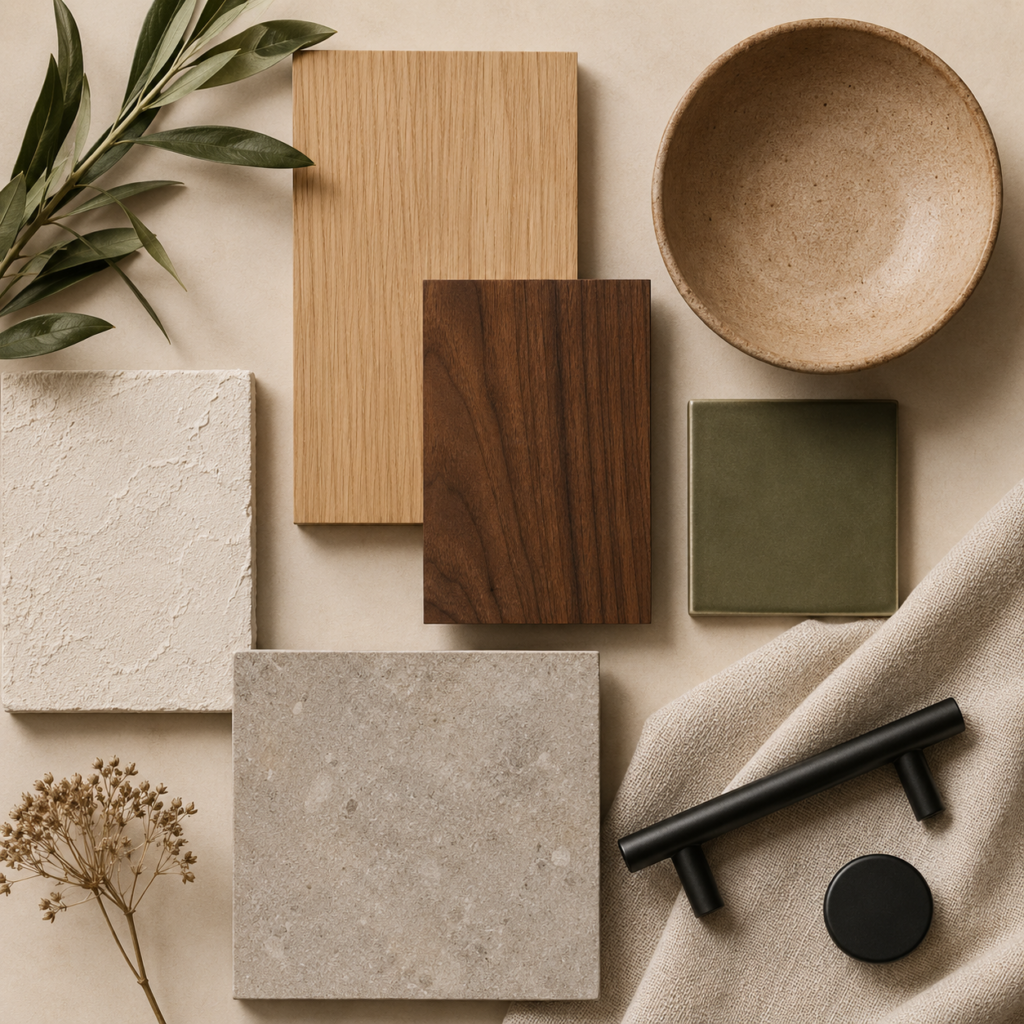
Japandi kitchen material palette with wood, stone, linen, ceramic, and warm neutral colors.
Materials That Make the Style Feel Rich Instead of Plain
The difference between “minimal” and “lifeless” is texture.
A Japandi kitchen should never feel like a blank showroom. It should feel touched by nature and shaped by daily life.
Consider these materials:
Wood: White oak, ash, walnut, maple, bamboo, or warm-toned veneer
Counters: Quartz, quartzite, honed stone, porcelain slab, butcher block, or soft concrete-look surfaces
Backsplashes: Handmade tile, zellige-style tile, stone slab, plaster-look tile, ribbed tile, or simple vertical tile
Textiles: Linen runners, cotton towels, woven shades, jute rugs, or soft seat cushions
Decor: Handmade ceramics, small bowls, wood trays, stone fruit bowls, and sculptural branches
Metal finishes: Matte black, brushed nickel, aged brass, soft bronze, or stainless steel, used sparingly
The NKBA’s 2026 kitchen reporting also shows strong momentum for natural materials, noting that organic neutral colors and wood grain are growing in popularity, with white oak highlighted as a leading wood type among respondents.
Storage: The Secret Ingredient of a Calm Kitchen
Japandi design depends on storage because visible clutter can quickly interrupt the peaceful feeling of the room.
The goal is not to hide life. The goal is to give life a place to land.
Smart storage ideas include:
- Deep drawers for pots and pans
- Drawer dividers for utensils
- Pull-out trays for oils and spices
- A hidden trash and recycling cabinet
- A vertical tray divider for cutting boards and baking sheets
- A pantry cabinet with labeled containers
- A concealed coffee or tea station
- A small open shelf for only the most meaningful everyday pieces
In a Fly By Eats kitchen, this is especially helpful because the website celebrates real cooking, not just styled cooking. A beautiful kitchen should support chopping, simmering, tasting, plating, cleaning, and coming back tomorrow to do it all again.
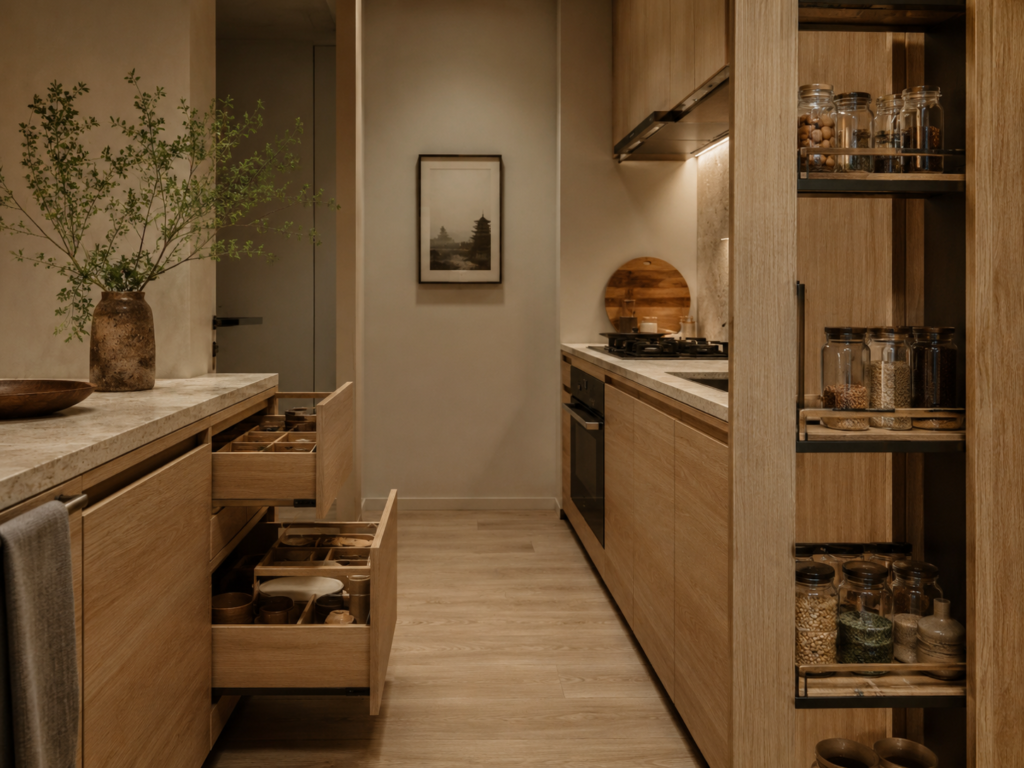
Small Japandi kitchen with organized storage, wood cabinetry, and clean minimalist counters.
Lighting: Soft, Layered, and Intentional
Lighting is one of the easiest ways to ruin or rescue a minimalist kitchen.
If the lighting is too cold, the room may feel sterile. If it is too dim, the kitchen may feel gloomy. Japandi lighting should feel soft, layered, and purposeful.
Use three layers:
1. Task lighting under cabinets for chopping, reading recipes, and cleaning counters.
2. Ambient lighting from recessed lights, ceiling fixtures, or a simple pendant.
3. Accent lighting inside shelves, under floating cabinets, or near a breakfast nook.
LED lighting is a smart choice because the U.S. Department of Energy notes that quality LEDs are energy efficient, durable, long-lasting, and can provide comparable or better light quality than other lighting types.
Choose warm or neutral lighting, usually around 2700K to 3500K, depending on the room. Cooler light can work for task zones, but the overall mood should still feel welcoming.
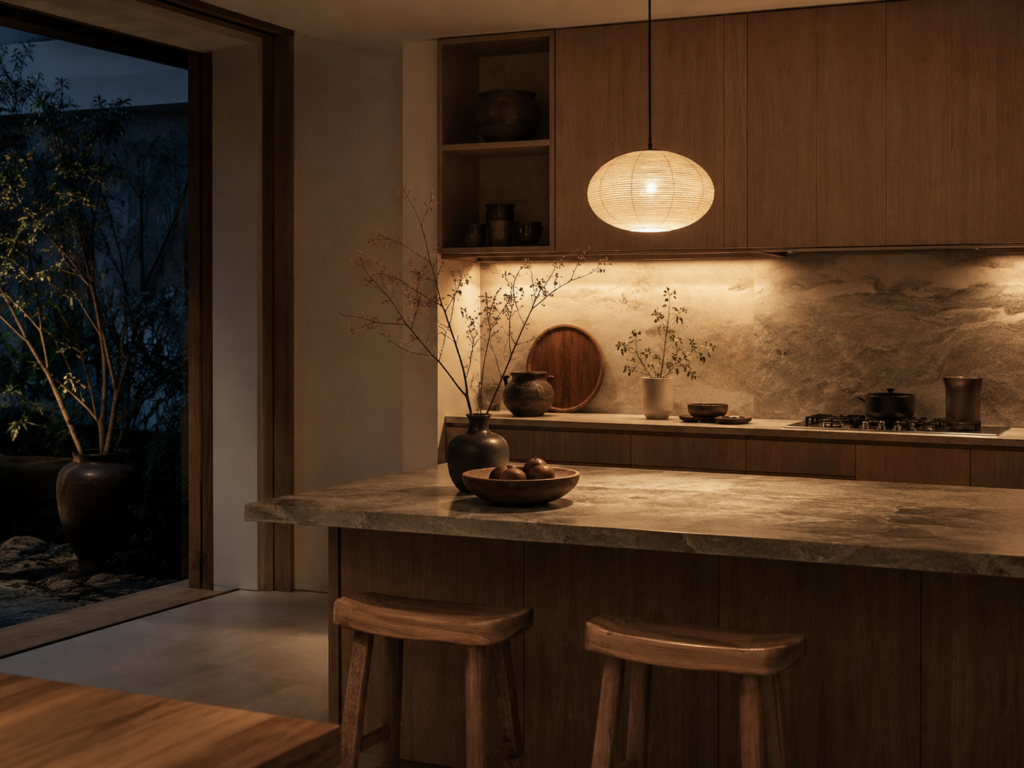
Japandi kitchen lighting with warm under-cabinet lights, wood cabinetry, and a peaceful evening atmosphere.
Ventilation Matters More Than People Think
A beautiful kitchen should also be healthy and functional. Cooking can increase indoor particulate matter, depending on cooking method, food type, and cooking fat. The U.S. Environmental Protection Agency recommends using a range hood when cooking, venting it outdoors when possible, and leaving it on for 10 to 20 minutes after cooking to help reduce exposure to indoor particles.
This is especially important in open-concept kitchens, where cooking air can move into dining and living spaces.
For Japandi design, choose a vent hood that blends into the cabinetry or looks architectural without feeling heavy. A concealed hood, plaster-style hood, wood-wrapped hood, or simple matte hood can preserve the room’s quiet visual flow.
How to Style a Japandi Kitchen Without Overdoing It
The styling rule is simple: fewer pieces, more meaning.
Instead of filling every shelf, choose objects that feel useful, handmade, natural, or personally grounding.
Beautiful styling choices include:
- A handmade ceramic bowl
- A small stack of everyday plates
- A wooden tray with tea cups
- A stone mortar and pestle
- A linen towel
- A low vase with branches
- A potted herb near the window
- A favorite cookbook
- A simple fruit bowl
- A woven basket for onions or garlic
Do not decorate just to decorate. Let the kitchen breathe.
This is where Japandi design becomes soulful. It gives ordinary objects dignity. A mug is not just a mug. A cutting board is not just a cutting board. A bowl of rice, a pot of soup, a teapot, or a clean counter after dinner can become part of the room’s quiet beauty.
Budget-Friendly Ways to Get the Look
You do not need a full remodel to bring Japandi energy into your kitchen.
Start here:
Clear the counters. Keep only what you use daily.
Change the lighting. Swap harsh bulbs for warmer LEDs.
Add wood. Try a wood tray, cutting board, stool, shelf, or utensil holder.
Use ceramic pieces. Replace plastic display items with stoneware, clay, or handmade-looking pieces.
Choose better storage. Drawer organizers can change the entire feel of the kitchen.
Add one plant or herb. Keep it simple, healthy, and useful.
Soften the textiles. Linen or cotton towels instantly warm the space.
Limit the palette. Remove loud visual clutter and repeat two or three calming tones.
Small choices can make the room feel more intentional within a weekend.
Common Mistakes to Avoid
A Japandi kitchen can lose its soul if it becomes too controlled or too trendy.
Avoid these mistakes:
- Making the space so minimal that it feels cold
- Using only white, black, and gray without wood or texture
- Displaying too many objects on open shelves
- Buying “Japandi-looking” decor that has no purpose
- Ignoring ventilation, lighting, and real kitchen workflow
- Forgetting that warmth matters as much as simplicity
- Copying the style without respecting the cultural ideas behind it
The goal is not perfection. The goal is peace, usefulness, and beauty that can live with you.
A Thoughtful Japandi Kitchen Checklist
Before you buy anything, ask:
- Does this make the kitchen easier to use?
- Does this add warmth, texture, or calm?
- Is this object useful, meaningful, or naturally beautiful?
- Does this material feel honest?
- Does this color support the overall mood?
- Does this choice reduce clutter or create more work?
- Will I still love this in five years?
That last question matters. Japandi is powerful because it is not built around fast trends. It is built around timeless choices, careful editing, natural materials, and daily rituals.
Top 5 Japanese Minimalist Design Inspirations |Creating A Japanese-Inspired Zen Space – Video
Final Thoughts: Simplicity Should Still Feel Alive
A Japanese or Japandi kitchen is not about stripping away personality. It is about creating enough quiet for personality to actually be felt.
It is the warmth of wood under soft light. The sound of a kettle. The space between objects. The calm of a clean counter. The comfort of knowing where everything belongs. The beauty of a handmade bowl that does not need to be perfect to be loved.
For Fly By Eats, this design style belongs in the kitchen conversation because it reminds us that food is never just food. Food lives inside spaces. Spaces shape mood. Mood shapes memory.
And sometimes, the richest kitchen is not the loudest one.
Sometimes, it is the one that finally lets you exhale.
Explore more kitchen design inspiration, thoughtful cooking ideas, and soulful food stories with Fly By Eats. Create a kitchen that does more than look beautiful. Create one that helps you feel at home.
References
- JAPAN HOUSE Los Angeles. (2020, April 21). A perspective on the Japanese concept of “ma”. JAPAN HOUSE Los Angeles. Supports the article’s discussion of negative space, pause, balance, and intentional simplicity in Japanese-inspired interiors.
- Japan Objects. (2021, December 11). 15 things to know about the traditional Japanese kitchen. Japan Objects. Supports the article’s cultural background on the Japanese kitchen, including how cooking spaces evolved around fire, water, household function, and daily life.
- Walther, A. (2021, January 8). What is wabi sabi? The elusive beauty of imperfection. Japan Objects. Supports the article’s explanation of wabi-sabi, imperfection, authenticity, aging materials, handmade ceramics, and natural simplicity.
- Taylor, E. (2025, February 26). “Japandi” style is the minimalist, multi-cultural interior design trend that shows no sign of stopping. Vogue. Supports the article’s definition of Japandi as a blend of Japanese and Scandinavian influences, with emphasis on craftsmanship, texture, natural materials, balance, serenity, and functional beauty.
- National Kitchen & Bath Association. (2025, September 16). NKBA | KBIS 2026 kitchen trends report. NKBA. Supports current kitchen design trends mentioned in the article, including storage maximization, organic and earthy aesthetics, seamless design, material sophistication, and health and wellness.
- U.S. Environmental Protection Agency. (2026, March 10). Sources of indoor particulate matter (PM). EPA. Supports the article’s ventilation guidance, including using a range hood while cooking, venting outdoors when possible, and leaving it on after cooking to reduce indoor particulate exposure.
- U.S. Department of Energy. (n.d.). LED lighting. Energy Saver. Supports the article’s lighting recommendations, including the use of LED lighting for energy efficiency, durability, and quality light in kitchen task and ambient lighting.
- Browning, W. D., Ryan, C. O., & Clancy, J. O. (2014). 14 patterns of biophilic design: Improving health and well-being in the built environment. Terrapin Bright Green. Supports the article’s connection between nature, natural materials, visual calm, daylight, and wellness-focused interior design.
Recommended Reads
This post may contain affiliate links. As an Amazon Associate, Fly By Eats may earn from qualifying purchases at no extra cost to you.