
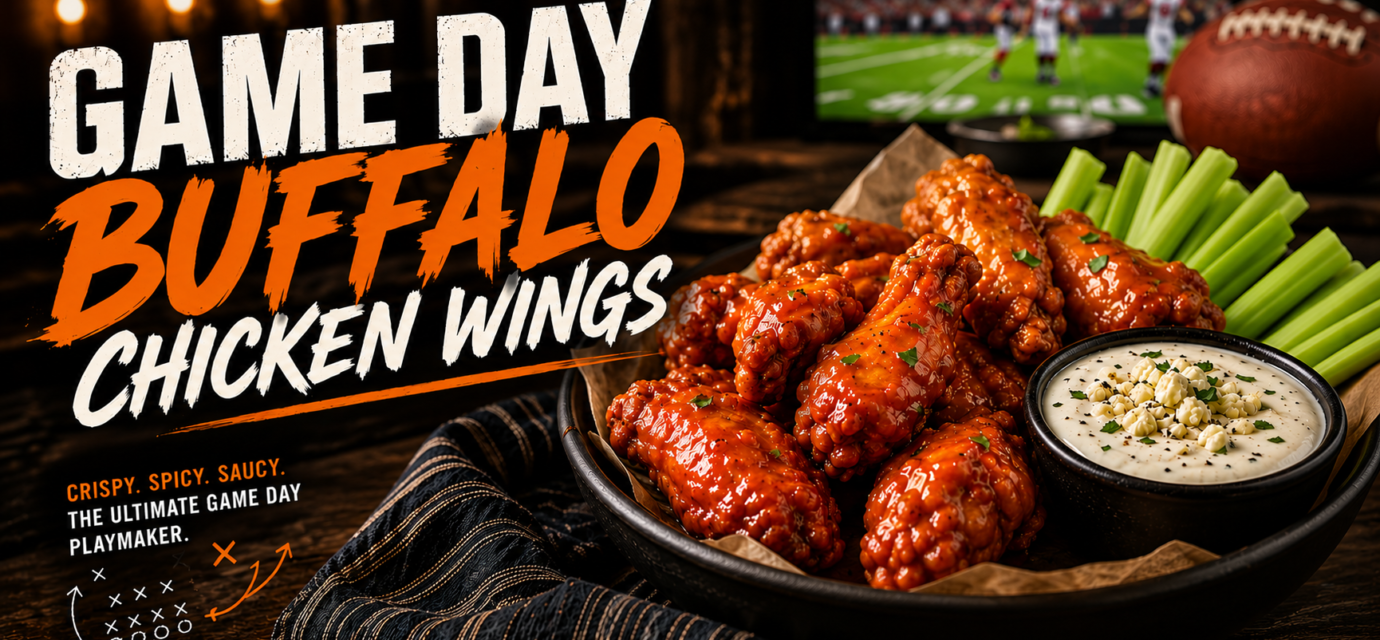
Game Day Buffalo Chicken Wings
Buffalo chicken wings have a way of changing the sound of a room. One minute, everyone is scattered around the kitchen, checking the score, grabbing drinks, or pretending they are “just having one.” The next minute, a platter of hot, glossy wings hits the table, and suddenly everybody is gathered close, reaching for celery sticks, dipping into blue cheese, and debating who gets the last flat.
This Game Day Buffalo Chicken Wings recipe is built for real home kitchens: crispy oven-baked wings, juicy meat, a buttery cayenne hot sauce that clings beautifully, and no need to babysit a pot of frying oil. You still get that classic Buffalo-style bite: tangy, spicy, savory, rich, and just messy enough to feel like a proper game day snack.
The beauty of Buffalo chicken wings is that they are simple, but not boring. A handful of smart technique choices make all the difference: drying the wings well, giving the skin enough airflow, baking at a high temperature, and tossing the wings in sauce only after they crisp. FoodSafety.gov lists 165°F as the safe minimum internal temperature for poultry, including chicken wings, so this recipe uses both visual cues and a thermometer-friendly safety check.
Whether you are cooking for football Sunday, a family movie night, a backyard gathering, or a casual appetizer spread, these wings bring the kind of comfort that feels playful, bold, and communal. They are the food equivalent of “come sit down, grab a plate, and stay awhile.”
Quick Recipe Snapshot
- Prep Time: 20 minutes
- Optional Drying Time: 1 hour to overnight
- Cook Time: 45–55 minutes
- Total Time: About 1 hour 10 minutes, plus optional drying time
- Servings: 6 to 8
- Difficulty Level: Beginner-friendly to intermediate
- Best For: Game day, tailgates, parties, casual dinners, appetizer spreads
- Expected Result: Crispy baked wings with juicy meat, tangy Buffalo sauce, buttery heat, and classic celery-and-dip energy
Why You’ll Love This Recipe
- No deep fryer required: The oven does the work with less mess and less oil handling.
- Crispy skin, not soggy sauce: The wings bake first, then get tossed in sauce while hot.
- Classic Buffalo flavor: Hot sauce, butter, garlic, and a little vinegar create that familiar tangy heat.
- Great for a crowd: The recipe scales easily for parties and game day spreads.
- Food-safety friendly: Clear temperature and storage guidance help home cooks serve with confidence.
- Flexible heat level: Keep it mild, make it hotter, or add a touch of honey for balance.
- Beginner-friendly technique: The steps explain what to look for, not just what to do.
Cultural and Seasonal Background
Buffalo wings are most closely associated with Buffalo, New York, and the dish’s modern popular story often centers on Teressa Bellissimo of the Anchor Bar, where wings were reportedly deep-fried, tossed in hot sauce, and served with celery and blue cheese in 1964. The Anchor Bar identifies Teressa Bellissimo and 1964 as central to its origin story, and Smithsonian Magazine also describes the Buffalo wing as a dish whose commonly told history points to Buffalo, New York, while noting that the exact origin details have been debated.
That debate matters because food history is rarely as simple as one place, one person, and one night. The Buffalo History Museum notes that Buffalo’s affection for chicken wings is not limited to the Bellissimo version and highlights John M. Young, a Black restaurateur who promoted wings in Buffalo through his “Wings & Things” restaurant and served uncut, breaded, deep-fried wings with a tomato-based Mambo sauce.
So, in this article, “Buffalo chicken wings” refers to the familiar bar-food style most readers recognize today: split chicken wings cooked until crisp, coated in a cayenne-style hot sauce and butter mixture, and often served with celery and blue cheese dressing. It is a dish with regional pride, sports-bar nostalgia, and a broader story that includes multiple cooks, communities, and traditions.
Seasonally, Buffalo wings have become especially tied to football season, tailgates, Super Bowl parties, and casual gatherings. Their appeal is easy to understand: they are finger food, they pair with cold drinks and crunchy vegetables, and they invite people to gather around one messy, flavorful platter.
Why This Recipe Works
The secret to great baked Buffalo chicken wings is managing moisture. Chicken skin contains water, fat, and protein. If the surface stays wet, the wings steam before they crisp. That is why this recipe starts by patting the wings dry and, when time allows, resting them uncovered in the refrigerator.
Baking powder also helps create a crispier exterior. Serious Eats explains that baking powder can raise the pH of chicken skin, support browning, and help form tiny surface bubbles that become craggy and crisp as the wings bake. The amount here is moderate, so it supports texture without leaving a strong alkaline taste.
A wire rack is another important detail. It lifts the wings off the pan so hot air can circulate and render fat can drip away. That means the skin browns more evenly instead of sitting in its own juices.
Finally, the sauce is added after baking. Buffalo sauce tastes best when it is glossy and warm, but if you coat the wings too early, the sauce softens the skin before it has a chance to crisp. Bake first. Sauce second. Serve right away.
Ingredients
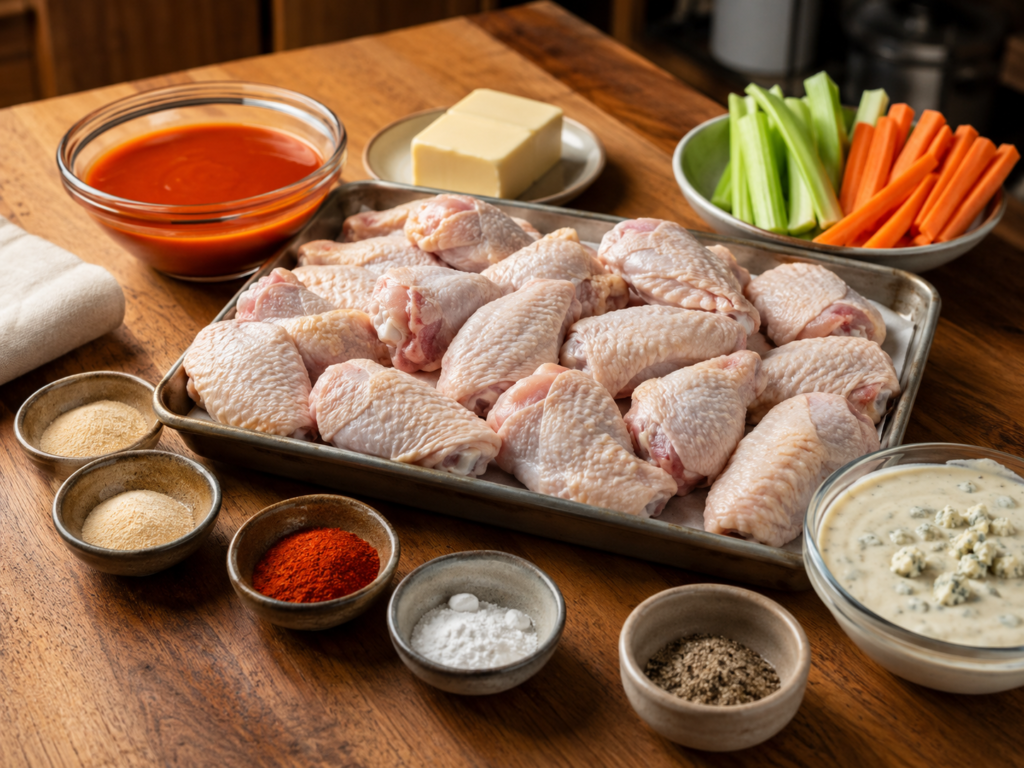
Ingredients for homemade Buffalo chicken wings arranged on a kitchen table.
For the Wings
4 pounds chicken wings, split into flats and drumettes, tips removed
Chicken wings are ideal because the skin-to-meat ratio gives you crisp edges and juicy bites. Split wings cook more evenly and are easier to serve.
1 tablespoon aluminum-free baking powder
This helps the skin brown and crisp. Use baking powder, not baking soda. Baking soda is stronger and can leave an unpleasant taste.
1 1/2 teaspoons kosher salt
Salt seasons the meat and helps draw surface moisture from the skin.
1 teaspoon garlic powder
Garlic powder adds savory depth without burning the way fresh garlic can at high heat.
1 teaspoon onion powder
Onion powder rounds out the seasoning and gives the wings a subtle snack-food savoriness.
1/2 teaspoon smoked paprika or sweet paprika
Paprika adds color and mild warmth. Smoked paprika gives a deeper, cookout-style flavor.
1/2 teaspoon black pepper
Pepper balances the richness of the butter and the brightness of the sauce.
1 tablespoon neutral oil, optional
A small amount of oil can help seasoning adhere, though the wings will render their own fat as they cook.
For the Buffalo Sauce
2/3 cup cayenne-style hot sauce
This is the backbone of Buffalo flavor: tangy, spicy, bright, and vinegar-forward.
5 tablespoons unsalted butter
Butter softens the sharp edges of the hot sauce and creates a glossy coating.
1 tablespoon honey, optional
Honey is not required, but it helps balance heat for readers who like a gentler finish.
1 teaspoon Worcestershire sauce, optional
Adds savory depth. Check labels if cooking for guests with fish, gluten, or other allergy concerns.
1 teaspoon apple cider vinegar or fresh lemon juice, optional
Adds extra tang if your hot sauce is mild or if you like a brighter finish.
1/4 teaspoon garlic powder
A small amount of garlic in the sauce ties the seasoning and glaze together.
For Serving
Celery sticks
A classic crunchy, cooling side.
Carrot sticks
Adds color, sweetness, and crunch.
Blue cheese dressing or ranch dressing
Blue cheese is the traditional Buffalo-style pairing, while ranch is a familiar crowd-pleaser.
Chopped chives or parsley, optional
Adds freshness and color right before serving.
Ingredient Notes and Smart Substitutions
Chicken wings: Use fresh or fully thawed frozen wings. If using frozen wings, thaw them safely in the refrigerator, then pat them very dry before seasoning.
Baking powder: Aluminum-free baking powder is preferred for a cleaner flavor. Do not substitute baking soda in the same amount.
Hot sauce: Use a vinegar-forward cayenne pepper sauce for classic Buffalo flavor. A smoky hot sauce will create a deeper barbecue-style wing, while a milder hot sauce will make the recipe more family-friendly.
Butter: Unsalted butter gives you better salt control. For a dairy-free version, use a plant-based butter that melts smoothly, but expect a slightly different flavor.
Honey: Maple syrup or a small amount of brown sugar can be used instead. Keep the amount modest so the wings still taste like Buffalo wings, not barbecue wings.
Worcestershire sauce: If avoiding fish or gluten, check the label or leave it out. The sauce will still taste good without it.
Blue cheese dressing: Use ranch, yogurt-based dip, or a dairy-free dip if needed. Always label dips clearly when serving guests with allergies.
Equipment You’ll Need
- Large rimmed baking sheet
- Wire rack that fits inside the baking sheet
- Aluminum foil or parchment paper for easier cleanup
- Large mixing bowl
- Paper towels
- Measuring spoons and cups
- Small saucepan
- Tongs
- Instant-read food thermometer
- Clean serving platter
Step-by-Step Directions
1. Prepare the pan
Preheat the oven to 425°F. Line a large rimmed baking sheet with foil, then place a wire rack on top. Lightly grease the rack or spray it with cooking spray to help prevent sticking.
The rack matters because it allows hot air to move around the wings. Without it, the underside of the wings can soften as fat and juices collect in the pan.
2. Dry the wings well
Remove the wings from their packaging and place them on a clean tray or cutting board reserved for raw poultry. For the safest method, do not rinse or soak the raw chicken wings. The CDC notes that raw chicken is ready to cook and does not need to be washed first; rinsing can spread germs to the sink, counter, and nearby foods. Instead, remove any visible residue with a damp paper towel, discard the towel immediately, then pat the wings very dry with clean paper towels. This helps reduce kitchen mess and gives the skin a better chance to crisp in the oven.
If you still choose to rinse the chicken: run water gently over the wings to reduce splashing, keep the chicken low in the sink, and do not place any produce, clean dishes, utensils, towels, or seasonings nearby. Immediately afterward, wash your hands for 20 seconds, then clean the sink, faucet handles, counters, cutting board, and any touched surfaces with hot, soapy water. After cleaning, sanitize those surfaces thoroughly before continuing. The CDC advises gentle water flow and immediate cleaning/sanitizing if someone chooses to wash chicken, and the USDA recommends cleaning first, then sanitizing with a solution such as 1 tablespoon liquid chlorine bleach per 1 gallon of water.
Once the wings are dry, throw away the used paper towels and wash your hands again before touching spices, pans, or other ingredients.
3. Season the wings
In a large bowl, combine the baking powder, kosher salt, garlic powder, onion powder, paprika, and black pepper. Add the wings and toss until every piece has a thin, even coating.
The coating should look light and dusty, not thick or pasty. If you see clumps of baking powder, keep tossing until they disappear.
4. Rest the wings if you have time
For the crispiest texture, arrange the seasoned wings on the rack and refrigerate them uncovered for at least 1 hour, or up to overnight. This helps dry the skin.
If you are short on time, you can bake them right away. They will still be flavorful, just slightly less crackly.
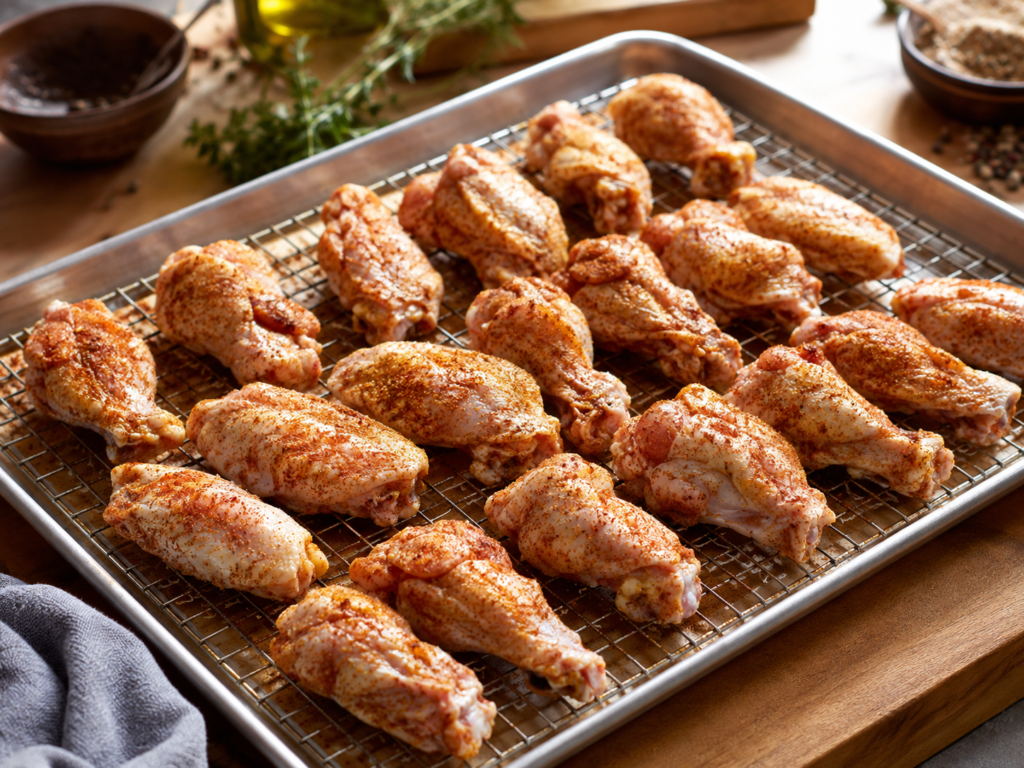
Seasoned chicken wings arranged on a wire rack before baking.
5. Arrange with space
Place the wings in a single layer on the wire rack. Leave a little room between each piece. Crowded wings trap steam, and steam is the enemy of crisp skin.
Use two baking sheets if needed. It is better to bake in two batches than to crowd one pan.
6. Bake the first side
Bake for 25 minutes. The wings will begin to render fat, tighten, and lightly brown. They may not look dramatic yet, and that is okay.
7. Flip and finish baking
Use tongs to flip the wings. Return them to the oven and bake for another 20 to 30 minutes, or until the skin is deeply golden, crisp at the edges, and the thickest pieces reach at least 165°F on an instant-read thermometer. FoodSafety.gov lists 165°F as the safe minimum internal temperature for poultry and leftovers.
For texture, many wings taste best when cooked a little beyond 165°F, often around 175°F to 185°F, because the extra time helps render fat and soften connective tissue. Safety still starts with reaching at least 165°F.
8. Make the Buffalo sauce
While the wings finish baking, melt the butter in a small saucepan over low heat. Stir in the hot sauce, honey if using, Worcestershire sauce if using, vinegar or lemon juice if using, and garlic powder.
Warm gently until smooth. Do not boil aggressively, because the butter can separate and the sauce may look greasy instead of glossy.
How to Make Buffalo Chicken Wing Sauce – How to Make Buffalo Chicken Wings
9. Toss the wings while hot
Transfer the cooked wings to a clean large bowl. Pour in about two-thirds of the Buffalo sauce and toss until coated. Add more sauce as desired.
Saucing while the wings are hot helps the glaze cling, but serving quickly helps preserve the crisp edges.
10. Serve immediately
Pile the wings onto a platter with celery sticks, carrot sticks, and blue cheese or ranch dressing. Add chives or parsley if desired. Serve with extra sauce on the side for people who like a saucier wing.

Plated Buffalo chicken wings with celery, carrots, and creamy dipping sauces.
Pro Tips for Best Results
- Use a thermometer: Color helps, but temperature confirms safety.
- Do not rinse the wings: Pat them dry instead to reduce moisture and avoid spreading raw chicken juices.
- Choose aluminum-free baking powder: It gives a cleaner flavor.
- Use a wire rack: Airflow is the difference between roasted wings and soggy-bottom wings.
- Do not over-sauce too early: Toss right before serving.
- Make extra sauce: Some guests love dipping the wings back into warm sauce.
- Use two pans for large batches: Crowding causes steaming.
- Flip once: This encourages even browning without fussing too much.
- Let the sauce stay warm, not boiling: Gentle heat keeps it smooth.
- Serve with crunchy vegetables: They balance the heat and richness.
Common Mistakes to Avoid
1. Using baking soda instead of baking powder
Baking soda is much stronger and can create a bitter, soapy flavor. Use baking powder only.
2. Crowding the pan
If wings touch too closely, they steam. Give them space or use a second pan.
3. Skipping the drying step
Wet wings struggle to crisp. Pat them dry thoroughly before seasoning.
4. Saucing before baking
Buffalo sauce can burn or turn sticky in the oven. Bake first, sauce after.
5. Guessing the temperature
Chicken wings should reach at least 165°F. Use an instant-read thermometer.
6. Boiling the sauce hard
High heat can split the butter. Warm gently and whisk until glossy.
7. Letting wings sit out too long
The CDC advises refrigerating or freezing leftover chicken within 2 hours, or within 1 hour if exposed to temperatures above 90°F.
Flavor Variations
Honey Buffalo Wings: Add 2 tablespoons of honey to the sauce for a sweeter, stickier finish.
Garlic Buffalo Wings: Add 1 finely grated garlic clove to the melted butter and cook gently for 30 seconds before adding hot sauce.
Extra Hot Buffalo Wings: Add cayenne pepper or a few dashes of a hotter pepper sauce to the Buffalo sauce.
Lemon Pepper Buffalo Wings: Add 1 teaspoon lemon pepper seasoning to the dry rub and finish with a squeeze of lemon.
Smoky Buffalo Wings: Use smoked paprika in the seasoning and add a pinch of chipotle powder to the sauce.
Garlic Parmesan Buffalo Wings: Toss sauced wings with a little grated Parmesan and chopped parsley right before serving.
Mild Family-Style Wings: Use a mild cayenne sauce and include the honey. Serve extra hot sauce on the side for heat lovers.
Serving Suggestions
Buffalo chicken wings love contrast. Serve them with crisp vegetables, creamy dips, and sides that can handle a little sauce.
Try them with:
- Celery sticks and carrot sticks
- Blue cheese dressing
- Ranch dressing
- Potato skins
- Loaded nachos
- Mac and cheese
- Coleslaw
- Cornbread muffins
- Kettle chips
- Pickle spears
- Soft pretzel bites
- Sparkling lemonade
- Iced tea
- Light beer or nonalcoholic beer
- Citrus mocktails
For a game day table, set the wings in the center with small bowls of dips, extra sauce, napkins, and a discard bowl for bones. Keep the setup casual and generous. Wings are not meant to feel fussy.
Storage, Freezing, and Reheating
Let leftover wings cool slightly, then place them in an airtight container. Refrigerate within 2 hours of cooking, or within 1 hour if the food has been outside or in temperatures above 90°F. The CDC gives this timing for leftover chicken safety.
Refrigerator: Store cooked wings for 3 to 4 days in an airtight container.
Freezer: Freeze cooked wings for the best quality for up to 3 months. FoodSafety.gov notes that freezer storage times are for quality when food remains continuously frozen at 0°F or below.
Reheating in the oven: Place wings on a rack over a baking sheet and reheat at 375°F to 400°F for 10 to 15 minutes, or until hot throughout.
Reheating in the air fryer: Reheat at 375°F for 5 to 8 minutes, shaking once.
Reheating temperature: FoodSafety.gov lists 165°F for leftovers, so reheat leftover wings until they reach 165°F in the thickest part.
Sauce refresh tip: If reheated wings look dry, toss them with a spoonful of warm Buffalo sauce right before serving.
Make-Ahead Tips
You can season the wings with the baking powder mixture and refrigerate them uncovered on a rack up to 24 hours ahead. This helps dry the skin and makes game day cooking easier.
You can also make the Buffalo sauce up to 3 days ahead. Store it covered in the refrigerator, then warm gently in a saucepan and whisk before tossing with the wings.
For parties, bake the wings close to serving time whenever possible. If you need to cook in batches, keep cooked unsauced wings warm on a rack in a low oven, then toss with sauce right before serving.
Frequently Asked Questions
Can I make Buffalo chicken wings without frying?
Yes. This recipe bakes the wings at high heat on a wire rack so the skin can crisp while the meat stays juicy. The texture is different from deep-fried wings, but it is still crisp, flavorful, and very party-friendly.
What temperature should chicken wings be cooked to?
Chicken wings should reach at least 165°F in the thickest part. Use an instant-read thermometer for accuracy. FoodSafety.gov lists 165°F as the safe minimum internal temperature for poultry, including wings.
Why do you use baking powder on chicken wings?
Baking powder helps the skin brown and crisp by affecting surface pH and encouraging tiny bubbles on the skin as the wings cook. This creates a more textured surface for crunch and sauce cling.
Can I use baking soda instead?
No. Baking soda is not a good one-for-one substitute here. It is stronger than baking powder and can make the wings taste bitter or soapy.
Should I wash chicken wings before cooking?
No. The CDC says raw chicken is ready to cook and does not need to be washed first. Washing can spread germs around the kitchen. Pat the wings dry with paper towels instead.
Can I make these wings in an air fryer?
Yes. Cook in a single layer at 380°F for about 20 to 25 minutes, flipping halfway, then increase to 400°F for a few minutes to crisp. Cook time depends on wing size and air fryer model. Always check for at least 165°F.
How do I keep wings crispy after saucing?
Serve them right away. For maximum crispness, bake the wings until deeply golden, toss with sauce while hot, and plate immediately. You can also serve some sauce on the side instead of heavily coating every wing.
What is the best dip for Buffalo wings?
Blue cheese dressing is the classic pairing, especially in Buffalo-style serving traditions. Ranch is also popular and often more familiar for family gatherings. Offer both if you are feeding a crowd.
Final Thoughts
Buffalo chicken wings are one of those foods that remind us how powerful simple cooking can be. They do not need fancy plating, rare ingredients, or a complicated story to feel special. A tray of wings, a bowl of sauce, a few crunchy vegetables, and people gathered around the table can turn an ordinary afternoon into something lively and memorable.
What makes this version especially satisfying is that it respects the spirit of classic Buffalo wings while making the method approachable for home cooks. You get the tangy heat, the buttery finish, the crisp edges, and the cooling dip, but you do not need to deep-fry or overcomplicate the process. It is practical, flavorful, and built for sharing.
There is also something beautifully communal about wings. They invite conversation. They slow people down. They make napkins necessary. They create the kind of casual table where nobody has to perform, and everyone can just enjoy the food in front of them. That fits the heart of Fly By Eats: food with flavor, comfort, culture, and a sense of welcome.
So whether your team wins, loses, or you are only there for the snacks, these Game Day Buffalo Chicken Wings deserve a spot on the table. Serve them hot, pass the dip, keep extra napkins nearby, and let the platter do what wings do best: bring people together, one saucy bite at a time.
Quick Recipe Card
Recipe Name
Game Day Buffalo Chicken Wings
Description
Crispy baked Buffalo chicken wings tossed in a tangy butter-hot sauce and served with celery, carrots, and blue cheese or ranch dressing. Perfect for game day, parties, tailgates, and casual gatherings.
Prep Time
20 minutes
Cook Time
45–55 minutes
Total Time
About 1 hour 10 minutes, plus optional drying time
Servings
6 to 8
Ingredients
For the Wings
- 4 pounds chicken wings, split into flats and drumettes
- 1 tablespoon aluminum-free baking powder
- 1 1/2 teaspoons kosher salt
- 1 teaspoon garlic powder
- 1 teaspoon onion powder
- 1/2 teaspoon smoked paprika or sweet paprika
- 1/2 teaspoon black pepper
- 1 tablespoon neutral oil, optional
For the Buffalo Sauce
- 2/3 cup cayenne-style hot sauce
- 5 tablespoons unsalted butter
- 1 tablespoon honey, optional
- 1 teaspoon Worcestershire sauce, optional
- 1 teaspoon apple cider vinegar or fresh lemon juice, optional
- 1/4 teaspoon garlic powder
For Serving
- Celery sticks
- Carrot sticks
- Blue cheese dressing or ranch dressing
- Chopped chives or parsley, optional
Instructions
- Preheat oven to 425°F. Line a rimmed baking sheet with foil and place a wire rack on top. Lightly grease the rack.
- Pat chicken wings very dry with paper towels. Do not rinse raw chicken.
- In a large bowl, mix baking powder, salt, garlic powder, onion powder, paprika, and black pepper.
- Add wings and toss until evenly coated.
- Arrange wings in a single layer on the wire rack. For best results, refrigerate uncovered for 1 hour or up to overnight.
- Bake for 25 minutes.
- Flip wings and bake another 20 to 30 minutes, or until golden, crisp, and at least 165°F internally.
- While wings bake, melt butter in a small saucepan over low heat. Stir in hot sauce, honey, Worcestershire sauce, vinegar or lemon juice, and garlic powder. Warm gently until smooth.
- Transfer cooked wings to a clean bowl. Toss with Buffalo sauce while hot.
- Serve immediately with celery, carrots, and blue cheese or ranch dressing.
Notes
- Use baking powder, not baking soda.
- For crispier wings, dry the seasoned wings uncovered in the refrigerator before baking.
- Use two baking sheets if needed to avoid crowding.
- Sauce the wings right before serving for the best texture.
- Adjust the heat by using mild, medium, or hot cayenne-style sauce.
Storage
Store leftover wings in an airtight container in the refrigerator for 3 to 4 days. Freeze for best quality up to 3 months. Reheat leftovers to 165°F before serving.
Nutrition Disclaimer
Nutrition information, if provided, is an estimate and may vary based on ingredients and preparation methods.
References
- Anchor Bar. (n.d.). History. https://anchorbar.com/history/
- Centers for Disease Control and Prevention. (2024, April 29). Chicken and food poisoning. https://www.cdc.gov/food-safety/foods/chicken.html
- Centers for Disease Control and Prevention. (2024, April 29). Preparing your holiday turkey safely. https://www.cdc.gov/food-safety/foods/holiday-turkey.html
(Useful for raw poultry handling guidance, including why washing poultry is discouraged.) - FoodSafety.gov. (2024, November 21). Safe minimum internal temperatures. https://www.foodsafety.gov/food-safety-charts/safe-minimum-internal-temperatures
- Food & Wine. (2017, September 7). How Buffalo wings took over America. https://www.foodandwine.com/news/how-buffalo-wings-took-over-america
- U.S. Department of Agriculture, Food Safety and Inspection Service. (n.d.). Chicken from farm to table. https://www.fsis.usda.gov/food-safety/safe-food-handling-and-preparation/poultry/chicken-farm-table
- U.S. Department of Agriculture, Food Safety and Inspection Service. (n.d.). Safe minimum internal temperature chart. https://www.fsis.usda.gov/food-safety/safe-food-handling-and-preparation/food-safety-basics/safe-temperature-chart
- U.S. Department of Agriculture, Food Safety and Inspection Service. (n.d.). Washing food: Does it promote food safety? https://www.fsis.usda.gov/food-safety/safe-food-handling-and-preparation/food-safety-basics/washing-food-does-it-promote-food
- U.S. Department of Agriculture. (2024, February 6). Food safety tips for your Super Bowl party. https://www.usda.gov/media/blog/2024/02/06/food-safety-tips-your-super-bowl-party