Finding Motivation in Small Daily Wins Georgia Served Warm: Khachapuri, Connection, and a Table Full of Welcome
There is something deeply human about warm bread arriving at the table.
Before anyone explains the history, before anyone names the region, before anyone tells you how the dough was kneaded or which cheese belongs inside, the body already understands. Steam rises. The crust gives off that soft, toasted scent of flour meeting heat. Cheese stretches when the bread is pulled apart. Butter glistens. Someone reaches for a plate. Someone laughs because the first bite is too hot, but they take it anyway.
In the Republic of Georgia, khachapuri carries that kind of welcome.
It is often described simply as Georgian cheese bread, but that description barely opens the door. Khachapuri is food that feels like a pause button. It asks people to sit down, tear a piece, share the center, and remember that even a hard day can hold one small win. Maybe the win is getting dinner on the table. Maybe it is inviting someone in. Maybe it is letting yourself enjoy something warm without rushing to the next responsibility.
At Fly By Eats, we love food that teaches without preaching. Khachapuri does that beautifully. It reminds us that motivation does not always arrive like thunder. Sometimes it comes softly, in the form of bread, cheese, a warm kitchen, and a table that says, “You made it this far. Sit down.”
Why Georgian Khachapuri Feels So Meaningful
Khachapuri matters because it belongs to everyday life as much as celebration. It is not only a restaurant dish or a travel-photo moment. Across Georgia, different regions have their own ways of shaping, filling, baking, and serving it, which makes khachapuri feel less like one fixed recipe and more like a family of breads connected by memory.
The word is commonly understood through two Georgian food ideas: cheese curds and bread. That pairing alone says a lot. Bread is one of the oldest signs of care at a table. Cheese speaks of milk, land, animals, seasons, and preservation. Put them together, and you have something humble but generous.
Some versions are round and enclosed, with cheese tucked inside like a secret. Some are topped with more cheese before baking. The famous Adjarian version, from the Black Sea region of Adjara, is shaped like a boat and filled with molten cheese, butter, and egg. It is the kind of dish that makes the table go quiet for a second, not because people have nothing to say, but because everyone is busy watching the center turn glossy and golden.
Khachapuri feels meaningful because it does not require perfection to offer comfort. It can be rustic. It can be handmade. It can be served on a wooden board, a simple plate, or in a busy café. What matters is the gesture: warm food placed before another person with the hope that they feel welcomed.
That is where the small daily win lives.
Not in doing everything. Not in becoming someone new overnight. But in making one thing with care. Sharing one meal. Taking one honest breath before the day moves on.
The Beauty of the Table
A Georgian-inspired table does not whisper scarcity. It leans toward generosity.
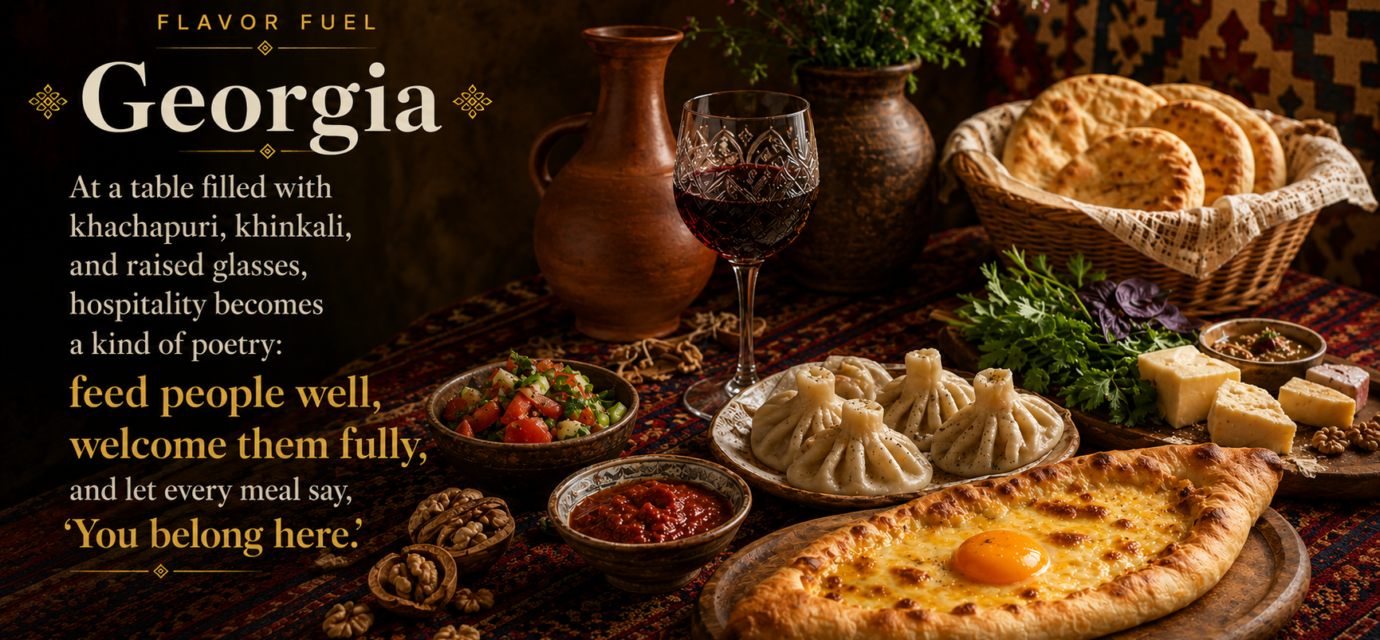
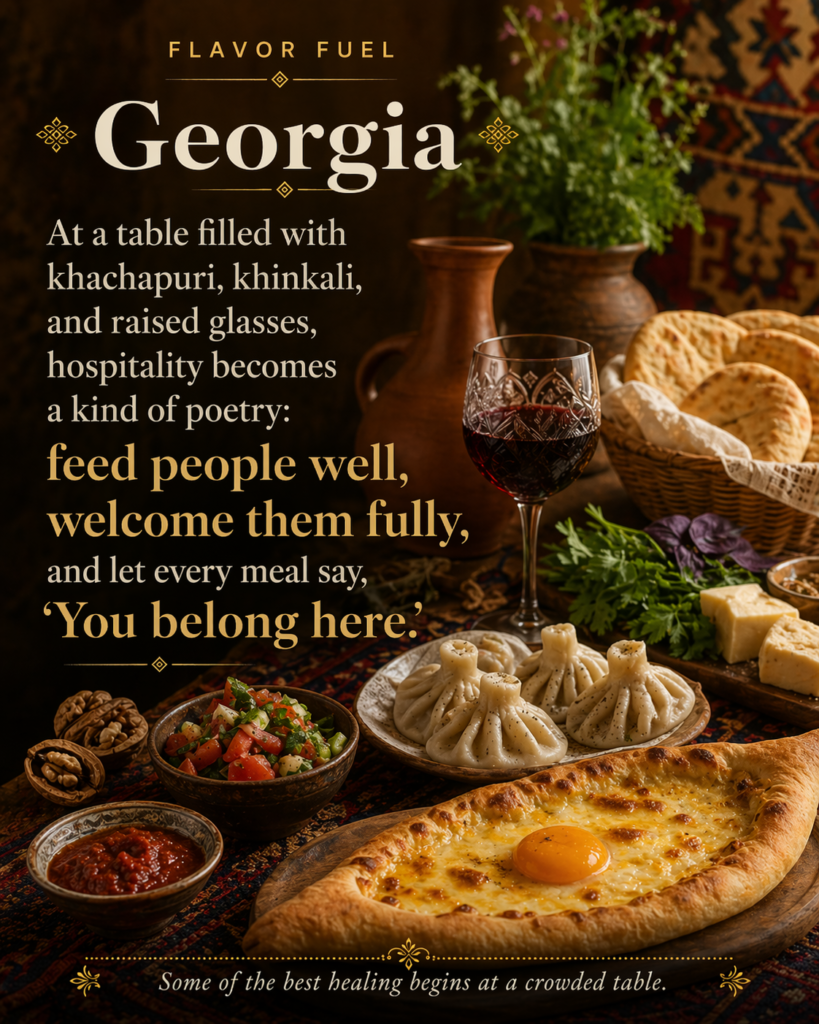
Picture khachapuri in the center, its crust browned in soft patches, the cheese bubbling at the seams. Around it might be plates of sliced cucumbers and tomatoes, fresh herbs, pickled vegetables, walnuts, beans, grilled meats, eggplant with walnut paste, or bowls of sauces that bring brightness and depth. The table feels layered, not fussy. It is colorful, fragrant, and alive.
There is the sound of bread tearing. The scrape of a serving spoon. The warmth of hands passing plates. The green sharpness of herbs. The creamy pull of cheese. The soft chew of dough. The richness of butter melting into the center of Adjarian khachapuri. The first bite is hot, salty, tender, and grounding.
In Georgian dining culture, the table is often connected to the supra, a traditional feast guided by a tamada, or toastmaster. A supra is not just about eating. It is about toasts, memory, conversation, respect, grief, joy, humor, and belonging. Food helps hold all of that. The table becomes a place where people are not only fed, but acknowledged.
Not every home meal is a grand supra, of course. Everyday life is everyday life everywhere. People work, rush, care for children, handle bills, get tired, and make do with what is available. But the spirit of the Georgian table still offers something powerful: hospitality can be practiced in small ways.
You do not need a banquet to make someone feel seen. Sometimes one warm bread is enough.
A Taste of History and Culture
Georgia sits in the Caucasus, a region shaped by mountains, valleys, vineyards, trade routes, neighboring cultures, and deep local identities. Its cuisine reflects that geography. There are breads, dumplings, herbs, walnuts, cheeses, beans, stews, grilled foods, pickles, and wines that vary by region and household.
Khachapuri is one of the country’s most recognizable foods, but it is not one-size-fits-all. Imeretian khachapuri is widely known and often round, with cheese inside. Megrelian khachapuri usually includes cheese inside and on top, making it especially rich. Adjarian khachapuri, the boat-shaped version, is tied to Adjara and its Black Sea setting. Other regional variations may include different shapes, doughs, cheeses, or fillings, showing how local landscapes and traditions influence the table.
The preparation has also changed with time. Older methods used sourdough-style starters, while modern home cooks and bakeries may use quicker doughs made with dairy, mineral water, or other adjustments. Khachapuri can be baked in ovens, cooked in pans, prepared in traditional vessels, or adapted for urban food shops. That flexibility is part of its staying power.
Georgia’s broader food culture is also closely connected to wine. Traditional qvevri winemaking, where wine ferments and is stored in large clay vessels often buried underground, is recognized by UNESCO as intangible cultural heritage. Wine is not required to appreciate Georgian food, and not every table needs alcohol, but wine has historically played an important role in Georgian feasting, agriculture, hospitality, and identity.
Khachapuri itself was granted intangible cultural heritage status in Georgia in 2019, a reminder that some foods carry more than flavor. They carry technique, language, regional pride, memory, and the ongoing work of keeping tradition alive.
What This Food Tradition Teaches Us
Khachapuri teaches that comfort does not have to be complicated.
At its heart, it is bread and cheese. Simple ingredients, treated with care, become something that feels abundant. That is a quiet lesson for anyone trying to find motivation in small daily wins. We often wait for life to feel grand before we celebrate it. We wait until the big goal is complete, the house is spotless, the business is thriving, the body is transformed, the plan is perfect, the healing is finished.
But the table teaches differently.
The table says: start with what you have. Warm it. Share it. Bless the small progress.
A loaf of bread can be a reminder that slow rising still counts. Cheese melting into the center can remind us that softness is not weakness. A shared plate can remind us that community does not have to be loud to be real.
In Georgian supra culture, toasts often give shape to gratitude, friendship, family, homeland, ancestors, and hope. That does not mean every meal must become ceremonial. It simply reminds us that words matter at the table. The way we speak over food can turn dinner into care.
A small daily win might sound like:
“I cooked today.”
“I invited someone over.”
“I rested before I burned out.”
“I tried something new.”
“I remembered where I come from.”
“I let myself be fed.”
Food traditions like khachapuri give us permission to honor those small wins without making them small in meaning.
How to Bring This Spirit Into Your Own Kitchen
You do not have to be Georgian to appreciate khachapuri, but respect matters. The goal is not to flatten a country’s food culture into a trend. The goal is to learn, acknowledge, cook with care, and stay curious.
Start by learning the difference between a few major styles. Imeretian is a beautiful place to begin if you want something simple and shareable. Megrelian is wonderful for cheese lovers because of the extra cheese on top. Adjarian is dramatic and cozy, especially when served hot from the oven.
For ingredients, many home cooks outside Georgia use a blend of cheeses when traditional Georgian cheeses are not available. Look for a balance of salty, stretchy, and creamy. Mozzarella can bring melt, feta can bring tang, and farmer cheese or ricotta-style cheese can bring softness. If you can find sulguni or Imeretian cheese from a Georgian or Eastern European market, even better.
If making Adjarian khachapuri with egg, cook it safely. The egg should be heated so the white and yolk are firm if you are following U.S. food safety guidance. Some restaurant versions may serve a soft yolk, but home cooks should make informed choices, especially when cooking for children, older adults, pregnant guests, or anyone with a weakened immune system.
To bring the spirit of khachapuri into your kitchen, think beyond the recipe:
Warm the bread before serving.
Place it in the center of the table.
Let people tear and share.
Serve herbs or vegetables nearby for freshness.
Keep the setting relaxed.
Invite conversation without forcing performance.
The beauty is in the welcome.
Simple Serving Ideas
Serve khachapuri as the heart of a casual meal. Add a crisp cucumber and tomato salad with herbs, a bowl of olives or pickles, roasted vegetables, or a simple bean dish. If you want a brunch-style table, pair it with fruit, yogurt, tea, or a bright nonalcoholic drink such as sparkling water with lemon and herbs.
For a cozy dinner, serve khachapuri with a spread of small plates. Think fresh herbs, radishes, sautéed mushrooms, walnut-based dips, grilled vegetables, or a warm soup. Keep everything family-style so the table feels open and generous.
For table styling, use natural textures: a wooden board, linen napkins, clay dishes, small bowls, and a few fresh herbs scattered in a glass or jar. You do not need an elaborate setup. In fact, khachapuri looks best when the table feels lived in.
A small hosting idea: invite guests to share one simple toast before eating. It does not have to imitate a formal Georgian supra. Keep it personal and respectful. Ask each person to name one small win from the week. Someone may say they finished a project. Someone may say they made it through a hard morning. Someone may say they finally called a friend back.
That moment will tell you why food matters.
A Thoughtful Note on Cultural Appreciation
Cultural appreciation begins with humility.
When cooking or writing about Georgian khachapuri, name where it comes from. Recognize it as Georgian, not just “cheese bread” with a trendy twist. Learn about the regions behind the styles. Support Georgian restaurants, bakeries, cookbook authors, food educators, and cultural organizations when possible. If you adapt the recipe because of ingredient access, say so honestly.
Avoid treating one version as the only “real” version. Georgian food is regional, personal, and layered. A family in Imereti, a bakery in Tbilisi, a restaurant in Batumi, and a Georgian home cook abroad may all approach khachapuri differently. That variety does not weaken tradition. It shows that tradition is alive.
Also, be careful not to romanticize hospitality as if it costs nothing. Generosity takes labor. Someone kneads the dough, shops for ingredients, cleans the table, watches the oven, serves the food, and makes guests comfortable. To appreciate the table fully, we should appreciate the hands behind it.
The best way to honor a food tradition is to approach it with gratitude, accuracy, and care.
Final Thoughts: Let the Bread Remind You to Begin Again
Khachapuri is warm in the most honest way.
It does not need to be polished to be beautiful. It does not need a perfect table to feel generous. It does not ask everyone to arrive with their life together. It simply arrives hot, fragrant, and ready to be shared.
That is why it belongs so naturally in a conversation about small daily wins. Some days, motivation is not a speech or a breakthrough. Some days, it is the decision to feed yourself with care. To invite someone in. To make one beautiful thing. To notice the steam rising from bread and remember that warmth still exists.
Georgia’s khachapuri offers that reminder with open hands.
It tells us that welcome can be simple. That food can hold memory. That a table can become a soft place to land. And that even in ordinary moments, there is room for gratitude, connection, and beginning again.
References
- Food and Agriculture Organization of the United Nations. (n.d.). FAOLEX database: Georgia food and nutrition legal profile. FAOLEX. https://www.fao.org/faolex/
- FoodSafety.gov. (2024). Cook to a safe minimum internal temperature. U.S. Department of Health & Human Services. https://www.foodsafety.gov/food-safety-charts/safe-minimum-internal-temperatures
- Georgian National Tourism Administration. (2022). Georgian unique culture. Georgia Travel. https://georgia.travel/unique-georgian-culture
- Georgian National Tourism Administration. (2022). Khachapuri: True symbol of Georgian cuisine. Georgia Travel. https://georgia.travel/get-a-taste-of-khachapuri
- Harvard University Davis Center for Russian and Eurasian Studies. (n.d.). Cultural highlights of Georgia. Harvard University. https://daviscenter.fas.harvard.edu/cultural-highlights-georgia-0
- UNESCO. (n.d.). Ancient Georgian traditional Qvevri wine-making method. UNESCO Intangible Cultural Heritage. https://ich.unesco.org/en/RL/ancient-georgian-traditional-qvevri-wine-making-method-00870
- UNESCO. (n.d.). Georgia. UNESCO Intangible Cultural Heritage. https://ich.unesco.org/en/state/georgia-GE