Lebanon at the Table: Mezze, Warm Bread, and Stories That Bring Us Together
Why the Lebanese Mezze Table Feels So Meaningful
Mezze is one of the clearest expressions of Lebanese hospitality because it changes the energy of dining. Instead of one plate belonging to one person, many plates belong to everyone. The center of the table becomes a shared place, and that simple arrangement says something powerful: we are here together.
In Lebanese homes, restaurants, bakeries, and family gatherings, food often carries the feeling of abundance even when the ingredients are simple. Parsley, tomatoes, lentils, chickpeas, olives, yogurt, bread, mint, garlic, lemon, bulgur, sesame, and olive oil can become a meal that feels alive with color and care. The point is not excess for the sake of display. The point is generosity, balance, and the joy of offering.
Bread matters deeply in this setting. It is not only served beside the meal; it helps people eat the meal. A torn piece of pita or flatbread can scoop hummus, hold tabbouleh, wrap grilled vegetables, soften the sharpness of pickles, or gather the last drizzle of olive oil from the plate. Bread is useful, comforting, and symbolic in the quiet way everyday foods often are.
Lebanon’s al-man’ouché, a beloved flatbread often topped with za’atar, cheese, or other ingredients, was added to UNESCO’s Representative List of the Intangible Cultural Heritage of Humanity in 2023. UNESCO describes it as an emblematic culinary practice in Lebanon, prepared in homes and specialized bakeries and enjoyed by people of many backgrounds. That recognition matters because it honors not only a food, but a living practice: mixing, topping, baking, buying, sharing, and eating something that belongs to daily life.
The Beauty of the Table
A Lebanese table is beautiful because it moves. Hands reach. Bread folds. Plates turn. The meal has sound: the soft rip of pita, the clink of small dishes, the scrape of a spoon through hummus, the pour of tea or coffee, the cheerful insistence that someone take more.
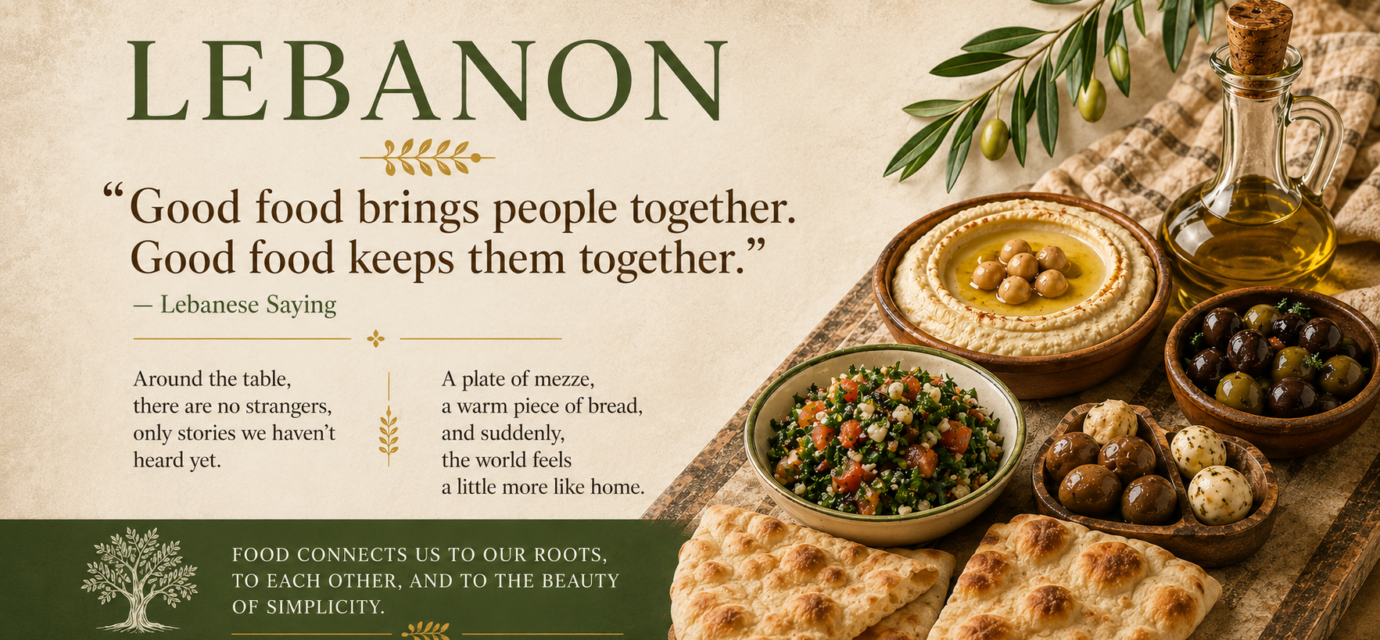
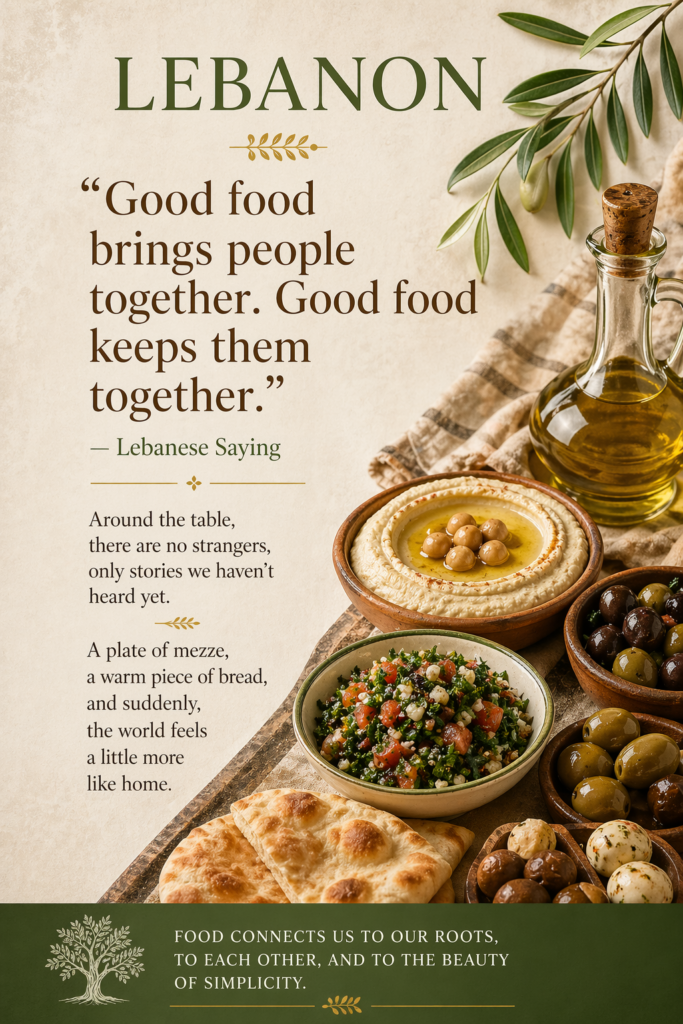
The colors are part of the invitation. Tabbouleh brings a deep green brightness from parsley and mint, dotted with tomato and softened by fine bulgur. Fattoush adds crisp vegetables, toasted or fried bread, and the tang of sumac. Hummus sits creamy and pale beneath olive oil and paprika or cumin. Baba ghanoush or moutabbal offers a smoky softness from roasted eggplant and tahini. Labneh arrives thick and cool, often finished with olive oil, herbs, or za’atar. Pickles bring sharpness. Olives bring salt and depth. Warm bread brings everything together.
The table may be casual, but it is rarely careless. Even a simple spread can feel considered: small bowls instead of oversized platters, herbs placed within reach, lemon wedges nearby, bread wrapped in a towel to keep it warm, cucumbers and tomatoes cut for easy sharing. Nothing has to match perfectly. In fact, part of the charm is the lived-in feeling of a table built for people, not performance.
The aroma is layered and inviting. Toasted sesame from za’atar. Garlic from toum or hummus. Charred eggplant. Warm dough. Lemon and olive oil. Grilled meat or vegetables if the meal continues beyond mezze. The air feels awake, but not overwhelming. Lebanese food often knows how to be bold and gentle at the same time.
A Taste of History and Culture
Lebanon sits on the eastern edge of the Mediterranean, a location that has shaped its foodways through agriculture, trade, migration, family memory, and regional exchange. Lebanese cuisine is part of the wider Levantine and Eastern Mediterranean food world, sharing ingredients and techniques with neighboring food traditions while still holding its own local identity through regional dishes, household practices, and community rituals.
Many Lebanese dishes are built around ingredients that speak to land and season: grains, legumes, herbs, vegetables, fruit, dairy, olive oil, sesame, and preserved foods. The rhythm of the cuisine has long depended on what could be grown, gathered, dried, fermented, pickled, pressed, baked, or shared. In villages and cities alike, food is connected to both daily survival and celebration.
One important tradition is mouneh, the practice of preserving foods for later use. Depending on the household and region, this may include pickles, jams, dried herbs, tomato paste, olives, labneh balls preserved in oil, grape molasses, or other pantry foods. Mouneh reflects planning, seasonality, and respect for ingredients. It is a reminder that a good table does not begin when guests arrive. It begins earlier, with preparation, patience, and care.
Lebanese food has also traveled widely through diaspora communities. Families who left Lebanon carried recipes, bakery traditions, coffee rituals, spice blends, and hospitality practices with them. In places far from Beirut, Tripoli, Sidon, Zahle, or mountain villages, Lebanese restaurants and home kitchens continue to serve as cultural bridges. A plate of kibbeh, a tray of baklava, a bowl of hummus, or a warm man’ouché can become a way of remembering home and introducing others to it.
Modern Lebanon’s food system also faces real pressures, including economic challenges, food access concerns, agricultural strain, and the need for more resilient local food systems. That reality should not be ignored when writing about the beauty of the table. Food culture is not a postcard. It lives inside real communities. To appreciate Lebanese food respectfully is to honor both its joy and its endurance.
What This Food Tradition Teaches Us
The Lebanese mezze table teaches that abundance is not always about having more. Sometimes abundance is about making what is present feel shared.
A bowl of labneh becomes more generous when olive oil is poured slowly over the top. A plate of cucumbers becomes more inviting with mint and salt. A small dish of olives becomes part of a larger welcome when placed beside bread. The lesson is simple but easy to forget: care changes the meaning of food.
Mezze also teaches patience. It is not a meal designed for rushing through a screen-lit lunch break. It asks people to sit with one another. To taste in small bites. To notice contrast: creamy and crisp, hot and cool, salty and sour, smoky and fresh. It reminds us that conversation can be part of nourishment.
There is also humility in the Lebanese table. Many beloved dishes begin with everyday ingredients: chickpeas, lentils, parsley, wheat, yogurt, eggplant, garlic, lemon. These are not rare luxuries. They are familiar foods handled with skill. That is one of the most beautiful things about traditional foodways around the world. They show how ordinary ingredients become extraordinary through memory, technique, and repetition.
Gratitude lives here too. Not the loud kind, but the kind that appears when people eat slowly enough to recognize the work behind the meal: the baker’s early morning, the farmer’s herbs, the grandmother’s hands, the host’s planning, the guest’s presence, the land’s offering.
How to Bring This Spirit Into Your Own Kitchen
You do not have to recreate an entire Lebanese feast to honor the spirit of the Lebanese table. Start with the idea of shared care. Choose a few dishes that invite reaching, dipping, wrapping, and talking.
A simple Lebanese-inspired mezze evening might include warm pita or flatbread, hummus, labneh with olive oil and za’atar, sliced cucumbers, tomatoes, olives, pickles, fresh mint, and a bright salad like tabbouleh or fattoush. If you want something warm, add roasted eggplant, falafel, grilled chicken, roasted potatoes with garlic and cilantro, or a small tray of man’ouché.
Pay attention to texture. A good shared table needs contrast. Pair creamy dips with crisp vegetables, soft bread with sharp pickles, fresh herbs with warm roasted foods, and lemony salads with something rich like tahini or olive oil.
For table styling, keep it natural and welcoming. Use small bowls, wooden boards, linen napkins, simple plates, and a basket or cloth-wrapped bundle of warm bread. Place herbs in a small cup of water like flowers. Add lemon wedges to brighten the table. Let the food bring the color.
If serving mezze to guests, remember food safety along with hospitality. Keep cold items cold until serving, and do not leave perishable foods at room temperature for more than two hours unless they are being held safely hot or cold. For longer gatherings, serve smaller portions and refresh the table as needed.
Most importantly, do not treat Lebanese food as a trend to flatten into a vague “Mediterranean board.” Learn the names of dishes. Credit the culture. Notice regional differences. Buy from Lebanese bakeries, restaurants, grocers, cookbook authors, and food makers when you can. Let curiosity lead you beyond the plate.
Simple Serving Ideas
For a cozy mezze table, start with three anchors: bread, one creamy dip, and one fresh salad. Warm pita with hummus and tabbouleh is enough to begin. Add olives, pickles, and sliced vegetables for color and crunch.
For a brunch-style table, serve man’ouché cut into wedges with labneh, cucumbers, tomatoes, mint, olives, and hot tea. This feels relaxed, affordable, and deeply satisfying.
For a dinner gathering, build the meal in waves. Begin with cold mezze like hummus, labneh, baba ghanoush, tabbouleh, fattoush, pickles, and bread. Then bring out warm dishes such as falafel, roasted potatoes, grilled vegetables, chicken skewers, kafta, or stuffed grape leaves. Finish with fruit, coffee, or a small sweet such as baklava, maamoul, or namoura.
For a weeknight version, keep it practical. Use store-bought hummus if needed, but dress it with olive oil, lemon zest, chickpeas, herbs, or a sprinkle of sumac. Warm the bread before serving. Slice fresh vegetables. Add one homemade element, such as quick labneh, tomato-cucumber salad, or roasted eggplant.
For a thoughtful drink pairing, offer mint tea, black tea, sparkling water with lemon, or Lebanese coffee if you have access to it. Arak is traditionally associated with some Lebanese meals, but nonalcoholic options are just as welcome and often more practical for mixed gatherings.
A Thoughtful Note on Cultural Appreciation
Appreciating Lebanese food means approaching it with respect, not ownership. It is fine to be inspired by a mezze table in your own home, but it is important not to reduce a deep food culture to decoration, vague labels, or a single dish.
Lebanese cuisine has regional diversity, family variation, religious and holiday connections, rural and urban expressions, and a long history shaped by both continuity and change. One family’s tabbouleh may be more lemony. One bakery’s man’ouché may be thinner, softer, crispier, cheesier, or more heavily scented with za’atar. One restaurant may serve mezze in a polished modern style, while another keeps the feeling of a neighborhood table. These differences are not mistakes. They are part of the living culture.
Respect also means being careful with the word “authentic.” Authenticity is not always one fixed recipe. It can be a grandmother’s method, a village bakery’s dough, a diaspora family’s adaptation, or a chef’s respectful interpretation. Instead of using the word as a gate, use it as an invitation to learn more.
When possible, support Lebanese voices. Read Lebanese food writers. Visit Lebanese-owned restaurants and bakeries. Ask thoughtful questions. Learn how to pronounce dish names with care. Understand that food carries memory, migration, pride, grief, celebration, and home.
Final Thoughts: The Bread Between Us
A Lebanese table reminds us that gathering does not have to be complicated to be meaningful. Sometimes all it takes is warm bread, something to dip into, something fresh, something sharp, and enough time to let people settle in.
The mezze table is not only a way of eating. It is a way of saying: come closer. Taste this. Tell me what you think. Stay a little longer.
In a world that often pushes meals into the background of busy life, Lebanon’s table offers a gentle correction. Food can still slow us down. Bread can still be passed by hand. A small plate can still carry a story. Hospitality can still be practiced in ordinary kitchens, on weeknights, with imperfect dishes and open hearts.
That may be the lasting gift of the Lebanese mezze table. It teaches that the most memorable meals are not always the most elaborate. They are the ones where people feel welcomed, where the food is shared, and where the table makes everyone feel, even briefly, like they belong.
References
- Food and Agriculture Organization of the United Nations, World Food Programme, & United Nations Food Systems Coordination Hub. (2024). Lebanon food system transformation pathway. United Nations Food Systems Coordination Hub. https://www.unfoodsystemshub.org/docs/unfoodsystemslibraries/national-pathways/lebanon/2024-03-01-national-pathway-lebanon-eng.pdf
- Food and Drug Administration. (2024). Serving up safe buffets. U.S. Food and Drug Administration. https://www.fda.gov/food/buy-store-serve-safe-food/serving-safe-buffets
- Food Heritage Foundation. (n.d.). The importance of mouneh provisioning in Lebanon. Food Heritage Foundation. https://food-heritage.org/the-importance-of-mouneh-provisioning-in-lebanon/
- Hoteit, M., Zoghbi, E., Rady, A., Shankiti, I., & Al-Jawaldeh, A. (2021). Development of a Lebanese food exchange system based on frequently consumed Eastern Mediterranean traditional dishes and Arabic sweets. F1000Research, 10, 12. https://doi.org/10.12688/f1000research.27461.1
- Ministry of Industry, Republic of Lebanon. (2022). Pre-feasibility study: Mouneh industry. Ministry of Industry. https://www.industry.gov.lb/getattachment/PublicationsAndStudies/Feasibility-Studies-2022/Pre-faisability-Mouneh-EN_compressed.pdf
- UNESCO. (2023). Al-Man’ouché, an emblematic culinary practice in Lebanon. UNESCO Intangible Cultural Heritage. https://ich.unesco.org/en/RL/al-man-ouche-an-emblematic-culinary-practice-in-lebanon-02000
- United States Department of Agriculture, Food Safety and Inspection Service. (n.d.). Danger zone (40°F–140°F). USDA Food Safety and Inspection Service. https://www.fsis.usda.gov/food-safety/safe-food-handling-and-preparation/food-safety-basics/danger-zone-40f-140f