
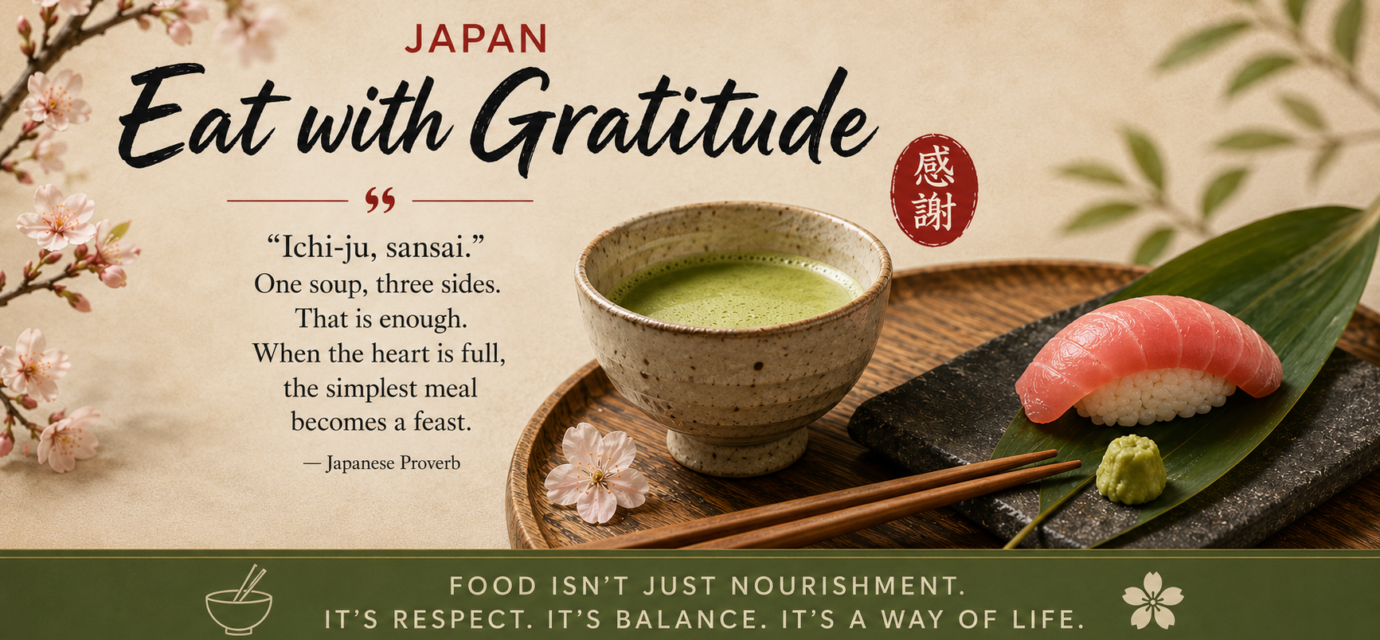
Japan, Plated with Grace: Food, Gratitude, and the Power of Simplicity
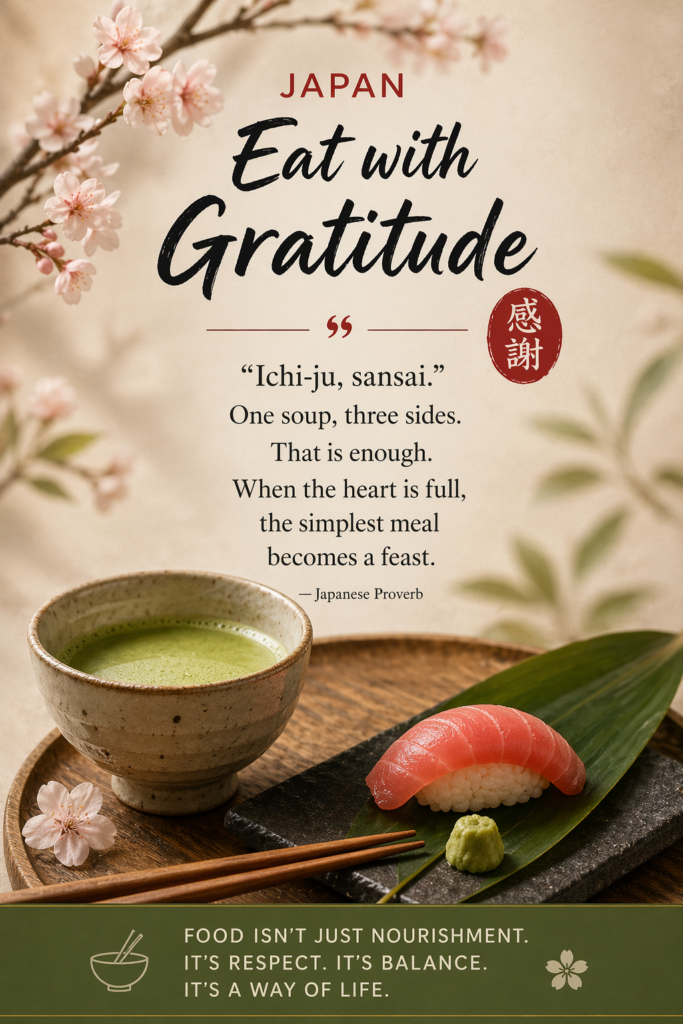
There is a quiet elegance in the way Japan approaches food.
It is not always loud. It is not always covered in sauce, stacked high, or arranged to overwhelm the eye. Sometimes it is a bowl of steamed rice, a small dish of pickled vegetables, a cup of miso soup, a piece of grilled fish, and a seasonal vegetable prepared with care. Nothing feels random. Nothing feels forgotten. Every item has a place, every flavor has a purpose, and every portion seems to understand the beauty of restraint.
That is part of what makes Japanese food culture so powerful. It reminds us that a meaningful meal does not need to be excessive. It does not have to compete for attention. It does not need to prove itself through size or spectacle. Sometimes the most memorable meals are the ones that leave enough space for us to notice them.
At its heart, Japanese dining carries a lesson that feels especially important in today’s fast-moving world: food can be simple and still feel abundant. A plate can be modest and still feel generous. A meal can be quiet and still speak deeply.
In Japan, food is rarely only about hunger. It is about season, gratitude, place, texture, balance, beauty, memory, and respect. It is about the way a meal connects people to the earth, to one another, and to the moment in front of them.
The Meaning of Washoku
One of the most important ideas in Japanese food culture is washoku, often translated as traditional Japanese cuisine. But washoku is more than a collection of recipes. It is a way of understanding food as part of daily life, nature, family, community, and seasonal rhythm.
UNESCO recognizes washoku as an intangible cultural heritage connected to traditional dietary practices, local ingredients, community customs, and respect for nature. Japan’s Ministry of Agriculture, Forestry and Fisheries describes washoku through qualities such as fresh ingredients, respect for natural flavor, nutritional balance, seasonal expression, and connection to annual events.
That matters because washoku is not simply about what appears on the table. It is also about how the meal is approached.
A traditional Japanese-style meal may include rice, soup, a main dish, and side dishes, each contributing something different. The rice grounds the meal. The soup warms it. The main dish offers substance. The side dishes bring contrast, color, freshness, or acidity. The arrangement encourages balance rather than excess.
There is wisdom in that structure. Instead of treating food as one oversized plate of sameness, washoku allows each element to be noticed. A small portion of pickles can brighten the meal. A bowl of soup can slow the body down. A vegetable dish can express the season. Even the empty space around each dish becomes part of the experience.
This is one of Japan’s most beautiful contributions to global food culture: the understanding that food can be both practical and poetic.
Simplicity Is Not the Same as Plainness
Simplicity is often misunderstood.
Some people hear the word simple and think of something plain, boring, or unfinished. But Japanese food culture shows that simplicity can be deeply intentional. A clear broth may look minimal, but it can carry layers of flavor. A small bowl of rice may look ordinary, but it holds the labor of farmers, the patience of cultivation, and the comfort of daily life. A single grilled fish may seem uncomplicated, but its seasoning, timing, and presentation can reveal great care.
Simplicity, in this sense, is not emptiness. It is focus.
It is the decision not to hide an ingredient under too much noise. It is the confidence to let a vegetable taste like itself. It is the patience to bring out natural sweetness, saltiness, warmth, or depth without forcing the food to become something it is not.
That idea feels refreshing in a world where meals are often judged by how big, bold, or dramatic they appear online. Japanese food culture invites another question: Can we notice what is already enough?
That question is not only culinary. It is emotional.
Many of us rush through meals. We eat while answering messages, watching videos, driving, working, or standing in the kitchen. We barely taste what we are eating because our attention is already somewhere else. A Japanese-inspired approach to the table asks us to return to the present.
It asks us to sit down.
To pause.
To look at the food before eating it.
To understand that care does not always arrive in grand gestures. Sometimes care looks like a warm bowl, a clean plate, a thoughtful portion, and a meal prepared without hurry.
Itadakimasu: A Word of Gratitude Before Eating
Before eating, many people in Japan say itadakimasu. It is commonly understood as an expression of gratitude before a meal, gratitude for the food, for the people who prepared it, and for the life and labor that made the meal possible. Japan’s official travel guidance describes it as a way of expressing appreciation to everyone and everything connected to the meal.
That small pause changes the posture of eating.
Instead of approaching food only as something to consume, it frames the meal as something received. The rice did not appear from nowhere. The vegetables grew from soil. The fish came from water. The soup required hands, time, heat, and attention. Someone harvested, washed, cooked, carried, served, or shared.
When we say thank you before eating, whether through a phrase, a breath, a prayer, or a silent moment, we remember that food is part of a larger web.
This is one reason Japanese food culture feels so graceful. It does not separate eating from gratitude. The meal is not treated like a disposable transaction. It is treated as a moment of connection.
For home cooks anywhere, this lesson is easy to carry into daily life. You do not have to prepare a formal Japanese meal to practice gratitude. You can pause before the first bite. You can plate leftovers with care. You can thank the person who cooked. You can waste less. You can notice the ingredients. You can treat a weekday meal as something worthy of attention.
Gratitude does not have to be elaborate to be real.
Seasonality and the Beauty of Now
Another defining part of Japanese food culture is seasonality.
The Japanese table often reflects the time of year through ingredients, colors, textures, and presentation. Spring may bring tender greens and delicate flavors. Summer may invite cooling noodles, crisp vegetables, and refreshing dishes. Autumn may highlight mushrooms, sweet potatoes, chestnuts, and deeper, earthy flavors. Winter often leans into warmth, simmered dishes, soups, and comforting broths.
Japan’s Ministry of Agriculture, Forestry, and Fisheries emphasizes that washoku expresses the beauty of nature and the changing seasons through food, flowers, leaves, utensils, and presentation.
This relationship with seasonality makes food feel alive. It reminds us that meals are not separate from weather, soil, water, and time. What appears on the table belongs to a moment. That moment will pass, and another will arrive.
There is something deeply grounding about that.
In many modern kitchens, we are used to having almost everything available all year. That convenience is helpful, but it can also make food feel disconnected from place. Seasonality brings back a sense of anticipation. Strawberries taste different when they feel like spring. Soup feels different when the air is cold. A simple cucumber dish feels different in the heat of summer than it does in the middle of winter.
The Japanese table often teaches us that food does not need to be rare or expensive to feel special. It simply needs to be noticed in its time.
The Japanese Meal as a Practice of Balance
A beautiful Japanese meal often feels balanced before you even take a bite.
There may be warm and cool dishes. Soft and crisp textures. Mild and salty flavors. Light acidity beside richer ingredients. White rice beside colorful vegetables. Soup beside something grilled. Pickles beside something mellow. Nothing has to dominate the table because each part supports the whole.
This is one of the reasons Japanese meals can feel both satisfying and gentle. They are not always built around heaviness. They often depend on contrast, pacing, and proportion.
That approach is useful for anyone who wants to cook more thoughtfully at home.
Instead of asking, “What one big thing am I making for dinner?” we might ask, “What does this meal need for balance?”
Does it need something fresh?
Something warm?
Something crisp?
Something bright?
Something grounding?
Something seasonal?
That simple shift can make everyday cooking feel more intentional. A bowl of rice with vegetables, soup, and a small protein can feel complete. A noodle dish with herbs, broth, and pickled vegetables can feel layered. A lunch plate with leftovers, greens, and a small sauce can feel cared for instead of thrown together.
Balance does not mean perfection. It means paying attention to how each part of the meal works with the others.
The Power of Presentation
Japanese food culture is also known for presentation, but not in a way that feels artificial. At its best, presentation is not about making food look untouchable. It is about honoring the food.
A small dish may be chosen because its color complements the ingredient. A bowl may be deep enough to hold warmth. A garnish may suggest the season. The empty space on a plate may make the food easier to appreciate.
Presentation becomes a form of respect.
This can be especially inspiring for home cooks who feel like beautiful meals require expensive tools. They do not. A clean plate, a small bowl, a folded napkin, or a quiet moment at the table can change the experience. Even the way food is arranged can affect how it is received.
A simple meal served with care often feels more nourishing than a complicated meal served without attention.
That is the grace of Japanese food culture. It shows that beauty is not always about luxury. Beauty can be found in order, clarity, proportion, and kindness.
What Japan Can Teach Us About Eating More Mindfully
Mindful eating has become a popular phrase, but many traditional food cultures have practiced some version of it long before it became a modern wellness idea. In the context of Japanese dining, mindfulness can show up through small actions: pausing before eating, noticing the season, serving portions with care, eating from individual dishes, and appreciating texture and temperature.
This does not mean every meal has to be quiet or formal. Food is also joy, laughter, family, celebration, comfort, and fun. But mindfulness gives the meal a little more room to matter.
It helps us move from automatic eating to aware eating.
That awareness can make even familiar foods feel new again. Rice becomes fragrant. Soup becomes soothing. Pickles become bright. Tea becomes calming. A small meal becomes enough.
For readers of Fly By Eats, this is where food and lifestyle meet. Japanese food culture is not only something to admire from a distance. It offers practical inspiration for everyday living:
Set the table, even if the meal is simple.
Use smaller dishes to create variety.
Add one seasonal ingredient.
Make soup part of the meal.
Serve food in a way that invites attention.
Pause before eating.
Waste less.
Let the meal be enough.
These are not complicated habits, but they can change the way a home feels.
Respecting Culture Without Reducing It
When writing about Japanese food, it is important to avoid reducing an entire culture to a few popular dishes. Sushi, ramen, tempura, and matcha may be internationally recognized, but Japanese food culture is much broader than restaurant favorites.
It includes home meals, regional traditions, preserved foods, seasonal customs, family recipes, tea, rice, soup, pickles, vegetables, seafood, noodles, sweets, and ceremonial foods. It includes both everyday simplicity and special-occasion beauty. It includes rural traditions, city dining, convenience foods, and modern creativity.
A respectful food story should leave room for that complexity.
It should also avoid treating Japanese culture as a trend or aesthetic. The beauty of washoku is not just visual. It is cultural, historical, practical, and relational. It is connected to how people live, gather, remember, celebrate, and care for one another.
That is why a thoughtful article about Japanese food should do more than describe pretty plates. It should ask what those plates teach us.
And one of the strongest lessons is this: food can be a daily practice of respect.
Respect for ingredients.
Respect for labor.
Respect for season.
Respect for appetite.
Respect for the people gathered around the table.
Bringing the Spirit of Washoku Into Your Own Kitchen
You do not need to live in Japan or own specialized tableware to be inspired by the spirit of washoku. The goal is not to copy a culture carelessly. The goal is to learn respectfully from its values.
Start with what you already have.
A bowl of rice or grains.
A simple soup.
A small vegetable dish.
A protein, if you eat one.
Something pickled, fresh, or bright.
A cup of tea or water.
The meal does not have to be fancy. It only has to be considered.
You might turn leftover rice into a thoughtful bowl with vegetables and soup. You might serve a small salad beside noodles instead of piling everything into one dish. You might place pickles or sliced cucumbers in a little bowl to add freshness. You might choose fruit that reflects the season. You might take thirty seconds to make the plate feel calm.
These details may seem small, but small things shape how we experience home.
A rushed meal tells the body one story. A cared-for meal tells another.
Why Simplicity Feels So Powerful Now
The modern world often encourages more: more flavor, more toppings, more scrolling, more buying, more rushing, more noise. Japanese food culture offers a gentle counterpoint.
It says less can still be full.
It says quiet can still be beautiful.
It says the ordinary can still deserve ceremony.
That message feels powerful because many people are not only hungry for food. They are hungry for peace. They are hungry for slower moments. They are hungry for meals that do not feel like another task to complete.
A simple Japanese-style table does not solve every problem, but it can create a small pocket of calm. It can remind us to breathe. It can make a weekday feel softer. It can turn food back into an experience instead of a background activity.
That is the deeper beauty of Japan, plated with grace.
It is not about perfection. It is about presence.
Final Thoughts: A Meal Worth Receiving
Japanese food culture teaches that grace does not have to be grand. Sometimes it arrives in a bowl of rice, a spoonful of soup, a carefully placed vegetable, or a word of gratitude before eating.
Through washoku, Japan reminds us that food is not separate from nature, time, labor, or care. A meal can hold the season. A table can hold memory. A simple dish can carry meaning far beyond its ingredients.
In a world that often celebrates excess, Japanese dining offers another kind of abundance, one rooted in balance, attention, and appreciation.
To eat with grace is not to eat perfectly.
It is to notice.
To receive.
To respect what is in front of you.
To understand that even the simplest meal can become meaningful when it is prepared with care and met with gratitude.
That is the power of simplicity.
And it is a lesson worth bringing to every table.
References
- Japan National Tourism Organization. (n.d.). Connecting with Japanese culture. Japan Travel.
- Japan National Tourism Organization. (n.d.). Mottainai-Japan’s culture of mindful consumption and less waste. Japan Travel.
- Japan National Tourism Organization. (2025). Understanding and mastering Japanese manners and etiquette. Japan Travel.
- Ministry of Agriculture, Forestry and Fisheries. (n.d.). What is Washoku? Washoku World Challenge. Government of Japan.
- Ministry of Agriculture, Forestry and Fisheries. (n.d.). Diversity of Washoku. Government of Japan. Public Relations Office, Government of Japan. (2023). Preserving Washoku for future generations. Highlighting Japan.
- UNESCO. (n.d.). Washoku, traditional dietary cultures of the Japanese, notably for the celebration of New Year. Intangible Cultural Heritage. UNESCO. (2013). Washoku, traditional dietary cultures of the Japanese. UNESCO Archives.